There is a fashionable way to tell the story of a creative firm. It begins with a manifesto, proceeds through a heroic pitch, and ends with the founders looking thoughtful in black sweaters. OBATA's story begins with a capacity problem. In late 1945, Alice Hausner was 25 years old and working as an illustrator in St. Louis. She opened her own studio. Within months, the work had become too much for one person, so Kimio Obata joined her, bringing contacts and advertising projects. By 1948, the partnership had become a company.
This is the first useful thing about OBATA: demand arrived before mythology. Hausner and Obata were working artists, and their early business grew from the practical exchange of skill, trust and overflow. In 1949 they moved into what may be the best office in the history of corporate communications - a paddlewheel boat moored at the foot of Pine Street. The river was scenic. The surrounding 39 blocks, waiting for the Gateway Arch, were not. Three years later the team returned to dry land.
Make the hard thing visible
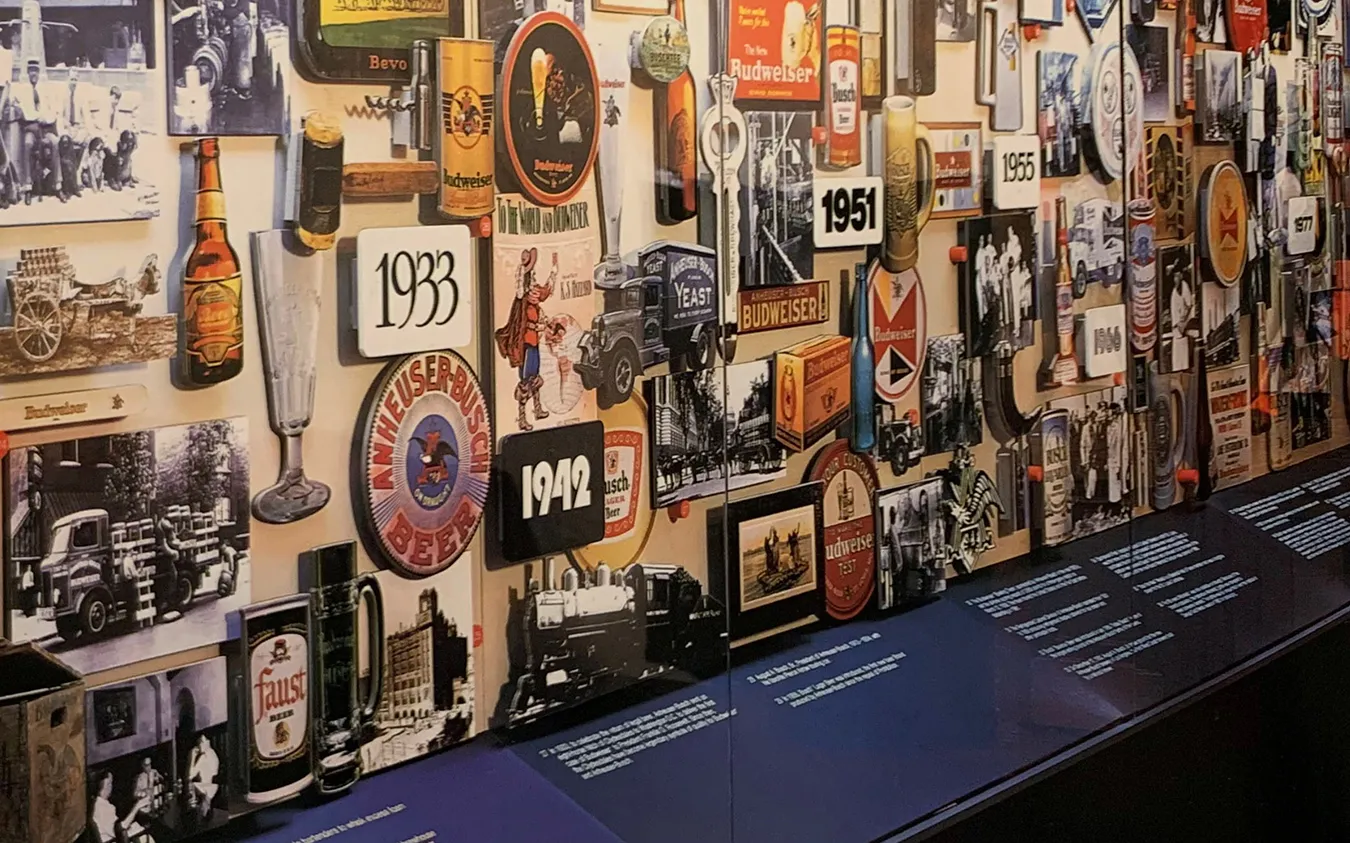
For its first decades, the hard thing was often a physical object or an idea that did not yet exist. Kimio Obata painted watercolor renderings of the planned Lambert Airport terminal. Hausner painted the mountain scene for Busch Bavarian beer. The firm designed Chex packaging for Ralston-Purina, a corporate identity for Emerson and the famous "M" for Monsanto. It created a nine-projector presentation for a Monsanto-sponsored theater at Walt Disney World. In 1986 it even made the original sculpted version of Spuds MacKenzie, the Bud Light mascot.
These assignments appear eclectic only if design is defined by its final surface. Look beneath them and the same operation repeats: absorb a complicated brief, decide what matters, and give an audience a clear thing to notice. A package must explain itself at supermarket distance. A corporate identity must survive thousands of uses. A nine-projector show must keep nine projectors from becoming the story.
The medium kept changing. The obligation did not: decide what matters, then make it difficult to misunderstand.OBATA's durable operating idea
The firm moved early when its tools changed. In late 1984, it bought an Apple Macintosh and became the first St. Louis design firm to make the jump. In 1996 it built its first internal website, then started developing sites for clients. These were not acts of gadget worship. The Macintosh compressed production; the web expanded distribution. Both made the studio responsible for more of the path between an idea and its audience.
A report is where companies discover whether they agree with themselves
Today OBATA sits in an unusual gap between sustainability consultancy, communications agency and digital studio. Its clients are organizations with enough scale to generate difficult material: manufacturers, energy companies, banks, technology businesses, healthcare investors and professional-services firms. They arrive with emissions data, governance language, employee stories, regulatory frameworks, brand rules and several internal groups that do not naturally speak in one voice.
The visible output might be called an ESG report. The underlying problem is alignment. Sustainability staff care about frameworks and evidence. Legal teams care about defensible claims. Investor relations cares about material performance. Brand teams care about coherence. Readers care about finding the answer before lunch. A conventional agency can decorate the collision. OBATA's proposition is to work on the collision itself.
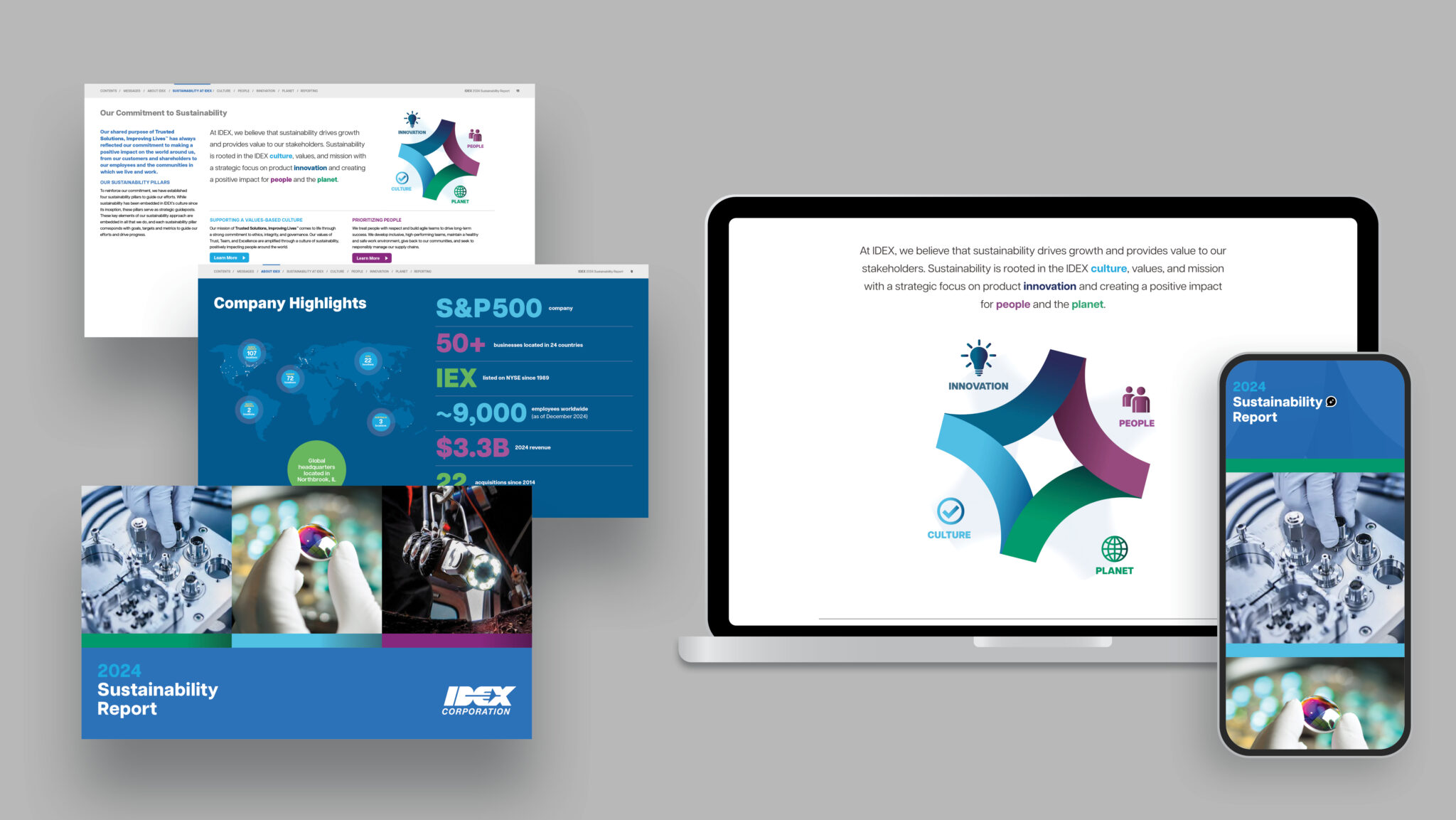
The IDEX engagement makes this tangible. OBATA benchmarked peers and examined how competitors used frameworks such as GRI, SASB, TCFD and CDP. It joined a stakeholder workshop, helped form four sustainability brand pillars, interviewed subject-matter experts, wrote and designed the 2024 report, and built a responsive microsite. The site added analytics, so IDEX could see which pages people visited and use that behavior to shape later communication. The project received a 2025 GDUSA award.
For Mercer International, the output was a 90-plus-page bilingual report, an interactive PDF, downloadable data tables and a mobile-ready microsite. The content had to represent operations in Canada, the United States and Germany. For Rheem, OBATA used questionnaires and interviews across a global organization to gather product, waste, training and community stories, then shaped them into an interactive report ahead of the company's centennial. The scale is larger than a logo project, but the old discipline remains: choose the signal, design out the noise.
The useful failuresThe email that refused to leave
An honest picture of the business appears in a smaller case. Ascension Ventures, a healthcare venture fund managing more than $1 billion, needed a new website and a secure portal where partners could retrieve financial reports. OBATA replaced an obsolete ASP system with a custom PHP module tied into WordPress. During quality assurance, notification emails failed inside partner organizations.
This is what failed first: not the grand strategy or the visual concept, but email traveling across organizational boundaries. OBATA worked with Ascension's IT group, changed the solution and tested again. It is a wonderfully ordinary example of where design becomes valuable. A portal that looks calm but cannot notify its users is not almost finished. It is not working.
What another team can copy
Start with the people who must approve the work. CNB St. Louis Bank completed a charter-driven rebrand in six weeks because key decision-makers joined the workshops and stayed involved. Map one narrative across every format before production splits. Test the seams - email, mobile, accessibility, permissions and analytics - because that is where separate organizations meet. And use the audience's behavior to improve the next edition.
The model has boundaries. OBATA says directly that it does not calculate greenhouse-gas inventories, validate data or provide assurance. A company that needs technical emissions accounting alone should hire that specialist. The integrated model also depends on access. If executives will not make decisions, subject-matter experts will not talk, or reliable data does not exist, a tightly coordinated communications team cannot manufacture credibility. Nor is it the economical answer for a small organization that needs only a template and a few pages.
What the client buysFewer handoffs, fewer chances to lose the plot
OBATA sells custom projects and ongoing advisory rather than a boxed product. Clients can engage it for a focused benchmark or readiness review, retain it for continuing advice, or hand over the full reporting cycle. Public rates are not listed; scope varies with the number of interviews, reporting frameworks, languages, formats and internal resources. The economic pitch is less about a cheap page than a shorter chain of vendors.
That is also where the firm fits in the market. A large consultancy can own strategy. A specialist can own carbon accounting. An agency can own brand. A developer can own the microsite. OBATA competes by owning the connective tissue among strategy, narrative, design and publication. With about two dozen employees, it is not trying to be the biggest participant in any one category. It is trying to make the categories cooperate.
The idea has survived more than changes in fashion. In the summer of 2000, OBATA suffered its second major fire. Most paper files were lost, along with one goldfish. The computers and digital files survived. The building was unusable for nine months, but the company resumed client service from temporary locations in three days. Later that year it deployed a custom content-management system for Emerson's intranet.
It is tempting to turn that episode into a parable about destiny. Better to keep the lesson smaller. The firm had adopted digital production before disaster made the value obvious. Its working memory was no longer stored only in the objects that burned. Good systems do not make an organization invulnerable. They give it somewhere else to stand.