At 14, John Saunders made himself an editor. He produced a soccer magazine in Ireland at an age when most careers consist of speculation and school timetables, then persuaded prominent people in the sport to talk to him. The project was small enough to be homemade and bold enough to announce a pattern: if a door interested Saunders, he preferred knocking to wondering. Sometimes he brought a microphone. Years later, he would bring an entire agency.
Sport supplied the first grand stage. In his late teens and early twenties, Saunders became a presenter and journalist with RTÉ, Ireland's public broadcaster. He announced matches for Shamrock Rovers and Irish internationals, covered major events including the Olympic Games, and delivered a morning radio slot so regularly that his opening words became part of other people's clocks. Live broadcasting rewarded accuracy, timing and the calm handling of whatever arrived next. It also taught him the quick arithmetic of attention: what matters, why now, and how to say it clearly before the audience moves on.
Public relations people pitched him while he worked in news. Some understood a newsroom; some plainly did not. Saunders thought he could do the job better. The confidence was youthful, by his own account, but it was not idle. At 23 he was asked to lead a new agency, Saunders Wallace. After a year he left and formed Pembroke PR with John Butterly. Journalism had given him an eye for the story. Enterprise gave him responsibility for finding it, shaping it and making certain somebody cared.
The openingA beer account and a bridge across the Atlantic
Anheuser-Busch brought Budweiser to Ireland in the late 1980s and hired Pembroke PR to work on its sports sponsorship. The brewer's communications agency was FleishmanHillard, headquartered in St. Louis. That client assignment became a transatlantic hinge. In November 1990, Saunders and colleagues Julian Davis and Rhona Blake launched FleishmanHillard Saunders in Dublin, with Saunders as managing director.
The office grew into Ireland's largest public relations consultancy and one of the international network's stronger operations. It also became a prodigious collector of industry awards. Omnicom bought the Irish business in 2001, but acquisition was a waypoint rather than an exit. Saunders moved through an expanding sequence of responsibilities: regional director for Europe in 2004, leader for Continental Europe and Eurasia, then regional president for Europe, the Middle East and Africa in 2011.
A career measured in crossings
His rise was international, but his style stayed conversational. Saunders has described himself as a servant leader, responsible for ensuring that colleagues have what they need to do good work. He calls himself a strong delegator and jokes that brilliant people have spent a career saving him from himself. The wit matters because it takes the starch out of hierarchy. So does the self-criticism. An executive who believes he needs saving is more likely to listen when help arrives.
There was play in the method, too. Saunders once secured a helicopter ride to a wedding reception for a newly married friend in return for publicity. He arranged for a live elephant to appear at a nine-year-old boy's birthday. These are not standard exhibits in the museum of corporate leadership. They reveal an operator who likes events to move, preferably with a story attached. At a 2025 master class, he gave the instinct a fitting name: “boyish enthusiasm for getting out there and making things happen.”
The top jobEnergy as an executive duty
In November 2015, Saunders became FleishmanHillard's president and chief executive, only the fourth person to hold the title across the firm's seven-decade history. He moved from London to St. Louis, though the Missouri city was hardly new to him. He had first visited in his twenties and spoke of a long affection for the place. Dublin and St. Louis, in his telling, were both big small towns. Their skylines differed. Their real resource was the same: people.
He brought a sports presenter's appreciation for energy to the office. Energy, Saunders has said, may be the greatest gift one person can offer another. The line sounds almost suspiciously simple beside the sprawling machinery of a multinational consultancy. It becomes less simple when treated as a daily obligation: arrive alert, meet clients, represent colleagues well, and keep doing so through complexity. Under his leadership, FleishmanHillard was named Global Agency of the Year in 2021. In 2023, he received the Individual Achievement SABRE Award.
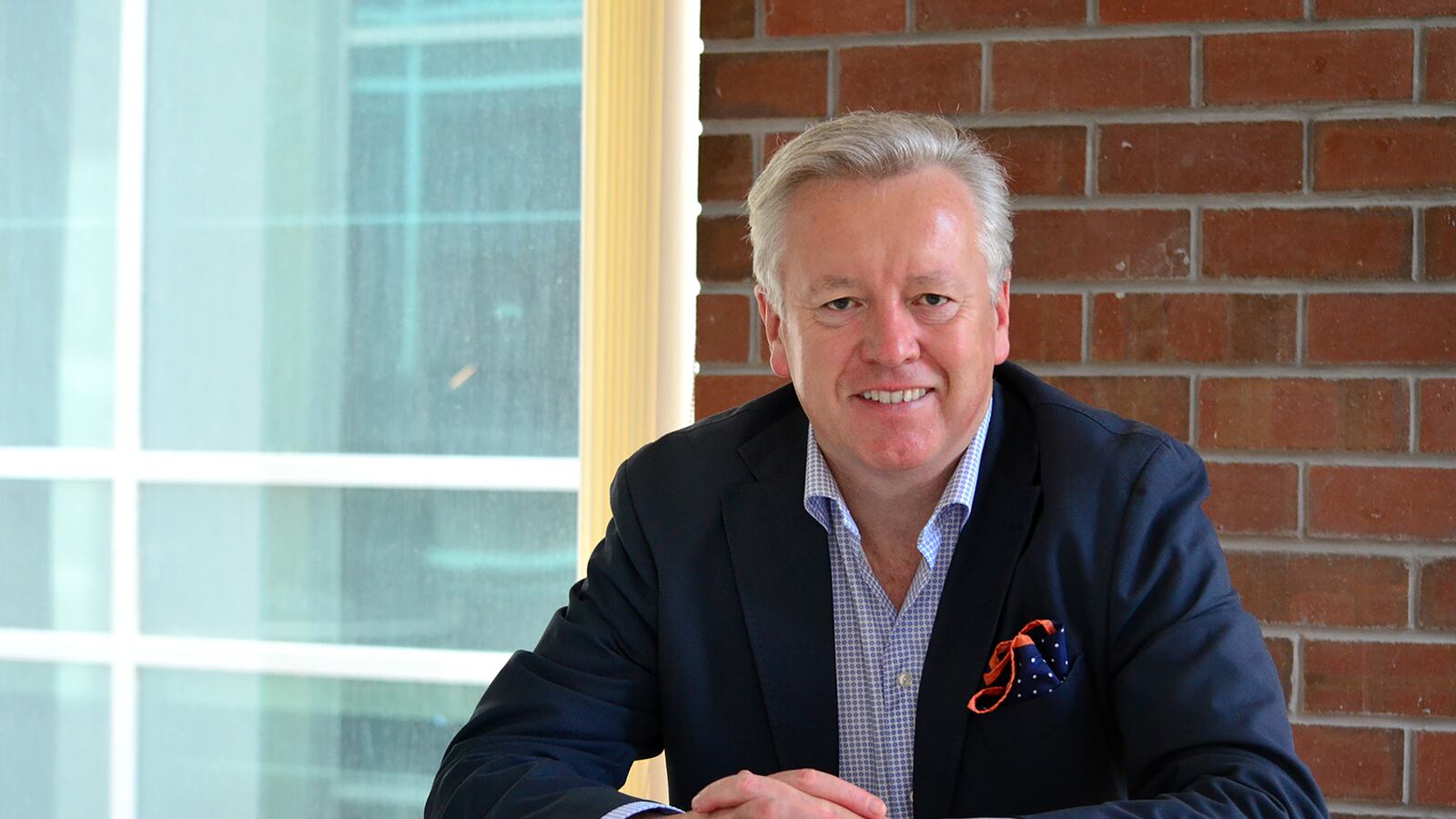
Recognition followed him on both sides of the Atlantic. The International Communications Consultancy Organisation, which he led from 2005 to 2007, inducted him into its Hall of Fame in 2011. Dublin City University conferred an honorary Doctor of Philosophy in 2023. In St. Louis, he became a trustee of the Missouri Botanical Garden, served on the board of Greater St. Louis, Inc., and led the 2017 St. Patrick's Day Parade as grand marshal. The Irishman who crossed the ocean for a global post had become part of the civic furniture.
The lineWhat happens when the story turns on you
Saunders's most instructive story is not an award or promotion. It concerns a client, a disputed claim and the danger of lending credibility to something untrue. In 2009, after reports involving musician Van Morrison and his tour manager, Saunders offered to help Morrison and his family without charge. There was one condition: Saunders had to be told the truth. Morrison denied the central claim, and Saunders defended him publicly.
The denial did not hold. Saunders was suddenly inside the story, his own name attached to a statement he believed false. He told Morrison that his reputation was all he had and demanded to be released from the position. When that did not happen, Saunders went to court. He eventually restored his standing, but the episode turned an ethical maxim into lived experience. A communicator cannot promise that every client will behave honorably. A communicator can decide what price he will not accept for complicity.
Can the claim be defended truthfully, transparently and without spending someone else's trust? If the answer fails, clever language will not rescue it.
That is why his phrase “stewards of trust” carries more weight than a polished conference slogan. Stewardship implies custody. Trust is held on behalf of colleagues, audiences, clients and the profession. It accumulates slowly and can be squandered in a sentence. Saunders kept his membership in the National Union of Journalists for nearly half a century, long after he crossed from the newsroom into public relations. The card in his wallet matched the rule in his head: facts still had first claim.
The principle also shaped his view of companies in public life. He argued that organizations could not remain neutral on every political and social issue, but neither should they lunge toward each fashionable debate. They had to know their values, understand what audiences expected, and act where their words could be authentic. A position without conduct is merely decoration. Silence can carry a message, too. For Saunders, the work was to close the distance between what an organization says and what people experience.
The handoverWhen ambition changes address
On October 1, 2024, Saunders became chairman and J.J. Carter succeeded him as president and CEO. Corporate succession announcements often arrive upholstered in ceremony. Saunders included a domestic truth. After nearly nine years at the helm, he wanted more time with family in Dublin and London, including six young grandchildren whom distance had made him miss. It was an executive decision with a grandfather's arithmetic.
He did not frame the transition as withdrawal. Instead, he described confidence in Carter and gratitude for colleagues and clients. The change fit a progression Saunders later sketched for students. Broadcasting had largely been about “me.” Leading teams became about “us.” His latest phase was about everybody except himself: the enterprise and the careers of other people. Few leaders become less central in their own account as their title grows. Saunders made decentering sound like the point.
In September 2025, the Missouri School of Journalism awarded him its Honor Medal for Distinguished Service. Before the ceremony, he delivered a master class titled “If You Don't Stand for Something, You'll Fall for Anything.” The audience heard about the soccer magazine, the persistence that won Anheuser-Busch, the helicopter, the elephant and the client dispute. The miscellany formed a coherent lesson. Initiative opens doors. Competence keeps them open. Integrity determines whether you can walk through them again.
A March 2026 podcast conversation returned Saunders to the full sweep of the tale, from public-address booths and morning radio to the chairmanship of a global firm. The scale had changed dramatically; the essential pleasure had not. He remained a storyteller interested in the next person, the next room and the possibility of making something occur.
The teenager with the soccer magazine could not have planned the route from Dublin to St. Louis. He did, however, establish the method early: ask, listen, create, persist. The journalist added verification. The founder added nerve. The executive added delegation. Time added a sharper sense of whom success should serve. Through every version, reputation remained the passport. Saunders built a career telling stories for other people. His own makes its clearest point without ornament: the truth travels well.