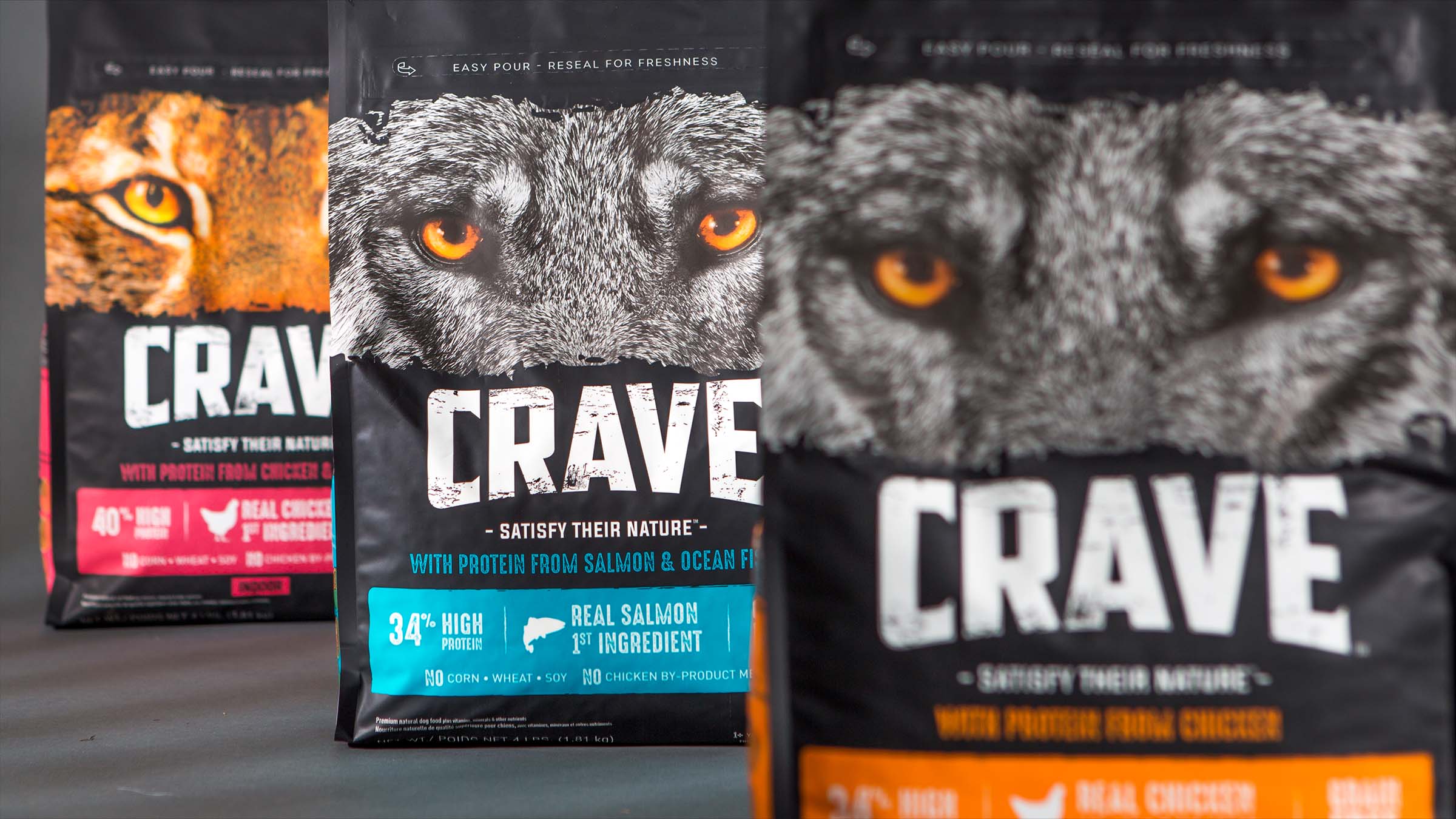
There are easier assignments than selling a black bag of dog food in an aisle full of other black bags of dog food. Brighton Agency's answer for CRAVE was a stare. The St. Louis firm placed the amber eyes of a wolf across the package, set them against rough type and let an old human reflex do the media buying: we look back when something looks at us.
It is a small decision, almost suspiciously small. Yet it describes Brighton better than its long service list does. This is an independent agency that works in pet care, agriculture, consumer goods, healthcare and life sciences. Those categories have little in common until you notice the kind of problem they produce. The product is often technical. The buyer is cautious. The explanation is trapped inside the head of a researcher, a veterinarian, a product manager or a regulatory team. Brighton's job is to get it out without making it dumb.
01 / The six-month animal
A packaging brief grows teeth
CRAVE began as a packaging assignment for a high-protein pet food inspired by a dog's ancestral diet. Brighton tested details in focus groups while it designed, adjusting the eyes, scale and color instead of waiting for research to deliver a verdict after the creative work was finished. The brand reached store shelves in six months. According to Brighton's case study, the identity became sturdy enough to support international sales without a corresponding paid launch campaign.
That sequence matters. Research did not produce a 90-slide deck that was ceremonially handed to the designers. It sat beside them. The audience's behavior - people instinctively meet a gaze - became the design device. The package did not explain wolves. It borrowed their attention.
Find the doubt
Why would the buyer pause, mistrust or ignore this product?
Make it visible
Turn a technical distinction into one graspable image, phrase or demonstration.
Fit the moment
Build the formats the audience can actually use, from a shelf to a classroom.
02 / Useful beats loud
When the ad becomes the thing people need
For Pampers Professional, Brighton faced a less photogenic problem. Expectant parents needed credible childbirth education, and hospitals did not always have the time or resources to make it engaging. The agency helped build a credentialed program with the Childbirth Education Association of Cincinnati: a guide of more than 100 pages, an online booklet, teaching posters and nine videos led by childbirth and lactation experts.
Then the context changed. In-person classes disappeared during the early pandemic. The videos moved onto Pampers.com as a free resource; shorter versions traveled through social channels, while broadcast spots appeared around fundraising events. By May 2020, Brighton reported more than 4.6 million organic video views and engagements across Pampers-owned channels.
Organic views and engagements reported by May 2020 for the Pampers childbirth education videos. The campaign worked because the content had utility before it had reach.
This is the practical idea worth copying: make the useful object before making the promotional fragments. Brighton started with the curriculum, then adapted it into a mobile booklet, classroom video, 30-second spot and six-second social clip. One body of knowledge became a family of formats. The opposite approach - inventing a post because the calendar says Tuesday - rarely compounds like that.
“Listen twice as much as you speak.”A Brighton core principle, cited by Tina VonderHaar
03 / The consultant who bought the client
What changed Tina VonderHaar's mind
Tina VonderHaar did not arrive through the usual copywriter-to-creative-director route. She studied computer science and mathematics after first imagining a life in meteorology, then spent a decade at Accenture. She met Brighton as a business consultant. The client impressed her enough that she joined it, took over from original owner Roger Yount in January 2009 and eventually bought the agency.

The numbers attached to those first five years are dramatic, though they come from an awards profile rather than audited accounts. Brighton grew from 40 employees and $31.6 million in capitalized billings to more than 60 people and $81.8 million. It also moved into a building half again as large and added a 417-square-foot video suite. The physical studio was the revealing bet: production stopped being something strategy handed off elsewhere.
Reported capitalized billings
Awards-profile figures / USD millions / five-year comparison
VonderHaar's more useful management story is about the time growth did not happen. She let a key leader run a new-business pitch without her oversight because she did not want to micromanage. The pitch drifted away from the agency's position and the client's. Brighton lost. Her conclusion was precise: empowerment and oversight are not opposites. They are a pair, and the work fails when alignment arrives after the presentation.
04 / A room with dogs in it
Culture, with fewer beanbags and more opinions
Brighton calls its employees Brightonians and its office Brightonia. There are dogs, chili competitions, monthly happy hours, a miniature-golf tournament and Zufallig, an annual party named after the German word for random. One edition included mouse racing, a fortune-teller and a sword-swallower. This is charming, but perks are not the operating system.

The operating belief is proximity. VonderHaar has been blunt that Brighton is an in-office agency. She argues that strategic brainstorming loses energy when cameras are off and people participate only when prompted. That preference will attract some employees and repel others. It is also a condition of the model. If a team cannot gather, challenge and revise in real time, Brighton's method needs stronger rituals than a standing video call.
The agency's 2025 intern class supplied one unusually clean culture metric. Brighton brought in four graduating seniors for eight weeks, offered jobs to all four and said all four accepted. Hiring outcomes do not prove happiness. They do show that the experience and the invitation matched well enough for four early-career people to say yes.
05 / Where it fits
Independent in St. Louis, borrowed reach everywhere else
Brighton is not a software company disguised as an agency, and it is not a global holding company with a St. Louis branch. It sells the conventional full-service mix - strategy, identity, advertising, content, digital, public relations, media and production - to regional, national and global clients. Its more distinctive position is between a specialist and a generalist: broad capabilities, concentrated category fluency.
The client list makes the point: Syngenta and NK Seeds, Royal Canin, Eukanuba, Pampers, MilliporeSigma, Phibro and others. ICOM membership gives the agency access to more than 80 independent shops across 60 countries. That lets Brighton add local knowledge and execution without paying for its own offices everywhere. It is global reach by federation.
The fit is strongest when a client has expert knowledge but no clear public story, needs strategy and production under one roof, and values sustained collaboration over a quick batch of assets. It is weaker when the buyer wants the cheapest isolated deliverable, a fully remote working style or a famous network name as insurance. Brighton is built for problems that need a continuing argument between strategist, maker and client.
The Brighton moves worth borrowing
- Write down the audience's hesitation before writing the message.
- Design and test together when the decision is visual.
- Build one genuinely useful source object, then adapt it into channel-sized pieces.
- Keep strategy close to production so meaning survives the handoff.
- Give people autonomy, but agree on the edges before the pitch starts.
The wolf eyes are memorable because they are not merely a flourish. They compress the product argument, the aisle problem and a bit of human psychology into one look. That is what Brighton sells: not louder communication, but the moment a difficult thing becomes easy to see.