Look at almost any boat under fifty feet and you will find the same secret ingredient hiding under the fiberglass: wood. Marine-grade plywood sits in the deck, the transom, the stringers - the exact places that spend their whole life soaking wet. It has held that job for roughly a century, and it fails in the same way every time. Water finds a seam, the wood drinks it, and the structure quietly rots from the inside. Supersede, a materials company in Phoenix, Arizona, thinks that is a strange thing to keep doing on purpose.
Its answer is a flat, gray sheet that looks and cuts like plywood but starts life as plastic scrap. Supersede Marine Board is extruded from recycled polypropylene, the same family of plastic found in bottle caps and bumper trim, and the company markets it as the first true 1:1 replacement for marine plywood - a board you can drop into an existing boat line without buying a single new machine. It does not rot, does not splinter, shrugs off termites and mold, and when it finally wears out, you can grind it up and extrude it again.
The one-minute version
- What
- Recycled-polypropylene structural board that replaces marine plywood
- Where
- Phoenix, Arizona - founded 2021, launched publicly October 2024
- Who buys it
- Boatbuilders first (Thunder Jet), then RV, trailer, modular-home and construction makers
- Funding
- $10M in 2025, backed by Closed Loop Partners
- Proof
- Standard on Thunder Jet's entire 2026 boat lineup
01What Supersede actually makes
The flagship is Supersede Marine Board, a hollow-core panel extruded from recycled polypropylene with a set of proprietary additives tuned to hit marine performance standards. It is not a molded slab of plastic; it is engineered to be bi-directionally stiff, which is the property that lets a boatbuilder treat it like a structural panel rather than a plastic sheet. A lighter sibling, USTA+ Board, targets applications where weight matters more than raw strength - RV cabinetry, wall sheathing, concrete-forming boards.
The pitch to a factory floor is deliberately unglamorous. The board cuts, drills and screws with the ordinary woodworking tools a shop already owns. There is no sanding, sealing or drying step, because there is nothing in it to swell or off-gas. It is VOC-free, with no formaldehyde and no chromated copper arsenate - the chemistry that makes treated wood something you do not want to breathe near. Supersede says it matches or beats plywood on the numbers that boatbuilders actually argue about: compressive strength, rigidity, fastener retention and dimensional stability.
Relative comparison based on the company's published performance claims, not independent lab testing.
02Who is buying it - and why that matters
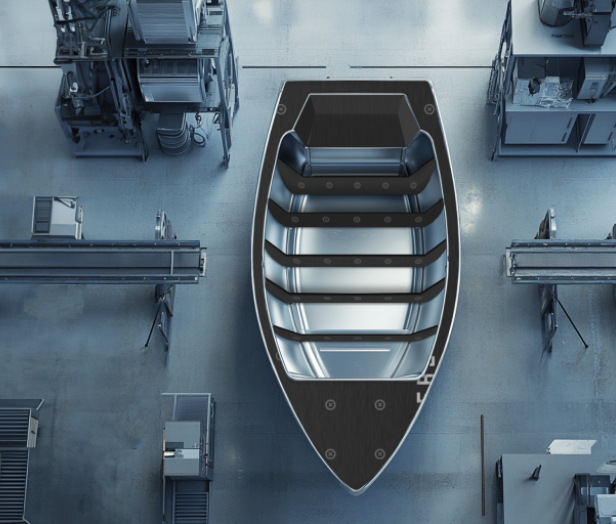
The single most important fact about Supersede is not a spec sheet. It is that Thunder Jet, an aluminum boatbuilder owned by Brunswick Boat Group, made Supersede Marine Board standard across its entire 2026 model year - flooring, kickboards, transom boards. Production boatbuilders are famously conservative; they do not swap a load-bearing material for a startup's product on a whim. When one does, and puts the new material on every hull it ships, that is the market voting with a purchase order.
"The most important thing you can do when you are trying to introduce something new into a legacy industry is to remove every possible reason for someone to say no."Sean Petterson, CEO and co-founder
From boats, the roadmap widens into every industry that quietly runs on plywood and oriented strand board: recreational vehicles, cargo trailers and tractor trailers, modular homes, and eventually mainstream construction subfloors, walls and roofs. These are enormous, unsexy markets. Supersede pegs the marine-grade plywood segment alone at around $12 billion, the broader US structural wood-panel market north of $30 billion, and the total addressable opportunity - once you fold in decking, cladding and roofing - near $95 billion.
There is a pattern to which markets Supersede is chasing, and it is a useful one for any founder to notice: it hunts for the plywood, not the industry. Boats, RVs, cargo trailers and modular homes look like completely different businesses, but each one has the same commodity sheet buried inside it, bought by the pallet and rarely thought about. By selling a single drop-in board into all of them, Supersede turns four fragmented markets into one product line - and every new industry it enters is another source of local off-cut feedstock for the next.

03The real innovation is the factory, not just the board
Plenty of companies have tried to make plastic lumber. What makes Supersede's bet different is how it wants to manufacture. Instead of one giant plant shipping heavy sheets across a continent, the plan is a network of small "micro plants" placed near two things at once: a local supply of plastic waste and a cluster of customers. Feedstock is mostly post-industrial polypropylene - clean factory scrap - sourced regionally to keep transport emissions and costs down. The plants run just-in-time, so a buyer is not exposed to the wild price swings of the lumber market.
The manufacturing itself leans on a patented extrusion process that turns messy scrap into a consistent structural sheet, and it deliberately deletes the steps that make wood panels slow and dirty to produce. There is no kiln-drying, no sanding line, no chemical sealing bath. The board comes off the line already waterproof, already dimensionally stable, and can be run in custom lengths, widths and thicknesses - even in a dual-material configuration when a job needs two different properties in one panel. For a factory, fewer steps is not a sustainability slogan; it is shorter lead times and less scrap.
That last step is the one worth stealing. Supersede runs an off-cut buy-back program: the trimmings a boat factory would normally pay to throw away get bought back and fed into the next batch of board. It turns a customer's waste-disposal line item into a small credit, and it closes the loop in a way a lumber yard structurally cannot. Combined with fixed pricing and custom sizing, it reframes the sale from "greener plywood" to "a cheaper, more predictable input that happens to be circular."
04The founder's second act
Supersede is Sean Petterson's second company, and the first one explains a lot about the second. Petterson grew up on Long Island around boats - working as a dockmaster, flipping and repairing them - before studying at the Rochester Institute of Technology. After losing his father to a construction accident, he founded StrongArm Technologies, which built wearable sensors and ergonomics software to keep industrial workers from getting hurt. That company raised tens of millions and was acquired in 2023, freeing him to chase a problem he had been staring at his whole life: the wood inside boats.
He did not build Supersede alone. Co-founder Jordan Darling, now COO, previously invented and patented plastic-hulled personal watercraft at a company sold in 2017; he and Petterson are both Forbes 30 Under 30 honorees in manufacturing. Head of engineering Shane Kenyon is a mechanical design engineer who led teams at Tesla, NIO and Nikola. All three are RIT graduates - a materials startup staffed by people who have shipped physical products at scale.

"Performance leads, always. Sustainability is a consequence of better design and manufacturing, not a separate value proposition layered on top."Sean Petterson
05Where it fits - and where it might not
The competition is not really other plastic boards; it is a century of habit. Supersede is up against marine plywood and lumber suppliers on one side, and engineered composites - fiberglass-reinforced plastic, foam-core panels, coated boards like Coosa and high-density polyethylene sheet - on the other. Its wedge is being the drop-in that arrives without concessions: no relearning, no new tooling, competitive on cost, better on water. The money agrees the wedge is real. The 2025 round was $10 million, split between $5 million of convertible debt and $5 million of senior secured equipment financing, with circular-economy investor Closed Loop Partners and a major US building-products distributor in the mix. It is exactly the kind of capital you raise to build real factories rather than slide decks.
What could keep it from working? Marine plywood's advantage is a hundred years of field data, and structural materials earn trust slowly - a board that outperforms in a lab still has to prove it over a decade of salt, sun and flex. The micro-plant model depends on a steady local supply of clean post-industrial polypropylene, which is easy near manufacturing hubs and harder in places without them. And plywood is genuinely cheap; fixed pricing only wins if the fixed number stays below a volatile one over time. Supersede's own advice - build your validation process before your sales process, and lead with performance rather than green messaging - reads like a company that knows a skeptical buyer is the whole game.
For now the story is refreshingly concrete. A company took the most water-exposed part of a boat, noticed it was still made of something that rots, and built a recyclable replacement that a real manufacturer put on every 2026 hull. Whether that scales to the $95 billion of sheet goods Supersede is eyeing is the open question. The proof it can start is already floating.
Explore & follow Supersede
- supersede.build - official site
- Supersede Marine Board - product
- LinkedIn - company page
- Instagram - @supersedebuild
- Sean Petterson - LinkedIn
- Jordan Darling - LinkedIn
- Trade Only Today - Q&A with Sean Petterson
- Recycling Today - launch coverage
- PlastChicks Podcast - Sean Petterson (video)
- Design World - product video