Some careers begin with a grand declaration. Sunil Frida's began closer to the workbench. As a child, he built puppet stages. He still enjoys taking things apart and putting them back together. The detail is small, almost suspiciously neat, but it explains the unusual consistency of a career that has crossed cable equipment, industrial software, cloud computing, endpoint security, and zero trust. Frida has kept returning to the same question: how do the pieces work together, and how can the result be made clear to someone who was not there for the assembly?
Today he is the chief marketing officer of Zscaler, responsible for product marketing, brand strategy, demand generation, communications, and go-to-market execution. The job sounds like a festival of nouns. The practical assignment is sharper. Zscaler sells an architecture that asks companies to rethink familiar security habits while artificial intelligence creates new users, new applications, and new kinds of risk. Frida's task is to make that shift understandable without sanding off the technical truth.
He arrived there by the long route. He studied electrical and electronic engineering at RMIT University, then earned an MBA from the University of Melbourne's Melbourne Business School. The combination looks prophetic now: circuits and strategy, machinery and markets. At the time, it was simply the beginning of more than two decades spent moving between what a technology does and what it means.
First, learn the machinery
In the 2000s, Frida worked at Harmonic, where his public titles included senior manager of solutions and strategy and director of HFC solutions. HFC means hybrid fiber-coaxial, the sort of acronym that causes normal conversation to seek an emergency exit. Frida's work concerned the stubborn physical reality underneath television, video on demand, internet gaming, and commercial data services: bandwidth has to travel somewhere.
A 2007 industry article quoted him explaining how a networking approach could save fiber and let different wavelengths carry different kinds of traffic. Six years later, at the Cable Show in Washington, he discussed the migration to converged cable access platforms. The vocabulary has aged like most telecom vocabulary: into a museum case with excellent ventilation. The skill has not aged at all. Find the constraint. Explain the architecture. Translate it into capacity, cost, or flexibility.
Frida later served as a vice president at Redwood Systems, which became part of CommScope. Then came GE Digital, where he led product marketing. It was a move from the network pipe toward the software and data shaping industrial operations. The audience changed, but the translator's burden remained. Engineers care whether a system works. Buyers must also know what changes on Monday morning.
A career moving closer to the story
The cloud gets very large
At Amazon Web Services, scale turned the translation problem into a small weather system. Frida spent more than seven years in leadership roles across databases, analytics, machine learning, internet of things, quantum computing, and robotics. By the time he left in 2024 as general manager of product marketing, the portfolio under his leadership was reported at $20 billion.
The impressive number is less revealing than the list. Databases and robots do not naturally sit down for lunch. Quantum computing does not wait politely while analytics finishes a slide. Each field has its own buyers, builders, competitors, and tempo. The marketing leader has to preserve those differences while building an operating system that lets a huge team move with some coherence.
Frida has said that AWS taught him the meaning of customer obsession. The phrase is often laminated into corporate wallpaper. In product marketing, it can be tested more brutally. Can a team describe the customer's problem before presenting its own vocabulary? Can it show the economic or operational consequence? Can it resist turning a portfolio diagram into a hostage situation?
His public comments suggest that the answer lies in mechanisms as much as messages. At AWS, he worked across product, sales, and engineering to establish durable operating rhythms. He also talks about a "say-do" mindset: a commitment should survive contact with the calendar. Marketing may be judged by what appears on a stage, but the stage is held up by a hundred promises kept backstage.
The people who have worked with him describe the same habit in less corporate language. One former colleague recalled bouncing new product ideas with Frida and turning them into actual offerings. Another praised his ability to recruit partners and customers, then keep those relationships alive. The useful word in both accounts is turning. An idea is not admired from a respectful distance; it is handled, tested, introduced to other people, and made operational. This may be why colleagues also call him fun to work with. A builder who never releases the screwdriver is exhausting. A builder who invites everyone to the workbench can create momentum.
“There’s both the market and the marketing.”Sunil Frida, speaking at RSAC
Race day, with consequences
In 2024 Frida moved to CrowdStrike as senior vice president of product marketing and analyst relations. He led global product marketing, competitive intelligence, alliances, and analyst engagement. He helped broaden the story around the Falcon platform and advance its AI and data positioning. This was marketing close to the bloodstream of a public cybersecurity company: competitive claims, analyst scrutiny, launches, and communications during critical moments.
On his first anniversary, Frida compared entering CrowdStrike to climbing into a Formula 1 car. The pace was relentless, he wrote, with launches, pivots, and real-time decisions arriving like race-day calls. It is an unusually accurate image for enterprise security. The vehicle is complicated, the track changes, and nobody cheers the pit crew for remembering every wheel. One missed fastening, however, becomes the whole story.
The metaphor also reveals his competitive streak. In another interview, he offered the kind of advice that would alarm a leisurely Sunday: “Never give up ... keep pushing harder than everyone else.” Yet the builder's version of competition is not mere volume. It is the stubborn willingness to understand one more layer, make one more connection, and keep the machinery honest.
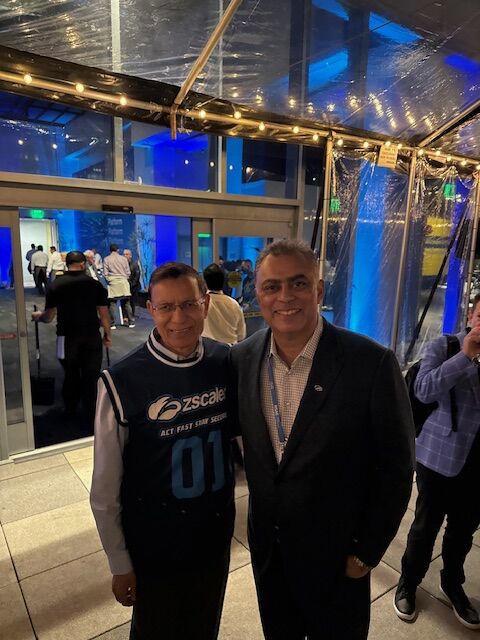
The unpolished moments
Zscaler appointed Frida chief marketing officer in January 2026. He joined a company built around the proposition that trust should not be granted simply because a person, device, or workload appears to be inside a network boundary. Now AI agents and cloud applications are multiplying the number of things asking to connect. The architectural argument is becoming more consequential just as the marketing language around AI and security becomes more interchangeable.
Frida has described the cybersecurity show floor as a sea of sameness. It is an occupational hazard. Every vendor is intelligent, unified, proactive, resilient, and conveniently located at booth 1842. Standing apart requires more than a brighter verb. It requires a defensible point of view about the market, a product difference that survives scrutiny, and the discipline to explain why the distinction changes a customer's outcome.
At his first RSA Conference on the Zscaler stage, Frida noticed something else. His reflection afterward did not begin with the slide, slogan, booth, or meeting count. He wrote about teammates jumping in before being asked, leaders creating room for others, and functions moving as one crew. “The best moments weren’t the polished ones,” he wrote. “They were the human ones.”
That observation rescues his story from becoming a tidy parable about an engineer learning to market. The work is not only translation between product and buyer. It is translation across people: engineering and sales, brand and demand, analyst and executive, colleague and colleague. A category story becomes credible when the company can operate inside it.
The useful career move is not always reinvention. Sometimes it is the same craft practiced at a higher altitude.
A builder in the C-suite
Frida's stated ambition at Zscaler is to help organizations see how the platform can reduce risk and increase agility in a cloud-first, AI-driven world. He has recently framed exposed firewalls not only as a technical vulnerability but as a question of resilience, trust, and how confidently a business can move. The sentence follows the old pattern from his broadband days. Start with architecture. End with consequence.
There is an appealing refusal of magic in that pattern. Good marketing cannot repair a weak product, and technical depth does not automatically produce a useful story. The craft sits in the passage between them. Learn enough to know what matters. Choose language that does not betray the mechanism. Give the customer a reason to make a decision.
The puppet stage, in retrospect, was good training. Someone has to build the frame, understand the strings, and still remember that an audience came for a story. Frida's career has simply made the stage larger. The cables became clouds. The clouds became security platforms. The audience became global. The builder kept asking how the pieces connect.