Steven J. Lund thought a hundred dollars would do. A bishop had asked the young couple for five hundred, and Lund had offered the smaller amount. Then Kalleen, his wife, heard about it. Her answer, as he remembered it years later, was brisk: “I don’t think that’s the way we’re going to live our life.”
There are many ways to begin the story of a company founder. A balance sheet is customary. A spouse correcting the household’s proposed charitable budget is rather more revealing. Long before Lund became Nu Skin’s chief executive and executive chairman, the couple were working out what their money was for. The question would follow them into a much larger life.
He recalled that exchange as his five years leading the Young Men organization of The Church of Jesus Christ of Latter-day Saints approached their end in 2025. It was a domestic memory, offered by someone whose working vocabulary also includes shareholders, international markets and corporate governance. In Lund’s telling, those worlds belong in the same conversation.
A long way round to Provo
Lund was born in Mesa, Arizona, on October 30, 1953, and grew up in California. The young person he remembers was a boy on a rural dirt road, surrounded by adults who took their religious responsibilities seriously. He credits those local leaders with giving him a sense that his own life had a purpose before he could have drawn anything resembling a career plan.
After high school and a year of college came missionary service in the Netherlands Amsterdam Mission. That meant learning Dutch and working in the Netherlands and Belgium. He later recalled the assignment as a demanding education in prayer and perseverance. A first year at university had opened one door; the mission sent him through another, several thousand miles away.
His return to education took a further detour through the U.S. Army. He served at Fort Stewart in Georgia and then in Frankfurt, Germany. In his later account, the decision to enlist followed an impression he understood as spiritual guidance. The experience itself included bewilderment and unexciting work. His faith did not make every posting enjoyable.
Frankfurt supplied a lasting connection: Kalleen Kirk, an American living there with her family. They met in Germany, reunited as students at Brigham Young University and married in 1980. They would have four children. For a story about a Provo company, a surprising amount of the groundwork happened somewhere else.
Back at BYU, Lund earned a communications degree and then a law degree from the J. Reuben Clark Law School. He completed the latter in 1983. His professional beginnings were in private legal practice, including litigation and product liability. That is a useful background for someone entering a business in which the distance between a promise and a product can become a very expensive argument.
The law clerk and the basement business
One important connection was Blake Roney. The two knew each other through a BYU congregation, and Roney worked with Lund as a law clerk. Roney’s sister, Nedra, had been asking questions about personal care products. Those questions became a business, with Sandie Tillotson and Lund joining the founding group.
Nu Skin began selling in 1984 from Nedra Roney’s basement in Provo. There were five employees, eighteen products and two hundred distributors. It was a small operation with a distribution model that depended on people selling through personal networks. The founders had to persuade a manufacturer to make the products and persuade customers to buy them. A basement keeps the first rent bill manageable; it does little to solve the second problem.
The scale changed quickly. By 1994, the business had more than fifteen hundred employees and over half a million independent distributors. Those are different populations, with different relationships to the company. A distributor network should never be read as an employee count. Even with that distinction firmly in place, the operational change was substantial.
Employees at Nu Skin. Historical snapshots, ten years apart.
Success brought mundane difficulties in bulk: warehouses, office space, order handling and support. By 1991, operations had spread across eleven warehouses in Provo. The company consolidated into a ten-story office complex and a distribution center in 1992. Lund remembered the earlier scramble as a struggle to build enough infrastructure to keep up.
That early expansion also brought investigations of the selling model and disputes over distributor conduct. Growth and scrutiny arrived together. The company’s physical rise above downtown Provo was visible; the obligations attached to the business were less picturesque, and just as consequential.
The job that came with the listing
Lund became president and chief executive of the public company in 1996, the year Nu Skin went public. He served until 2003. Becoming a listed company gives an enterprise a ticker symbol and a more formal audience for its decisions. The founder’s enthusiasm now has to coexist with the shareholder’s questions.
During his tenure, Nu Skin International agreed in 1997 to a $1.5 million civil penalty to settle Federal Trade Commission allegations that it had violated an earlier advertising order. The settlement did not constitute an admission of a legal violation. It remains part of the company’s record, and a reminder that oversight belongs inside any account of its expansion.
Lund’s career then took a turn that a conventional executive biography might hurry past. In 2003, he left the CEO role and, with Kalleen, led the Georgia Atlanta Mission for three years. The dates matter. This was a defined period away from the chief executive’s desk, with responsibility for a different institution and a much younger group of people.
- 1984Helps found Nu Skin in Provo
- 1996–2003President and CEO of the public company
- 2003–2006Leads the Georgia Atlanta Mission
- 2006–2012Vice chairman of Nu Skin’s board
- 2012 onwardExecutive chairman
He returned as vice chairman in 2006 and became executive chairman in 2012. That sequence makes his corporate life more interesting than a continuous climb through increasingly impressive titles. He has occupied several kinds of authority within the same company, with a three-year assignment elsewhere between them.
The room full of teenagers
In April 2020, Lund became the Church’s Young Men General President. He was at home in the Salt Lake Valley when the appointment was sustained, with his family around him. He later joked about the reassuring fact that everyone in the room had voted in support. Even a global assignment can begin with a favorable household poll.
His initial counselors were Ahmad Corbitt and Bradley R. Wilcox. The presidency inherited work already begun on the Church’s Children and Youth program. Lund acknowledged the foundation laid by his predecessor, Stephen W. Owen. There is a practical modesty in that acknowledgment: a new title does not mean the work began when its latest holder arrived.
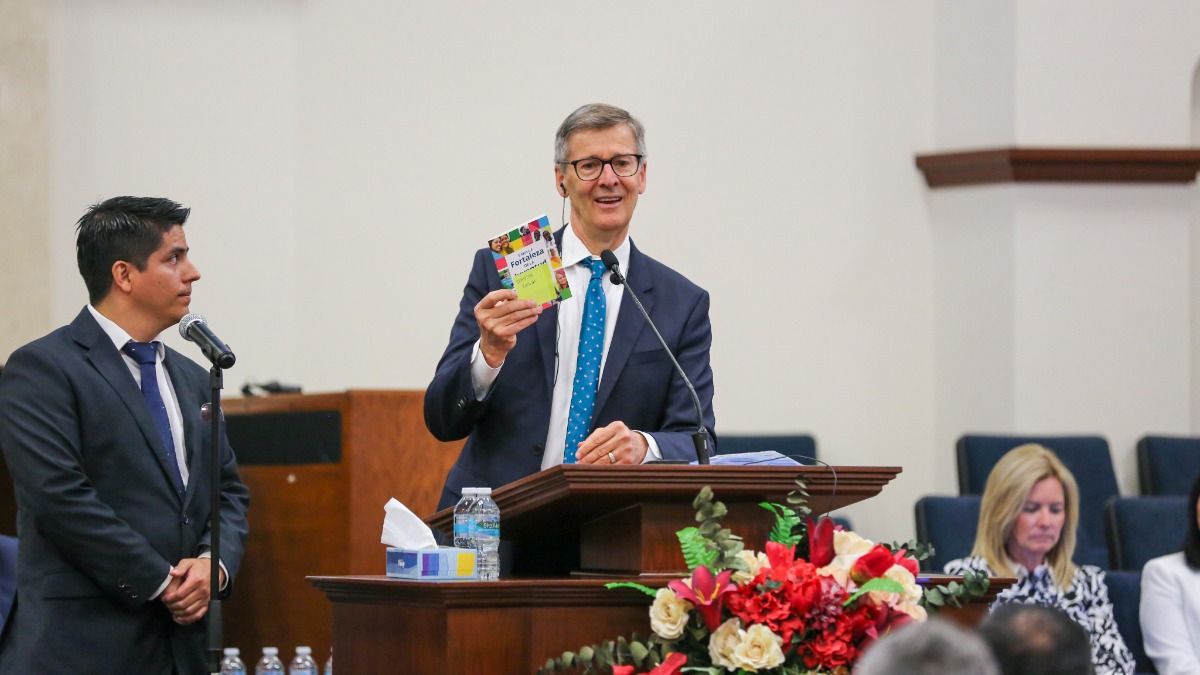
His public teaching often returns to what happens after an uplifting event. In October 2022, he described more than two hundred thousand young people attending For the Strength of Youth conferences that summer. The number was large. The question he drew from it was intimate: how would a young person carry that experience home?
He urged the cultivation of religious habits that could survive the end of a conference or a mission. One departing missionary’s uncertainty prompted a compact answer: “You don’t have to wear the badge to bear His name.” The distinction between an assignment and the life that follows it was something Lund had encountered himself.
“You don’t have to wear the badge to bear His name.”
Steven J. Lund, October 2022
A lawyer’s interest in learning
Education also appears in his civic record. He has chaired Utah Valley University’s board of trustees, and in 2015 he was appointed to the Utah State Board of Regents. His service has included the BYU Law School Board of Advisors and the Direct Selling Association’s board. Universities, an industry association and a global company gave him several different tables at which to consider institutional decisions.
When he addressed BYU-Idaho students in November 2020, he recalled arriving in Rexburg as an eighteen-year-old to learn Dutch. His memory of the campus included formidable winter weather and small classrooms. Decades later, he argued that religious belief and academic study could inform each other. “Learning is a sacred enterprise,” he told them.
The schoolroom memory gives that statement some texture. Before he became a lawyer explaining ideas to other people, he had been a young missionary struggling to acquire a language. It is easier to listen to an accomplished adult discussing education when he leaves room in the account for having once found the homework difficult.
There are less institutional interests, too. Lund plays guitar, reads and spends time with his family. These details need no elaborate theory attached to them. A biography with room for a guitar is usually a more recognizable human document than one consisting entirely of appointments.
What remains after a title changes
Lund’s term as Young Men General President ended on August 1, 2025, when Timothy L. Farnes began serving. His corporate responsibilities continued. Nu Skin’s 2026 reporting lists him as executive chairman, with Ryan Napierski as president and CEO. The distinction helps place him accurately in the company he helped create.
In June 2025, welcoming James Winett to the board, Lund emphasized experience in strategy, operations, finance and advising businesses. It was the working language of a chairman assembling useful expertise. Alongside that public corporate role, his final months in the youth presidency included reflection with Kalleen on the commitments that had shaped their marriage.
That returns the story to the donation. The difference between one hundred dollars and five hundred was once worth discussing in their home. Years later, Lund still considered the exchange worth repeating. Among the titles, board seats and international assignments, he kept a place for the moment his wife challenged his arithmetic. It is a modest scene to carry through a long career, and a revealing one to keep.