Steven Jiang wanted to improve recruiting, so he gave himself an inconvenient assignment: become a recruiter. For six months, he and his co-founder operated a small agency while developing their technology. The future software chief had candidates to find, hiring managers to satisfy, and deadlines that showed little interest in his engineering credentials. It was an education with customers attached.
The assignment grew out of a familiar workplace irritation. At Samsung’s research and development operation, Jiang and his manager, Xinwen Zhang, struggled to hire the people their teams needed. They worked with recruiters, saw the delays, and thought technology could help. Then came the useful admission: being frustrated by a process did not mean they understood everyone doing it.
Jiang personally recruited for Drive.ai, TP-Link, and four other companies. The experience helped the founders concentrate on talent sourcing: identifying suitable people and encouraging them to apply. Recruiters including Dean Da Costa and Katie Gechijan continued to advise them. A good way to spoil an engineer’s elegant theory is to introduce it to someone with a vacancy to fill.
Running a recruiting agency while building recruiting technology.
A partnership with a change of seating
Jiang’s training was in computer science. He completed undergraduate studies at the University of Science and Technology of China in 2010, followed by a master’s at North Carolina State University in 2012. His route into entrepreneurship ran through Samsung’s mobile division in Silicon Valley, where he became an engineering manager. The hiring problem arrived as part of the job.
Zhang was his boss there. In 2015, the two founded the company that became Hiretual and later hireEZ. Their partnership carried an established working relationship into an unfamiliar business. By 2025, Zhang was serving as chief technology officer and Jiang as chief executive. The seating arrangements had changed; the collaboration had endured.
Jiang has joked about the pleasure of becoming his former boss’s boss. The joke has the economy of a well-written resignation letter. More consequentially, the pair stayed with the same underlying problem as their product changed: how to help employers reach people they might otherwise miss.
A bowl of pho, then a new name
One encounter with investors began over Vietnamese pho in the summer of 2021. Conductive Ventures later recalled being surprised that a company with double-digit millions in annual recurring revenue had escaped its notice. Jiang’s business was in Mountain View, in offices previously occupied by Gigya, another company in the investor’s history. The geography was familiar; the discovery was fresh.
In its March 2022 account, Conductive reported that hireEZ’s revenue had grown 2.5 times year over year in 2021. It also described more than 600 enterprise customers and over 175,000 users worldwide. Those figures belong to that period. They give the lunch a useful context: the conversation concerned an operating business with customers, rather than an idea waiting for its first test.
On February 2, 2022, Hiretual announced $26 million in funding led by Conductive Ventures and a new name, hireEZ. Jiang used the occasion to argue for outbound recruiting. Employers, he said, needed to approach prospective candidates proactively instead of depending on people to submit applications. The name was intended to make that ambition easier to explain.
The change also supplied a memorable date: 2/2/22. Two years later, Jiang recalled celebrating that night with employees and the recruiting community in Mountain View. His retrospective soon turned to customer complaints. A party can mark a product’s arrival; customers are rather more interested in what happens on Monday morning.
The email that ate an hour
By March 2023, Jiang was writing about a smaller unit of recruiting frustration: the personalized email. A hireEZ survey of more than 300 talent acquisition professionals had found that some recruiters spent thirty minutes to an hour composing one message. For a person trying to contact candidates promptly, the greeting could become a considerable occupation.
The company was preparing a GPT-powered engagement feature using GPT-3 and recruitment-specific machine learning data. Jiang described early access, a waiting list, and the intention to collect feedback before widening availability. He also returned to a concern he had heard before: whether AI would replace recruiters. His position was that automation would alter their responsibilities and leave more room for work requiring personal attention.
The detail matters because finding a suitable name is only one part of a recruiter’s day. Someone must decide what to say, make contact, follow up, and maintain a relationship. An excellent search result can still become a neglected conversation. Jiang’s product was following the work beyond the search box.
In February 2024, hireEZ introduced hireEZ 2, a candidate relationship management platform. It brought sourcing together with analytics, automation, talent pools, and campaign management across email and text. Jiang said recruiters had described traditional CRMs as complex and disjointed. The proposed answer was to put more of the workflow in one system, connected to existing applicant tracking software.
That creates a demanding product brief. Every additional function has to earn its place in the working day. A platform that gathers everything together can save movement between tools, but its own controls still need to make sense. The burden moves inward, toward the people designing the product.
The software acquires a job of its own
In April 2025, Jiang gave that burden a name: the usability-capability tradeoff. His argument was straightforward. Recruiting tools had become more powerful while becoming harder to navigate. Users could acquire more possibilities and, at the same time, more difficulty exercising them. The software industry has occasionally mistaken a crowded control panel for a generous gift.
EZ Agent was his proposed response. Rather than requiring recruiters to operate each function individually, an agent could help coordinate the work. The question shifted toward what a recruiter wanted accomplished and how the system could assist in getting there. Jiang’s interest in usability made the agent a continuation of an older concern: the distance between a feature and its practical use.
hireEZ’s March 2025 account described its agentic approach as semi-autonomous and collaborative. It covered steps including sourcing, screening, outreach, scheduling, and analytics, with people retaining oversight. The intended division of labor gave the system repetitive execution and left strategic decisions and valuable interactions with recruiters. That division requires attention wherever a workflow crosses from calculation into judgment.
“The biggest cost is to do nothing.”Steven Jiang, 2025
Jiang’s willingness to change the product came with a sober explanation. In 2025, he described survival over the next three to five years as a practical concern during rapid technological change. He spoke of rebuilding infrastructure to accommodate new AI capabilities. He also described a customer base extending from smaller businesses to larger corporations and partners such as Cielo.
In that account, profitability and the need to rebuild occupied the same conversation. Success had supplied customers to serve; it had not supplied an exemption from change. For an engineer turned chief executive, the work now included deciding which parts of the machine deserved another look.
Making the case beyond the recruiting team
By October 2025, Jiang was also addressing how recruiting leaders should seek AI investment. His advice was to connect a request to company outcomes: earlier starts for important hires, the cost of turnover, and the amount of work a recruiting team could handle. He wanted talent acquisition discussed as a contributor to the performance of other departments.
It is an argument that fits his own origin in engineering management. A vacancy belongs to recruiting’s workload, but its consequences turn up elsewhere. Someone is waiting for a colleague before a project can proceed. Jiang urged leaders to translate that dependency into numbers an executive team could assess. The hiring conversation needed to travel beyond the hiring department.
A steakhouse standard for human judgment
In July 2026, hireEZ announced partnerships with Nexxt and Talroo. The plan connected its open-web sourcing with Nexxt’s candidate audiences and Talroo’s active job seekers. Nexxt was available in the platform at announcement; Talroo was planned for early design partners in 2026, with general availability to follow. The distinction matters when an announcement describes both present access and intended expansion.
For Jiang, the attraction was coordinating candidate channels through a single workflow. The problem had grown from finding people into managing the paths by which they arrived. Recruiting agencies, job marketplaces, and sourcing software each reach people differently. Combining those paths gives a product team another version of his original assignment: understand the work before rearranging it.
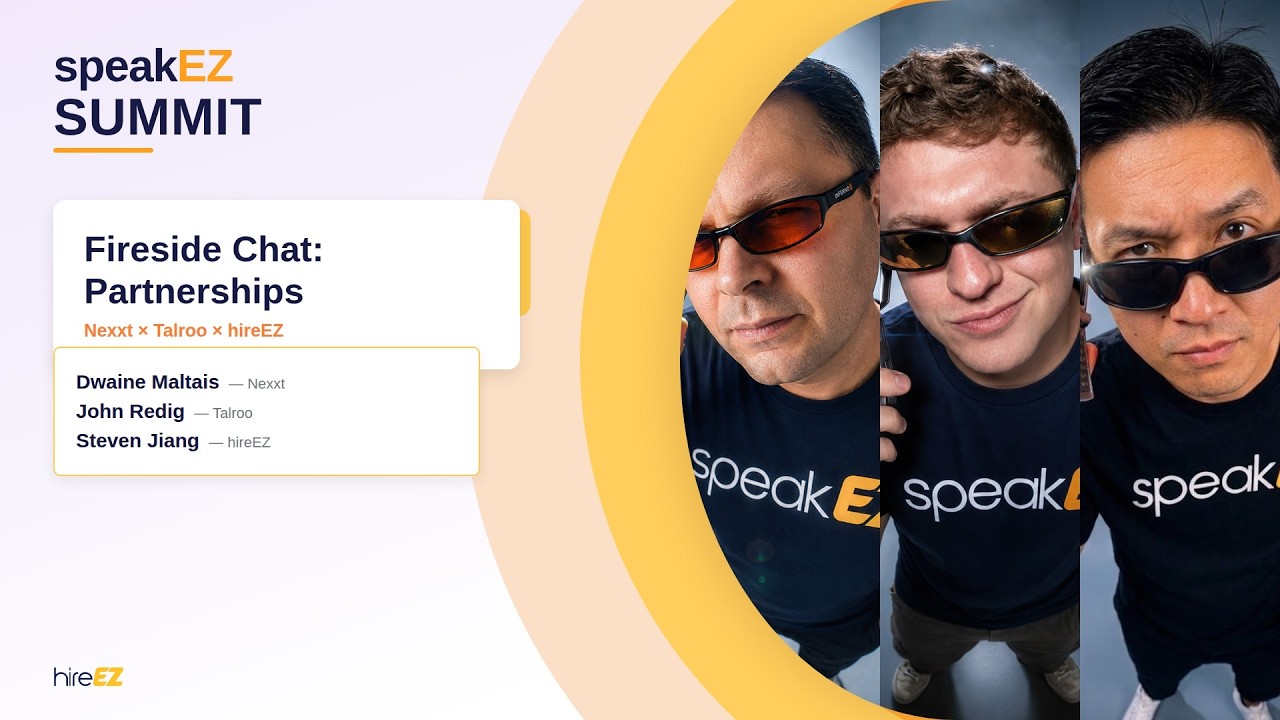
At the 2026 speakEZ Summit, Jiang discussed that direction with Nexxt’s Dwaine Maltais and Talroo’s John Redig. He used a food analogy for the distinction between AI output and experienced human judgment: the chicken nugget and the steakhouse. Speed and repeatability have their uses. Accountability and trust ask for something more particular.
His point returned to the ends of the workflow. A person originates the need; people remain responsible for the decision to hire. Between those points, AI can accelerate the work. The six-month recruiting apprenticeship gives that argument some history. Long before an agent could coordinate the steps, Jiang had made himself responsible for following them.