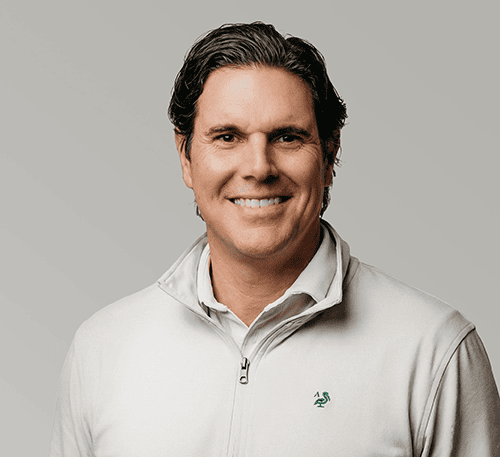
Six acquisitions in forty-five days. That is not a typo. In November and December of 2018, as CEO of Traject, Steve Reardon completed six software company purchases in rapid succession. By the time the calendar flipped to 2019, he had eight total add-ons under his belt at that one company alone. It is the kind of sprint that tells you something.
Durban, Then Stanford, Then Everything Else
Steve Reardon grew up in Durban, South Africa - a port city that doesn't show up in Silicon Valley origin stories very often. He studied Business Science at the University of Cape Town, graduating in 2003, and then did what a lot of ambitious people do in their twenties: he started a company.
Peldon Technologies was not a software startup. It was a photo printer and multifunctional kiosk business, selling to pharmacies and retailers. He started it with $1,000 in savings. He grew it across three South African cities, built a team of seven, and then sold it to a competitor in 2009. The business wasn't the end goal - it was the first proof of concept.
What followed was a decade of building businesses in two very South African industries - golf and cycling. PlayMoreGolf, a golf course membership aggregator, taught him the vocabulary of recurring revenue: MRR, CAC, churn. Cycle Lab Group, South Africa's largest cycling retail chain, taught him how to lead. He ran 150+ employees there as CEO before deciding he needed something different.
"I fell out of love with each sport or passion. I fell in love with the businesses."Steve Reardon
In 2016, Reardon packed up his family - his wife and two daughters - and moved to California. The immediate destination was Stanford Graduate School of Business, where he enrolled in the MSx Sloan Fellows program. One year. Full-time. Focused on introspection, growth mindset, and self-awareness. He describes it as a program that changed his life. It also introduced him to Alpine Investors.
Learning the Playbook at ASG
Alpine Software Group is the software arm of Alpine Investors, the San Francisco-based private equity firm known for its PeopleFirst approach to investing. ASG's thesis is straightforward: find uniquely positioned vertical SaaS businesses, buy them, install great operators, and grow them. Reardon joined in 2017 as CEO of Bill4Time, a legal tech SaaS company based in Seattle. He was new to the model. He was learning.
In 2018, he moved to Traject, a digital marketing technology company. That's where the 45-day sprint happened. Eight acquisitions total in 2.5 years. The frenetic pace wasn't accidental - it was the ASG model working at full speed, and Reardon was executing it. By the time he stepped up to become CEO of the whole group in 2020, he had seen the playbook from the inside.
The 45-Day Sprint: Nov-Dec 2018 at Traject
- Six software company acquisitions in a single 45-day window
- Eight total add-ons completed as Traject CEO over 2.5 years
- Digital marketing tech focus - building a multi-product SaaS platform
- Laid the foundation for the ASG CEO role in 2020
Running the Machine
As CEO of Alpine Software Group since 2020, Reardon runs an organization with roughly 160 employees, approximately $25 million in annual revenue, and a growth rate above 65 percent. The portfolio spans vertical SaaS businesses in sectors from loss prevention to real estate CRM to sports technology. He has overseen 60+ acquisitions in total - and served 100 founders who designed their exit with ASG.
The founder NPS score - 87 - is worth pausing on. Net Promoter Score is typically a customer satisfaction metric. ASG applies it to the founders they've acquired from. An 87 NPS among people who just sold their life's work is an unusual number. It suggests the exit experience is designed as carefully as the deal itself.
"These businesses are predictable and resilient. We saw that proven during the pandemic."Steve Reardon, on vertical SaaS
Reardon's operating philosophy is talent-obsessed in a way that feels genuine rather than buzzword-heavy. He talks about talent as "the majority of the game." He describes his role as identifying and developing the next generation of CEO talent to run portfolio companies. During the pandemic, rather than reacting, he built out multiple scenario models - 10%, 20%, 50% growth slowdowns - to prepare his operators for every version of the future.
The Self-Assessment That's Hard to Fake
Most executives describe themselves using superlatives. Reardon does the opposite. He has said plainly that he is "better at the one to 10 or 10 to 100 stage" and that he's "just not a zero-to-one guy." That distinction - between building from nothing and scaling what exists - shapes how he recruits, what roles he fills, and which acquisitions make sense for ASG's model. It's an unusual degree of self-awareness to advertise.
"Talent is the majority of the game."
"The CEO with the best team wins."
"You didn't get hired to be timid."
"Recognition paired with delegation and intentional people development keeps paying off."
When to Sell - and How to Think About It
Reardon has become something of a public philosopher on the question founders dread most: when is the right time to exit? His framework strips the sentimentality out of it. The question he poses is: "Would another owner be a better owner for the business in the current phase it's in?" If yes, sell. If not, keep building.
He brings the same quantitative directness to evaluating businesses. He has said he can assess the health of any recurring revenue SaaS business with just four or five data points. The SaaS metrics - MRR, CAC, churn, net revenue retention - aren't jargon to him. They're the vocabulary he's been speaking since the PlayMoreGolf days in South Africa.
The ASG Acquisition Criteria - What Reardon Looks For
- Vertical SaaS businesses with a defensible, uniquely positioned niche
- Recurring revenue metrics: predictability over hype
- Founders willing to design an exit, not just accept one
- Businesses in the "1-to-10 or 10-to-100" growth phase - not pre-product
- Alignment between founder intent and next phase of ownership
The $400M Exit and What's Next
In August 2025, Innovative Systems - an ASG portfolio company - was sold to GTCR for $400 million in enterprise value. It was a landmark exit for ASG and a signal of what the platform has been quietly building toward. In late 2025, OSINT intelligence software was acquired by Kaseware. In January 2026, ASG expanded internationally with the acquisition of PlayHQ, an Australian sports technology platform that received a merger-notification waiver from Australia's competition regulator.
ASG IV - the fourth fund iteration - launched in 2025. The pace has not slowed. If anything, the 2025 year-in-review counted nine exits, a number that most PE-backed software acquirers would take as a full decade's work.
Reardon still lives in the San Francisco Bay Area with his family. Outside of work, he photographs, cycles, and plays golf - though if his own analysis holds, it's the business side of each that holds his attention longest. He is, by his own admission, a builder of the middle: the long, unglamorous distance between idea and institution.
"The founder experience is less about glory and more about lying awake worrying about payroll."Steve Reardon