Steve Angel had reached a stage of corporate life that many executives spend decades trying to arrange. He had run Praxair, led the combined Linde business and moved into chairmanships. There were boards to oversee and other people to handle the daily interruptions. He found a flaw in the arrangement. He missed the interruptions.
“Board work is boring to me. I missed the day to day,” he said in an August 2026 interview. It is a pleasantly unceremonious explanation for taking charge of a freight railroad. Executive appointments tend to arrive wrapped in language about opportunity and transformation. Angel supplied something easier to recognize: a preference for a particular kind of working day.
On September 28, 2025, he became president and chief executive officer of CSX, succeeding Joe Hinrichs. The Jacksonville-based company brought him back toward an industry he had encountered years earlier at General Electric. Between those two railway chapters lay an engineering education, two decades in industrial gases and the work of putting two international companies together.
“Board work is boring to me. I missed the day to day.”
Steve Angel · August 2026
The return makes a better starting point than the job title. Angel had already held titles substantial enough to furnish a respectable retirement. What interested him was being responsible for an operating business again. A railroad supplies that responsibility in generous quantities.
A long way round to the railway
Angel is a native of Winston-Salem, North Carolina. He graduated from NC State in 1977 with a degree in civil engineering. His first formal training concerned the physical world, a useful beginning for a career that would stay close to machinery, facilities and the movement of materials.
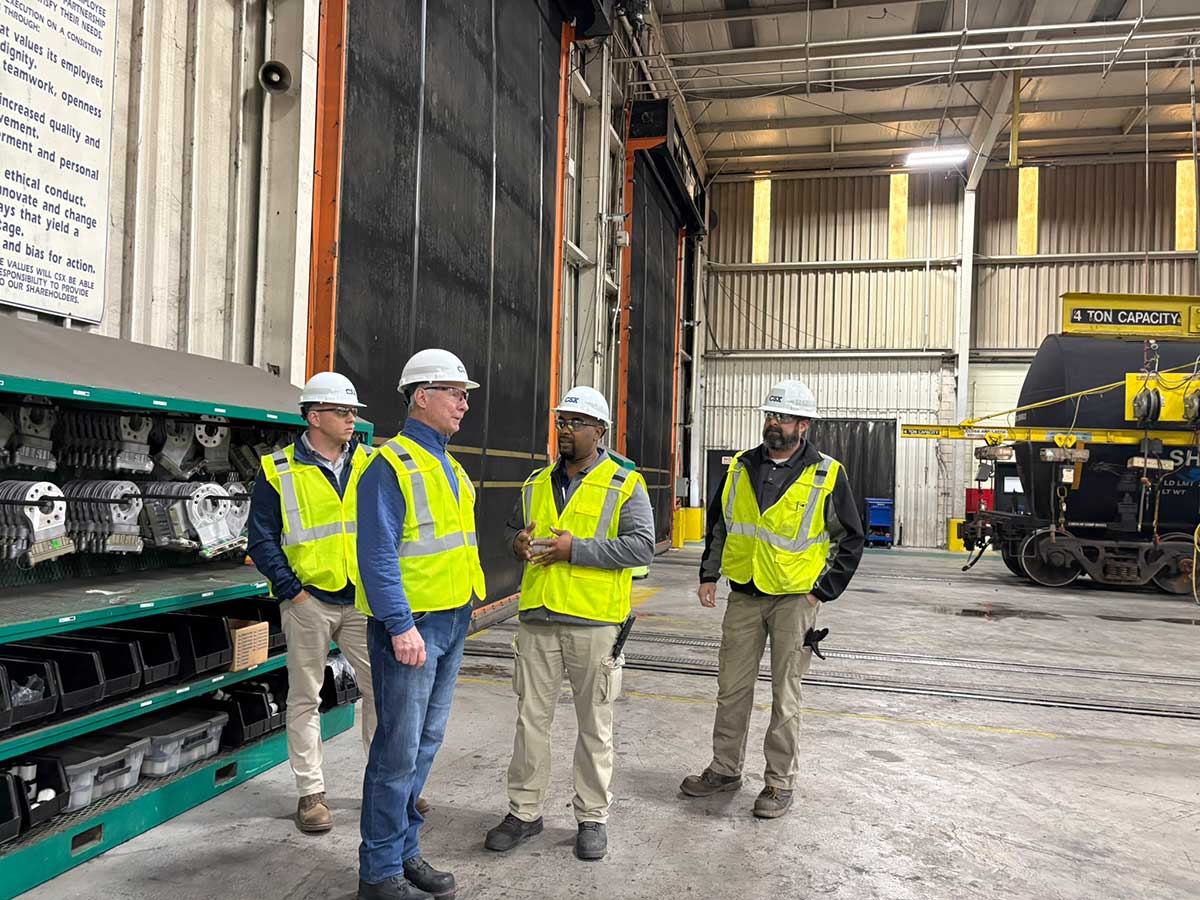
He joined General Electric in 1979 and remained until 2001. His management assignments included work directly connected with locomotives and rail operations. The important distinction is that he came to CSX with experience around rail equipment, rather than a career spent running a railroad. Familiarity gave him a connection; the new assignment still required a new apprenticeship.
Along the way, he earned an MBA at Loyola College in Baltimore while working at GE. Engineering and business became complementary parts of his education. The combination is visible in the jobs that followed: operations large enough to demand technical understanding, and businesses where investment choices mattered for years.
Praxair hired him in 2001 as an executive vice president responsible for businesses in North America, Europe and Asia. He became president and chief operating officer in 2006, then chairman, president and CEO in 2007. That sequence took him from regional responsibilities to responsibility for the whole enterprise. It also gave him a long period at the controls before the merger that would become a defining part of his public résumé.
Two companies, one operating problem
The Linde-Praxair combination in 2018 was enormous in practical terms. The companies described a business with approximately $27 billion in 2017 pro forma revenue, more than 80,000 employees and customers in more than 100 countries. Angel became CEO of the combined Linde plc; Wolfgang Reitzle became chairman.
Even the completion had stages. Regulatory requirements meant the businesses initially had to remain separate in important respects while divestitures were finished. The financial transaction closed on October 31, 2018. Restrictions under the US hold-separate order were lifted effective March 1, 2019. Announcing a combination and being permitted to operate it as one company were different dates on the calendar.
- 1979General Electric
- 2001Praxair
- 2018Linde CEO
- 2025CSX CEO
The proposed logic joined Linde’s engineering and technology capabilities with Praxair’s operating practices. Delivering it meant making a large organization function across borders and inherited corporate structures. That is the less photogenic half of merger work. The handshake makes a picture; integration makes a recurring management assignment.
In October 2019, the American-German Institute honored Angel with its Global Leadership Award, recognizing Linde’s contribution to the German-American partnership. The award placed the business in a wider setting. Combining a German and an American industrial company involved a relationship between institutions as well as a set of financial objectives.
The next transition came in March 2022. Sanjiv Lamba succeeded Angel as CEO, and Angel succeeded Reitzle as chairman. Linde’s announcement credited his tenure with operational discipline and reported a doubling of total shareholder return over the preceding three years. He had moved from directing the business to overseeing it. Eventually, that distinction would matter to him personally.
The patience behind the deal
A career like that creates expectations. When Angel arrived at CSX, his experience in consolidation drew attention in a railroad industry already debating combinations. His record made the question understandable. It did not establish that another transaction was inevitable.
Asked about strategic opportunities in October 2025, he pointed to the long stretch he had spent leading Praxair before the Linde combination. His emphasis was on timing and on operating well in the meantime. As he put it, “you run the company to the best of your ability every day.”
That answer makes a useful distinction between a reputation and an assignment. A merger background may be one reason a board chooses an executive. The railroad still has to provide service while everyone discusses its strategic possibilities. Customers do not receive their freight as a footnote to a transaction thesis.
His connections also extend beyond the companies he has run. Angel is non-executive chairman of GE Vernova, the energy company, and his biography includes a board role at Stoke Space Technologies. The range is striking without requiring a grand theory about it. An executive who began at GE has remained involved with several kinds of industrial technology.
A different kind of capital allocation
There is another institution that keeps appearing in Angel’s life: NC State. His connection survived the move from engineering student to corporate executive. He supported scholarships, faculty and facilities, helped with the fundraising effort for Fitts-Woolard Hall, and returned to speak with students.
The university described his support for women and minority engineering programs and his willingness to mentor younger people. In 2020, it awarded him the Watauga Medal, its highest non-academic honor. He was also among the inaugural members of his engineering department’s Hall of Fame. These were recognitions of an ongoing relationship with the place where he had studied.
The Angel family’s contribution to NC State’s Extraordinary Opportunity Scholarship Initiative.
That year, his family committed $2.5 million to the university’s Extraordinary Opportunity Scholarship Initiative. A second family, remaining anonymous, committed the same amount. The gifts strengthened a matching pool intended to encourage further giving for need-based scholarships across colleges and majors.
Angel described his motive in personal terms: “I passionately believe in giving back to the institution that gave me so much”. The program’s design matters here. Its reach extended beyond the engineering discipline that had launched his own career. The aim was to help students with financial need get access to a university education.
For someone whose professional life involves deciding where resources can produce a return, this is a revealing choice. A scholarship gives a person more room to attempt something. The result arrives on a student’s timetable, well beyond the next earnings call.
What the numbers can actually say
By July 2026, CSX had results that showed improvement. Second-quarter revenue reached $3.94 billion, up 10% from the same quarter a year earlier. Volume rose 6%, operating income increased 17% to $1.51 billion, and diluted earnings per share reached $0.54.
The revenue increase reflected higher fuel surcharge revenue as well as more volume and higher pricing. That detail keeps a handsome percentage from doing too much explanatory work. More revenue can come from several places, and each tells a slightly different story about the business.
Angel credited railroaders with handling the increased volume while maintaining attention to safety and productivity. The results belong to an operating system with many contributors. Employees, customers, infrastructure and work begun before his arrival all sit behind a quarterly table. His leadership can influence that system; the table cannot isolate his individual contribution.
The sensible test is therefore cumulative. Can the company sustain service and financial improvements through different conditions? Can gains in one period become repeatable practices? These are questions an operating career prepares someone to confront. They remain questions until the subsequent work supplies an answer.
Back where the decisions arrive daily
The organization continued to change. On October 12, 2026, CSX announced the retirement of chief operating officer Mike Cory. Doug Ryhorchuk, senior vice president of Operations, and Casey Albright, senior vice president of Network Operations and Service Design, would now report directly to Angel.
Those reporting lines bring substantial operating responsibilities closer to the CEO. Ryhorchuk oversees transportation, engineering and mechanical functions. Albright leads the design and execution of service plans. Angel publicly emphasized the experience of the operations team and the continuing priorities of safety and reliable customer service.
His Linde chairmanship had ended on January 31, 2026. The CSX assignment was already under way. The calendar records a change of responsibilities; his own explanation gives it a human scale. After a career in which he had ample reason to step back, he wanted the daily work again.
There is something quietly amusing about achieving enough success to escape operational demands, then volunteering for more of them. Angel’s route back to rail makes the preference plain. He likes having a business to run. At CSX, the next day keeps giving him one.