Before there was an app, there was a walk around midtown Manhattan. Brandon Krieg remembers asking strangers whether they invested. When the answer was no, he and his future business partner wanted to know why. “But why not?” was the follow-up. For people who had spent years inside financial markets, the interesting discovery was outside the office: people who needed to build wealth had reasons for never starting.
- Buy fractions of stocks and funds, automate deposits, or use a managed portfolio.
- The plan costs $12 monthly or $108 annually, with additional management fees on certain accounts.
- Grab acquired Stash in July 2026. The app still serves the U.S. market.
Stash, launched in 2015, made the starting amount small enough to reconsider. Five dollars could buy a fraction of an investment. The product’s central proposition was psychological as well as financial: you could become an investor before you felt like one.
A customer with a paycheck
The intended customer comes into focus in a 2023 account from investor Union Square Ventures. Stash customers earned around $58,000, it said. Their largest known employers included Walmart, Amazon and the U.S. Army. Many were first-time savers, putting aside an average of $30 at a time. Those numbers describe a particular moment, but they explain the design brief better than the word “fintech.”
A $30 contribution does not need a trading terminal. It needs a manageable decision and a way to happen again. Stash combines fractional stock and exchange-traded fund purchases with recurring deposits through Auto-Stash. Customers can choose their own investments or give Stash discretion to manage a diversified Smart Portfolio. Traditional and Roth IRAs address retirement; custodial accounts let adults invest for children.
This puts Stash between several familiar alternatives: Acorns, Betterment, Robinhood and traditional brokerage accounts. Its pitch combines investing, banking access, education and guidance in a subscription. The expertise is partly investment management and partly product design: explaining an unfamiliar action, then putting the means to complete it nearby.
Your receipt has a second job
The most memorable introduction arrived in 2019. Stock-Back attached investment rewards to debit purchases. Spend at an eligible publicly traded business and a small piece of stock can arrive in your investment account. Where a merchant’s stock is unavailable, an eligible alternative investment fills the gap.
It is a neat inversion of the usual shopping reward. Instead of collecting points to spend again, customers collect an asset. The amounts can be tiny; caps, eligibility rules and investment expenses matter. Buying more things to earn more stock would defeat the saving logic. The useful part is the introduction to ownership during something the customer already does.
Banking services now come from Stride Bank, which issues the debit Mastercard. Stash itself is not a bank. Its investment services operate through regulated affiliates, with Apex providing clearing and custody. That division matters: insurance attached to eligible bank deposits does not protect a stock portfolio from falling prices.
The price of a small beginning
There is an awkward arithmetic underneath the friendly entry point. The current plan costs $12 a month, or $108 paid annually. Twelve monthly payments total $144. Against a hypothetical, unchanged $500 investment balance, that is 28.8% of the balance; against $5,000, it is 2.88%.
$144 annual cost on monthly billing ÷ illustrative balance. Subscription only; balances held constant. Not a return projection.
That comparison is deliberately limited. The fee buys a bundle, not just a brokerage account. It nevertheless exposes the question a beginner should ask: will the guidance and other benefits justify the cost? Smart Portfolios with at least $1,000 and Managed Retirement Accounts also carry a 0.25% annual advisory fee. A low starting amount and a low ongoing cost are separate promises.
StashWorks offers another route. Launched in May 2024, the workplace benefit connects saving and investing to payroll. Early partners included Wonder, Aurify Brands and PEAK6 Investments. For Stash, employers become a distribution channel. For workers, payday becomes a recurring opportunity to set money aside.
The company had to learn repetition, too
The business did not progress in a straight line. Liza Landsman became CEO in 2023. Krieg and Ed Robinson returned as co-CEOs in October 2024. Fortune reported that the restructuring also removed 40% of an approximately 220-person workforce, following earlier cuts. Paying subscribers had declined from roughly two million in 2022 to more than 1.3 million.
The strain showed in the operating model before the investment idea disappeared. Robinson described removing management layers to make Stash “less bureaucratic.” That was his explanation; the immediate cost was jobs. The lesson for another founder is uncomfortable but usable: customer adoption alone cannot tell you whether the organization serving those customers is affordable.
From opening the door to answering the question
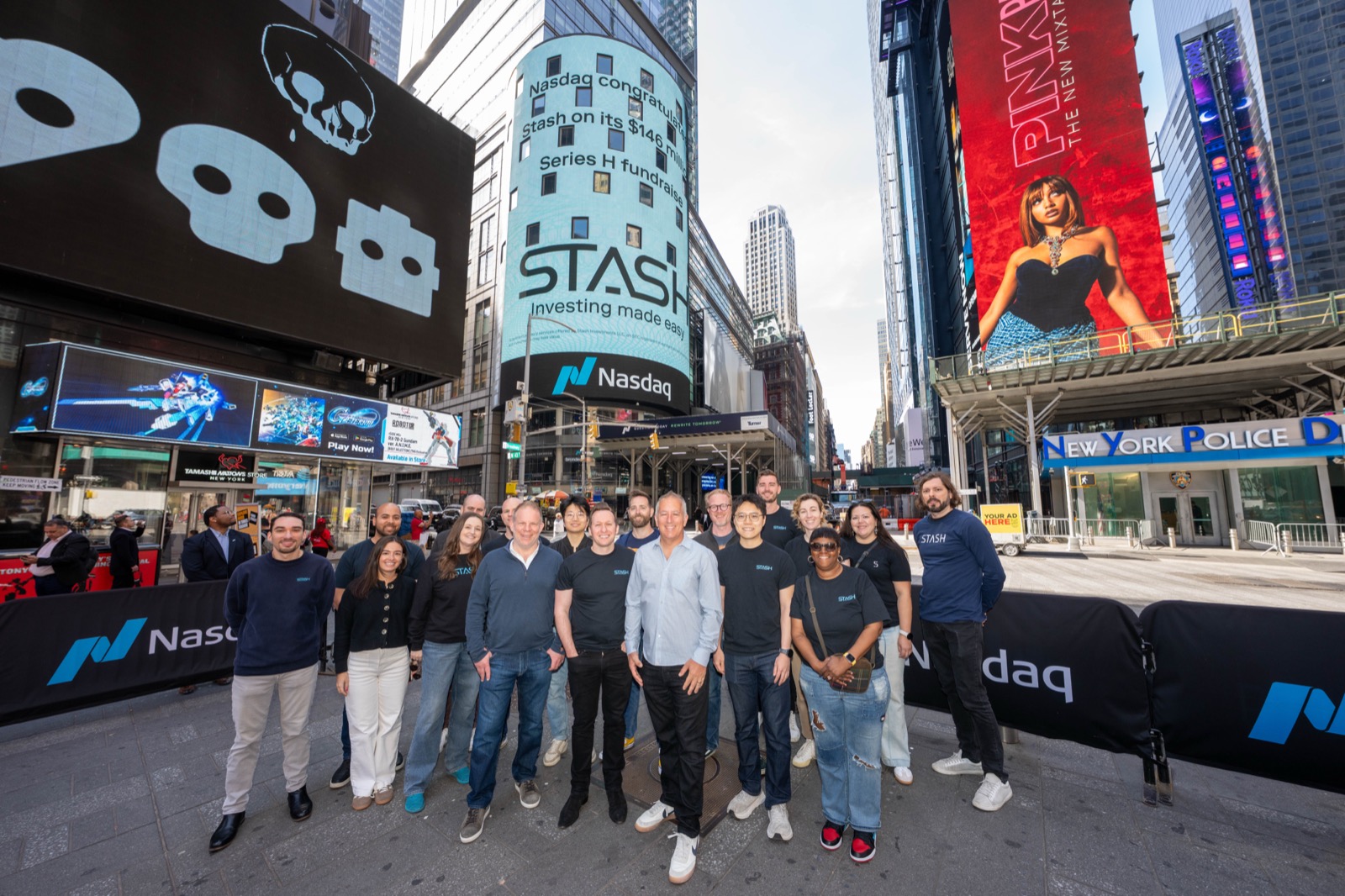
In May 2025, Stash announced a $146 million Series H led by Goodwater Capital. Its next emphasis was Money Coach AI: guidance embedded in the product. Stash reported that one in four customers who interacted with it took a designated positive action within ten minutes. That measures activity, not investment performance, and does not prove the coach caused the action.
Make the first action small. Make the next action easy to find.The product lesson
Grab’s acquisition, completed July 1, 2026, gives that experiment a new owner. The announced enterprise value was $425 million, with payment for 50.1% at closing and remaining payments at future fair market value. Grab highlighted subscription income and technology; its Southeast Asian ambitions remain prospective.
What can someone copy? Interview the people who have not started. Reduce the first commitment. Connect the explanation to an available action. Those moves depend on customers having money they can leave invested and finding enough value to keep paying. An app can shorten the distance between intention and action. It cannot supply the spare money.
Follow the experiment
Stash website ↗ · Learn ↗ · Company news ↗
LinkedIn · X · Instagram · Facebook
Watch Stash on YouTube ↗
Listen: Why I Started Stash, with Brandon Krieg ↗