The first person to buy YNAB could not use it. Jesse Mecham had put his budgeting spreadsheet on sale; the customer had a Mac. The spreadsheet needed Windows. Refund issued. For a business concerned with giving every dollar a purpose, the first dollars had a remarkably short assignment.
- Plan with money you have, before you spend it.
- Save for irregular bills alongside ordinary monthly expenses.
- Pay $109 a year or $14.99 a month; one subscription covers up to six people.
The compatibility problem was fixable. The more interesting question was whether anyone would pay for a different relationship with money. Mecham had built the original spreadsheet in 2003 while he and his wife, Julie, were college students. The business launched in 2004. Their household needed a way to make a small income stretch. What emerged was a method that made a bank balance less misleading.
A balance is a terrible permission slip
Imagine checking your account and seeing $2,000. Dinner out seems reasonable. Then the insurance renewal arrives. The money was there, but part of it already belonged to somebody else. Your bank displayed possession. It said nothing about obligation.
YNAB makes those obligations visible. You assign the dollars you currently have to categories: rent, groceries, repairs, a holiday. Saving gets a category too. Zero-based budgeting means nothing remains unassigned; it does not mean spending your account down to zero. Before buying something, you consult its category. When priorities change, you move money between categories.
The practical trick is to include expenses that refuse to arrive monthly. A hypothetical $600 annual bill becomes $50 set aside each month. The bill has not shrunk. Its surprise has. This is what YNAB calls preparing for true expenses, and readers can copy it with envelopes or a spreadsheet.
There is another consequence of naming the jobs: competing priorities have to meet each other. In the example above, another $50 for fun must come from somewhere. Moving it out of future bills makes the cost visible immediately, rather than when the bill arrives. The categories become a small negotiation with your future self. You can change your answer. You simply have to acknowledge which answer you are changing.
The software has homework
YNAB sells web and mobile software to individuals, couples and families trying to make spending decisions, build savings or repay debt. Bank imports reduce typing. Targets show progress toward purchases and deadlines. Spending and net-worth reports offer perspective, while a loan planner estimates the time and interest saved by extra payments.
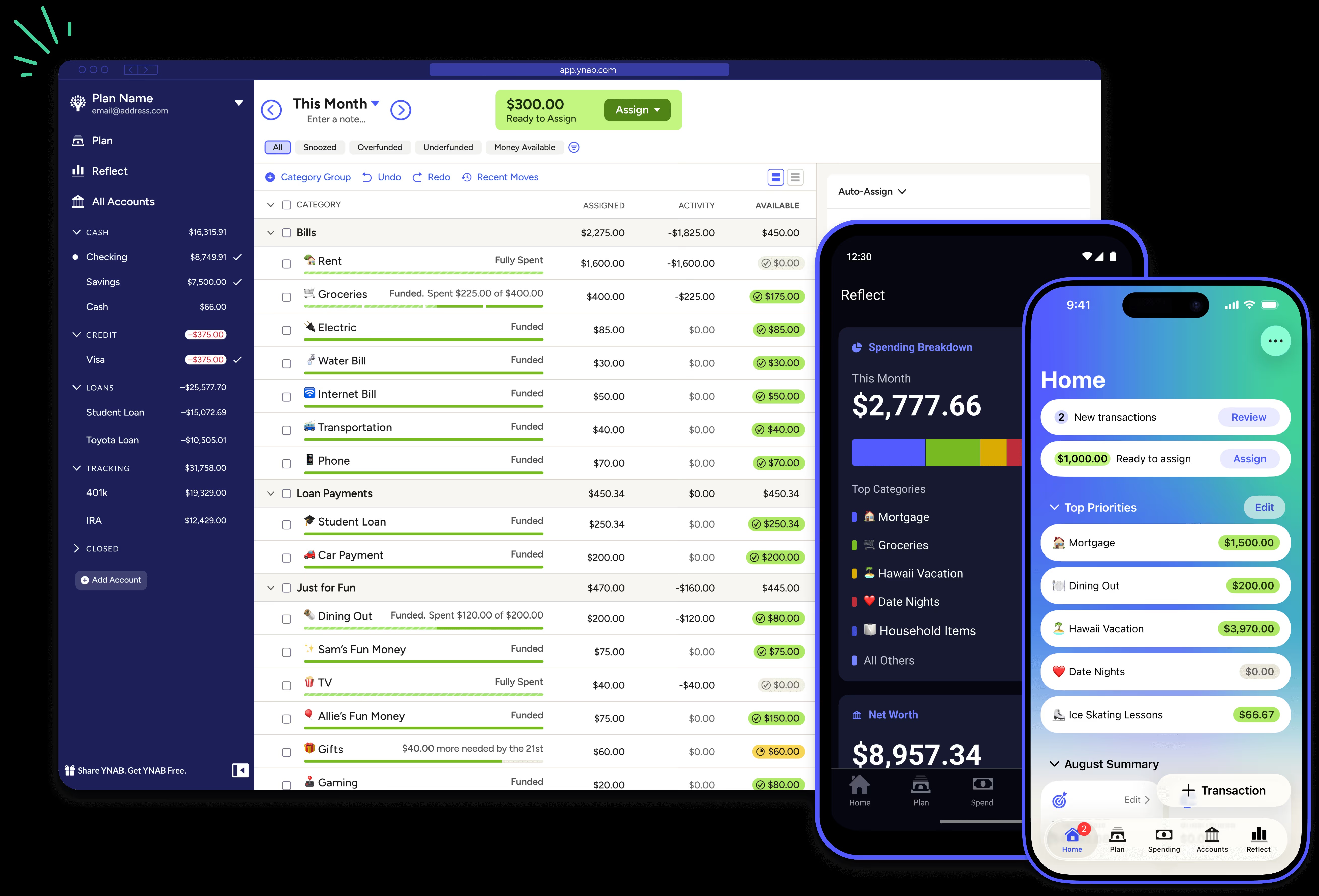
Automation does not remove the decisions. Users still need accurate transactions, sensible categories and a willingness to cover overspending. YNAB’s help center treats reconciliation - matching the app’s records to the bank’s - as part of trusting the plan. Someone seeking a dashboard to glance at occasionally may find that involvement tiresome.
Bank connectivity also has boundaries. Direct Import supports institutions in the United States, Canada, the United Kingdom and selected European countries; it does not cover every bank. Manual entry and file imports provide alternatives. An import connection cannot tell you whether the concert matters more than the sofa.
Paying to pay attention
As checked in October 2026, YNAB costs $109 annually or $14.99 monthly, before applicable tax. Twelve monthly payments total $179.88. The standard trial lasts 34 days and requires no credit card when started directly through YNAB. Eligible college students can claim a free year after verification.
The company’s privacy policy says subscriptions fund the service and that it does not sell financial data supplied through the product. That arrangement gives the business a clear customer: the person paying to manage money. YNAB also offers employers Financial Wellness by YNAB, combining app access, education and rollout resources at a published $109 per employee annually.
Alternatives include Monarch, which combines account aggregation, budgeting and collaborative planning, and Quicken Simplifi, which includes a spending plan and cash-flow projections. A spreadsheet remains an alternative too. YNAB’s distinguishing emphasis is the repeated allocation of money already available. Its expertise combines household cash-flow software with teaching the behavior needed to use it.
Sharing is particularly relevant for couples whose accounts show balances but conceal different assumptions. One person may see spare cash; the other sees next month’s rent. A shared plan gives those assumptions names. YNAB cannot settle the disagreement, but it can put the same numbers in front of both people. The subscription includes up to six participants, so a household does not have to buy a separate license for every conversation.
The distinction matters when choosing a tool. Monarch’s account overview and Simplifi’s projections address related questions about financial position and future cash flow. YNAB asks users to make a present-tense commitment with available cash. Those approaches overlap, but the daily experience depends on which question you most want the software to answer.
The lesson became the distribution
Mecham’s prescription for marketing is compact: “Teach, don’t sell.” In an August 2026 interview with Adam Mendler, he described word of mouth as his most valuable and cost-effective channel. YNAB’s guides, live sessions, podcasts and videos make that approach tangible. Education helps people learn the product and gives them something useful to pass along.

He also said the company had bootstrapped without venture capital. Independence fits a product whose value depends on repeated use rather than a single transaction. The public API extends that relationship to developers building integrations; official GitHub repositories include JavaScript, Ruby and Python clients.
“Teach, don’t sell.”Jesse Mecham, interviewed by Adam Mendler, August 2026
The plan gets to change
YNAB’s own product changes acknowledge that good intentions encounter irritating software. In September 2026, it added a built-in CSV converter to file imports, removing a detour through outside reformatting tools. In October, it changed how credit-card interest appears, addressing the repeated overspending signal faced by people unable to pay that interest immediately.
Inside the company, its careers page describes a remote team, a four-day workweek, a three-week minimum vacation policy and twice-yearly profit sharing. There is a pleasing consistency between selling deliberate choices about money and making explicit choices about working time.

The method still needs money to allocate and someone willing to revisit the plan. It cannot repair an income that fails to cover essentials. Its useful promise is narrower: a clearer view of which dollars are available for which decisions. That can make an ordinary purchase surprisingly different. You already decided what this money was for. Now you get to use it.