At East Iowa Machine Company, the interruption was built into the arrangement. One Hyper-V server handled file sharing. Reboot it for an update, and access to the files stopped. Nothing had to break. Ordinary maintenance was enough. The manufacturer needed redundancy, but a full-scale data center was an expensive answer to a modest question: could the files stay available while somebody worked on the server?
- StarWind turns server-local disks into replicated shared storage.
- Its small clusters target businesses, branches, and edge sites with limited IT resources.
- Buy the software, bring your own appliance hardware, or order a turnkey system.
The company’s published StarWind case study describes a two-node cluster, deployed in a few days, with roughly $20,000 avoided against alternative hardware. That is a customer account, published by the vendor. Still, the original inconvenience is instructive. The first thing to fail was the architecture’s tolerance for a completely predictable event.
01 The box you can leave out
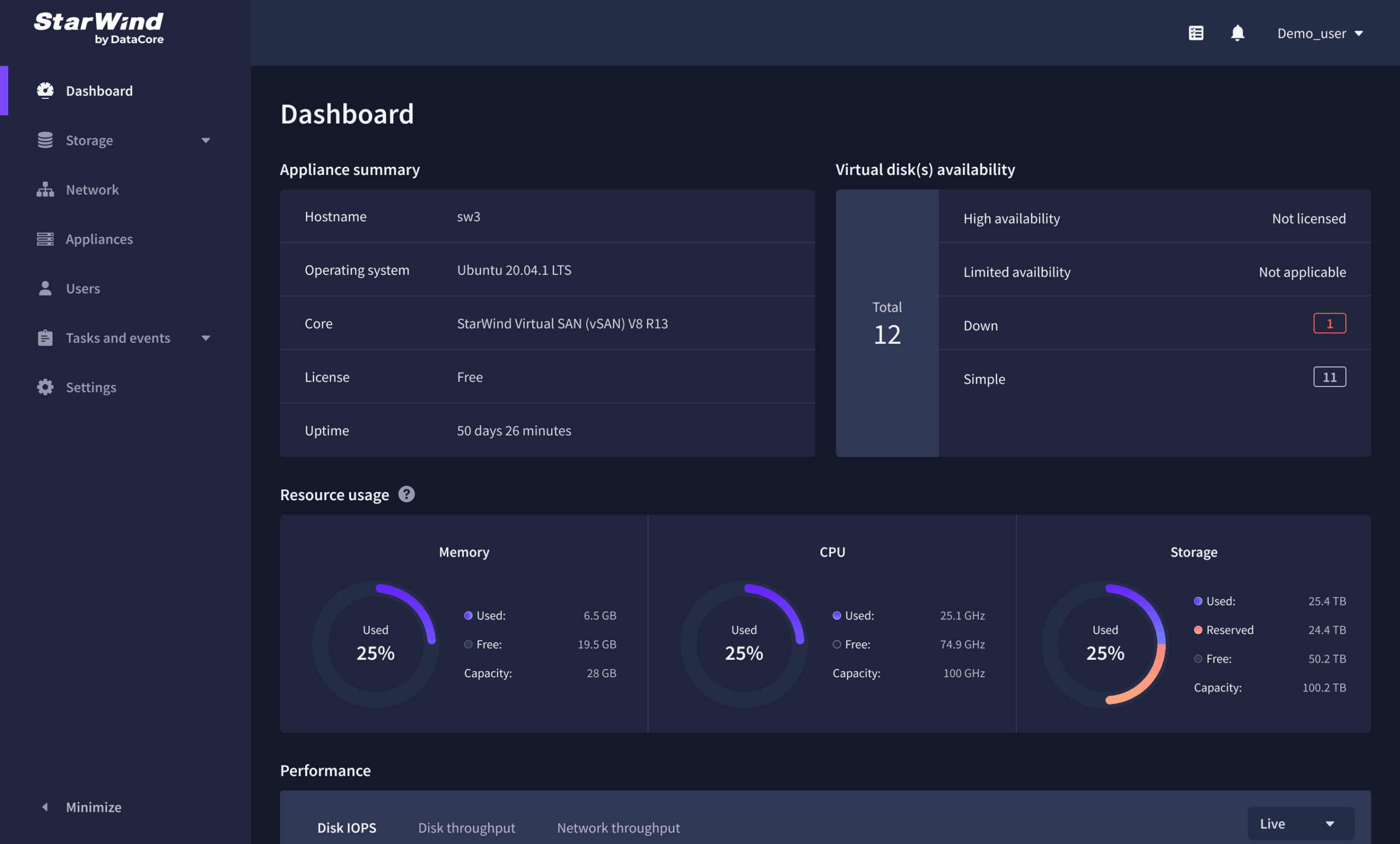
StarWind’s central product, Virtual SAN, makes storage inside separate servers behave as shared storage. It mirrors data between hosts. A virtualization cluster can then use that storage without relying on a separate physical storage-area-network appliance. The disks remain physical. The separate storage box becomes optional.
Put computing and storage together on the same hosts and you have hyperconverged infrastructure, or HCI. The attraction for a small site is practical: fewer separate systems to acquire and manage. StarWind’s software can start with two storage nodes. Its supported environments include VMware vSphere, Microsoft Hyper-V, and Proxmox VE, subject to version and configuration requirements.
+ local disks
storage
+ local disks
This is the territory StarWind has chosen: small and midsize organizations, enterprise remote offices and branches, and edge locations. These sites may have modest racks and thin staffing. Their applications can still matter a great deal. A checkout system does not become less important because it runs far from headquarters.
02 Working hardware. Awkward economics.
Sometimes the equipment works and the purchasing model becomes the obstacle. Ciena Healthcare’s case study describes IBM storage with VMware virtualization, constrained by disk and licensing lock-in and difficult expansion. VMware vSAN was considered too expensive. A TrueNAS option was judged insufficiently mature for that organization at the time.
After a proof of concept, Ciena chose StarWind for deployment flexibility and ease of maintenance. Its account reports over $80,000 in upfront savings against VMware vSAN. That figure belongs to this procurement comparison. It does not tell us what another customer will pay.
EIMCo
versus alternative hardware
Ciena Healthcare
upfront versus VMware vSAN
Vendor-published customer comparisons; different project scopes.
The cases point toward a useful buying habit: name the constraint before shopping. An interruption during updates, a painful expansion bill, and a shortage of administrators are different problems. A feature checklist can conceal those differences. Ask for a quote that includes the hardware, usable capacity, support term, and backup arrangement you intend to run. A proof of concept built around the actual inconvenience is harder to fool.
Another customer illustrates the migration angle. Canadian IT services provider iF1 Solutions described aging HPE infrastructure that was difficult to expand and upgrade. Its published account says it replaced SANs and servers with a two-node StarWind appliance cluster and converted VMware virtual machines to Hyper-V. It reported $10,000 to $20,000 saved per client against HPE/Dell alternatives. Here, the decision combined storage, servers, and virtualization licensing. Treating those as separate purchases would have missed much of the comparison.
03 How much assembly would you like?
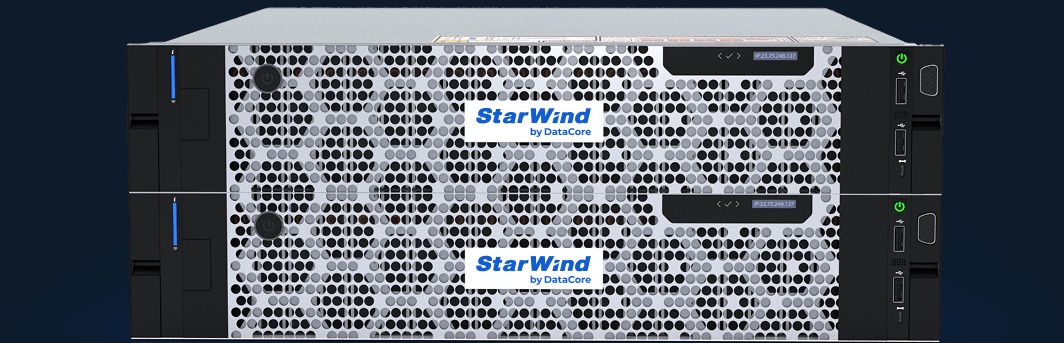
The product range separates buyers by how much work they want to own. The choice concerns operating effort as much as equipment. Virtual SAN supplies storage software for their servers. Virtual HCI Appliance packages the software stack for customer-owned hardware. HCI Appliance supplies the integrated hardware too, bringing compute, storage, networking, virtualization, and management into one platform.
The company also offers backup appliances and Virtual Tape Library software, which lets backup applications work with emulated tapes and cloud storage. Its free V2V/P2V Converter helps move machine images between environments. These tools address the less photogenic parts of an infrastructure decision: moving the workload and keeping recoverable copies.
Commercial pricing requires a quote. StarWind’s current model bases software licensing on usable capacity, rather than CPU sockets or cores. Term subscriptions include support and updates; assisted deployment is included. Optional ProActive Premium adds continuous monitoring. The free editions are self-supported, a consequential distinction for anyone expecting an engineer to answer at an inconvenient hour.
04 A company built around the small site
Founders Artem Berman and Anton Kolomyeytsev were developing iSCSI storage technology by 2003. A $3.25 million Series B followed in 2014, led by Almaz Capital with ABRT Venture and AVentures Capital participating. The technical specialization persisted: shared storage, virtualization, and availability for organizations without abundant infrastructure staff.
In May 2025, DataCore acquired StarWind to extend its reach into edge and branch-office HCI. The acquisition announcement also singled out uncertainty around Broadcom-VMware pricing as a reason organizations were reconsidering their infrastructure. StarWind fits alongside DataCore’s broader storage portfolio as a compact option for distributed sites.
“The best SAN is no SAN.”
StarWind’s HCI Appliance pitch
Alternatives include VMware vSAN, Nutanix, StorMagic, Scale Computing, and conventional SANs. StarWind’s distinguishing combination is a small starting footprint, choices across virtualization platforms, and engineering support around the deployment. The value depends on which of those choices a customer actually needs.
Its Proxmox work supplies a concrete example of that flexibility. StarWind’s free SAN integration plugin adds thin provisioning, snapshots, and linked clones to generic SAN storage in Proxmox environments. The installation guide explains how it coordinates shared access with snapshot-capable storage. That matters to a team changing virtualization platforms while keeping a SAN: migration need not mean replacing every layer together.
05 The homework survives
Two nodes do not remove design work. Replication needs suitable bandwidth and latency. StarWind’s appliance guide describes dedicated links; its Proxmox configuration also requires a cluster quorum device. A statement about storage needing no witness should never replace checking the hypervisor’s own quorum requirements.
Mirrored storage also needs separate backups: a replicated deletion is still a deletion. Buyers should size usable capacity, test host and network failures, and rehearse recovery with real workloads during the trial. Hardware reuse makes less sense if the old machines cannot meet performance or support requirements.
Development has continued under DataCore. May 2026 release notes announced general availability for NVMe-oF storage targets; September notes described a new appliance foundation and migration process. For a buyer, the useful test remains wonderfully ordinary: run the maintenance that used to interrupt work, and see what happens.