At sixteen, Stanley Bergman helped organize summer camps in Port Elizabeth. The task required getting everyone involved, including the person who might otherwise be left on the edge of the group. Decades later, running Henry Schein, he kept returning to that experience. A company had more complicated accounts. The question of participation remained familiar.
It is an unusually modest origin for a management philosophy. There are teenagers to organize, and the organizer has to earn their attention. Anyone who has tried that knows why the memory might last. The experience gave him a way to think about authority that depended on what other people actually did with it.
Bergman became Henry Schein’s CEO in 1989 and stayed until March 2026. During that span, annual sales rose from $225 million to $12.7 billion in 2024. He helped turn a family distributor into an international business. Yet when he explains his approach to people, he often goes back to a shop counter, a classroom, or a camp.
A shop before a boardroom
His parents had escaped Nazi Germany for South Africa in 1936. They ran Eric Stores, a small department store in South End, Port Elizabeth. Both worked in the business. His mother, physically small and forceful in personality, supplied a lesson he still repeats: “It’s all about people.”
South End offered him daily evidence. Families from different backgrounds lived and traded alongside one another. He remembers the neighborhood as a place where difference could be ordinary, woven into the practical business of getting through the day.
Apartheid tore that community apart. Neighbors and businesses were forced into segregated areas. For Bergman, the later corporate vocabulary of diversity had an earlier, concrete reference: people he knew, a place that worked, and a government that destroyed its social fabric.
His account of the shop also includes a partnership. His father’s community leadership and his mother’s presence in the business belonged together. Years later, when he and Marion described their own marriage, they traced their commitment to supporting each other’s ambitions back to that example.
“It’s all about people.”
Stanley Bergman, recalling his mother’s lesson
The unlikely school prospect
At Grey High School, the future executive gave his teachers limited reason to anticipate a prominent business career. Mathematics, chemistry, and physics were difficulties. History interested him, although memorizing dates did not. He had little enthusiasm for cricket or rugby. His sporting station was goalkeeper on the third hockey team.
A counselor suggested that university might be beyond his path. In 2018, fifty years after graduating, Bergman returned to deliver the school’s memorial lecture. The invitation supplied a pleasingly delayed reply, though he used the occasion to acknowledge what his education had given him.
He did not dismiss the classroom. He argued that its foundation had enabled him to make use of lessons learned elsewhere. The distinction is generous to both the school and the boy who failed to look promising on paper. Potential can be present long before its owner learns where to put it.
He had already found other places to practice. At six, he connected a buyer and seller of a portable radio at his father’s bowling games and earned a commission. The financial vocabulary arrived slightly after the transaction.
By twelve, stamp collecting had introduced him to another kind of business. He wrote to postmasters for new issues to resell, discovering that a small transaction could connect him with another country. It was an early lesson in reaching beyond the market immediately around him. The enterprise also had a useful advantage for a schoolboy: international inventory could arrive through the post.
Someone had to open the door
Bergman studied at the University of the Witwatersrand in Johannesburg and qualified as an accountant. He and Marion met in 1970 and married in 1972. They decided against building their future under apartheid and eventually settled in New York in May 1976. They became American citizens a decade later.
In New York, he worked in accounting and systems consulting. Henry Schein became the business that changed the direction of his career. Jay Schein, the founder’s son, invited him to join in 1980. His first formal position was vice president of finance and administration; he became executive vice president in 1985.
Jay occupies a particular place in Bergman’s account. He offered advice, but he also gave a young professional responsibility inside the family company. Bergman describes that as sponsorship. Someone with authority had made room for him to act.
After Jay’s death in 1989, Bergman became chairman and CEO. Marion encouraged him to accept the responsibility. In their joint reflection on their marriage, he treats her counsel as part of the decision, alongside the influence of professional mentors. The succession belonged to a business; the decision entered a household.
Room to act like an owner
The company went public in 1995. Expansion meant a growing problem familiar to many organizations: how to gain the advantages of size while keeping people close enough to decisions to exercise judgment.
Bergman’s answer included entrepreneurship inside the company. Professor Edward Shils, a mentor associated with entrepreneurial studies at Wharton, helped shape his thinking. The aim was to give people some of the initiative of an owner while drawing on the resources of a larger enterprise.
In 2014, he described a business organized into roughly 450 entities, with people having ownership in those units. He encouraged experimentation and expected some decisions to go wrong. That was a description of the company then, rather than a permanent organizational chart. It reveals how he wanted scale to function.
International expansion depended on local knowledge, too. He described partnerships in Brazil and China in terms of complementary skills. Local entrepreneurs understood their markets; Henry Schein brought its own expertise and resources. An international company still needed people who understood the next customer.
A larger business, measured at two points
The numbers are useful, provided they do not swallow the person. They describe the size of the enterprise he helped lead. They cannot explain, by themselves, why he kept talking about participation or why a conversation with a prospective colleague might turn toward character.
Andrea Albertini later recalled an early interview with Bergman that concentrated on who he was and the leader he wanted to become. Technical knowledge and experience were not the center of Albertini’s memory. He remembered the tone of the conversation, and how it anticipated the culture he would encounter.
Five groups, one enterprise
Bergman has described Henry Schein as an arrangement among five constituencies: employees, customers, suppliers, investors, and society. Each has a claim on the business. The point of the model is to make those relationships work together over time.
Speaking to a philanthropy gathering in 2017, he explained that he had once considered pursuing social responsibility professionally before becoming absorbed in business. At Henry Schein, he found a way to combine the two interests. The founders’ own habit of giving provided an example to build upon.
- 01 Employees
- 02 Customers
- 03 Suppliers
- 04 Investors
- 05 Society
A business model built around relationships that have to keep working together.
There is a clear commercial argument in this view. People want to work for an institution they can respect. Partners want relationships that will last. Investors need an enterprise capable of continuing to earn trust. Bergman regards responsibility to society as part of that continuing work.
In 2017, a committee of fellow CEOs selected him as Chief Executive’s CEO of the Year. At the celebration, he used the occasion to urge business leaders to broaden participation in the digital economy. The benefits of technological change, he argued, brought obligations to people who had yet to share them.
That concern fits the rest of his story. He had seen a functioning neighborhood divided by imposed barriers. In business, he repeatedly returned to the practical consequences of letting people participate. The setting changed; the question stayed close to home.
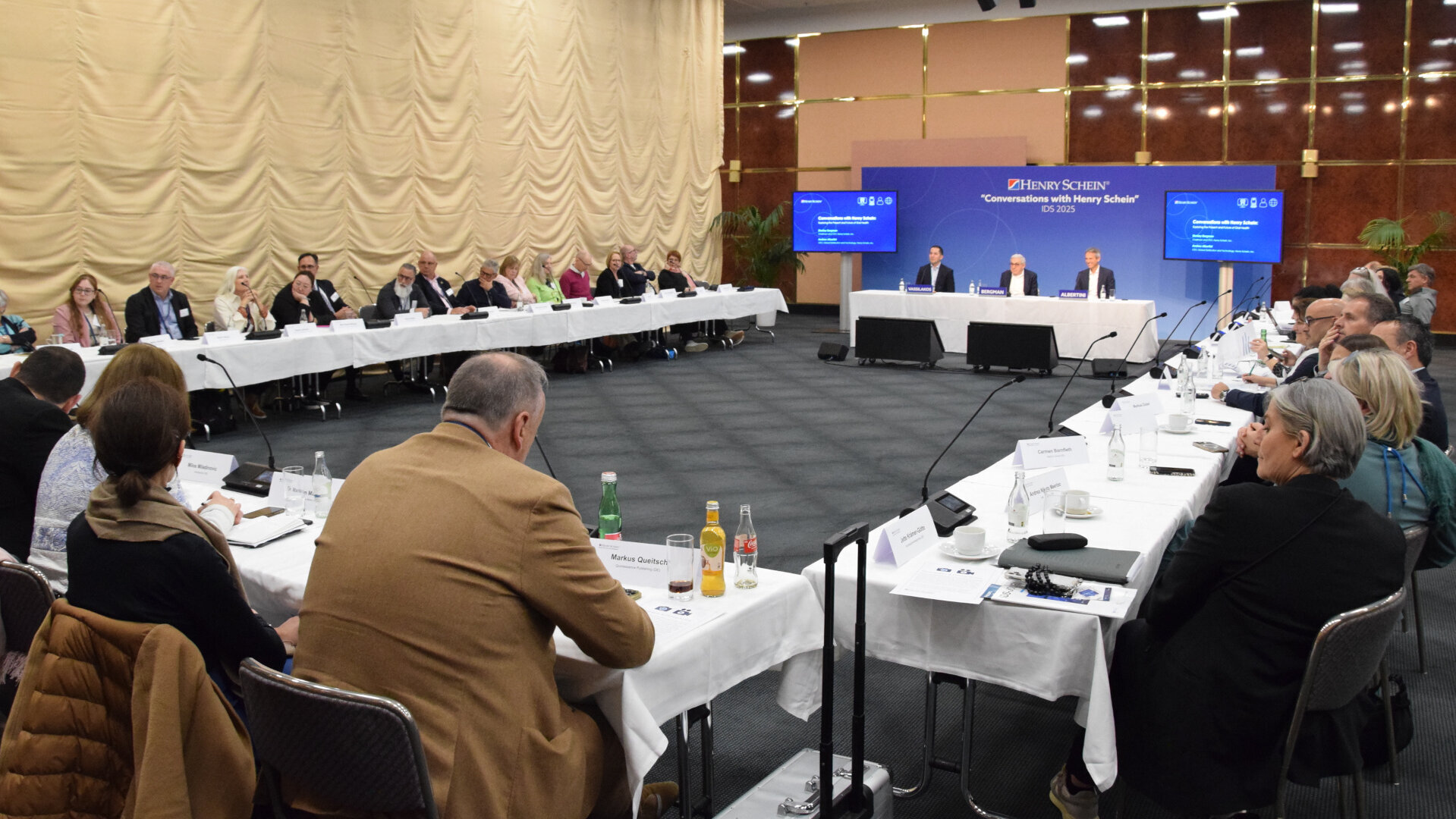
A different chair at the table
There is a lighter side to his professional seriousness. In a 2022 conversation, he explained that the books behind him were history and biography. Leadership books held less appeal. He preferred studying what people had done and considering what it might mean for the future.
That preference is consistent with the way he tells his own story. He gives teachers, family members, and colleagues substantial parts in it. An executive biography can make an appointment look inevitable once the dates are arranged. Bergman keeps returning to the people who intervened before the outcome was clear, when encouragement or an invitation could still change what happened next.
His personal accounts also resist making the chief executive the only interesting person in the room. At a Synergos gathering, he introduced himself and Marion through their son, joking that they were known as “Eddie’s Parents.” Their sons, Paul and Eddie, had encouraged the family toward more active philanthropy.
In July 2025, Bergman announced plans to retire as CEO. The eventual handover came on March 2, 2026, when Frederick Lowery took the role after a career that included senior responsibilities at Thermo Fisher Scientific. Bergman remained chairman to support the transition.
“Henry Schein has been my professional home for 45 years,” he said when announcing his plans. The choice of home is revealing. It leaves room for attachment, gratitude, and the recognition that other people will continue the work.
His career now has a different vantage point. The person who spent decades asking colleagues to take responsibility has passed the executive role to someone else. It gives his old camp-counselor lesson another application: make room, bring people in, and allow the next person to lead the game.