Before Kristin Peck had a corner office, she had stalls to muck out. Her family raised Morgan horses. Her father produced rodeos; her sister competed at horse shows. Dogs, cats, and birds filled out the household. Animals were part of the daily work long before they became the subject of her professional life.
In high school, she worked for American Equine Products. The company later became part of the business she would lead as chief executive of Zoetis. It is the sort of circular detail that makes a career look inevitable once somebody has written the biography. Peck has been frank that she could scarcely have imagined the eventual job at the time. Destiny is much tidier on paper than it is while you are doing the chores.
The intervening years took her through property finance, private equity, business school, consulting, and corporate strategy. She learned to evaluate businesses, then took responsibility for the less abstract business of making things and getting them to customers. Her route to the top offers a useful question for anyone staring at a career plan: how much can you learn by taking the next interesting job?
The detour that changed the destination
At Georgetown, Peck spent time in Ecuador and considered a future involving foreign service and social work. That experience helped shape her interest in employment and economic opportunity. She came to see growing businesses as a way to give people more control over their lives. Later, in consulting, she enjoyed working on the practical question of how an organization could grow and create opportunities for the people inside it.
There is an appealing lack of executive theatre in that account. It starts with what work can make possible for somebody else. Consulting also taught her about influence: a good recommendation has limited value until somebody agrees to act on it. You can have the analysis, the slides, and the answer, and still have quite a lot of work left.
She earned an MBA at Columbia Business School, graduating in 1999, and worked at Boston Consulting Group before joining Pfizer in 2004. Earlier roles included Prudential Realty Group, the O'Connor Group, and J.P. Morgan. The sequence gave her experience across transactions, strategy, and organizations with very different working habits.
From the deal to the delivery
At Pfizer, Peck became executive vice president of worldwide business development and innovation. Among her responsibilities was evaluating strategic alternatives for businesses within the company. One of those assignments helped pave the way for Zoetis to become an independent public company. She was involved in its 2013 initial public offering, a corporate separation whose consequences would occupy much more of her career than a completed transaction usually does.
Her responsibilities at Zoetis stretched across manufacturing and supply, product marketing, market research, and commercial operations. She took charge of U.S. operations in 2015 and added business development and strategy in 2018. A company can look quite different from each of those desks. A forecast becomes a production schedule; a customer's frustration becomes a problem that crosses several departments.
When Zoetis announced her appointment as CEO in October 2019, its chairman highlighted customer loyalty programs, digital investment, and manufacturing efficiency. These were concrete reasons for choosing an internal successor. Peck had already worked on the relationship between a corporate plan and the machinery required to carry it out. She succeeded Juan Ramón Alaix on January 1, 2020.
- 1999Columbia MBA
- 2013Zoetis IPO
- 2015U.S. operations
- 2020Chief executive
A meeting with an expiry time
Her approach to teamwork was visible before she became CEO. As a U.S. business leader, she used different meetings for different tasks: quarterly strategy discussions, monthly operational meetings, and a smaller Friday huddle. The Friday call lasted 45 minutes and concentrated on sharing business signals. Subjects needing a fuller discussion were taken separately. Anyone who has watched a status meeting acquire a second life as a symposium will appreciate the distinction.
The mechanics mattered because she wanted leaders to understand how their responsibilities connected. A difficult technology rollout had required them to work together each morning, exposing gaps in coordination. Her team also used external indicators and customer feedback alongside internal numbers. A sales forecast and a supply plan belonged in the same conversation. The point was to make the dependencies visible before a problem invited everyone to explain why it belonged to another department.
That interest in how decisions travel became especially useful in 2020. Zoetis expanded the authority of local leaders across the 45 countries where it then had a direct presence. Conditions differed between markets, and managers needed room to respond. A headquarters can establish priorities without becoming the destination for every practical question.
An editorial sketch of the approach: agree on direction, give people room to act, and keep information moving.
The end of the perfect answer
Peck initially measured herself against Alaix, whose composure and command of an answer had helped form her picture of a chief executive. She has since described discovering that she could acknowledge uncertainty and be more open with colleagues. The job gave her permission to sound like herself. That is a surprisingly substantial adjustment when a promotion comes with so many inherited expectations about how its occupant should behave.
In smaller virtual conversations, she could hear more directly what people were experiencing. Colleagues had different circumstances, pressures, and ways of responding. The lesson she drew was about listening closely enough to make the next communication useful. An executive message could demonstrate that something had actually been heard.
By December 2024, she described the job in terms that would make an ambitious public speaker pause. She had come to regard listening as central to inspiring people. Her account of family life included games of Uno, a small domestic detail that helped colleagues see a person behind the title. The chief executive also had a calendar at home, and other people with opinions about it.
“This job is not really about speaking, it’s actually about listening.”
Kristin Peck, December 2024
Who gets the chance to move?
Peck's interest in colleagues' careers has an institutional side. She received the 2019 Feather in Her Cap Award for contributions that included mentoring women. She has also served on the board of Catalyst, the workplace research and advocacy organization. By 2022, Zoetis had maintained the gender parity on its executive leadership team that it reached before her appointment.
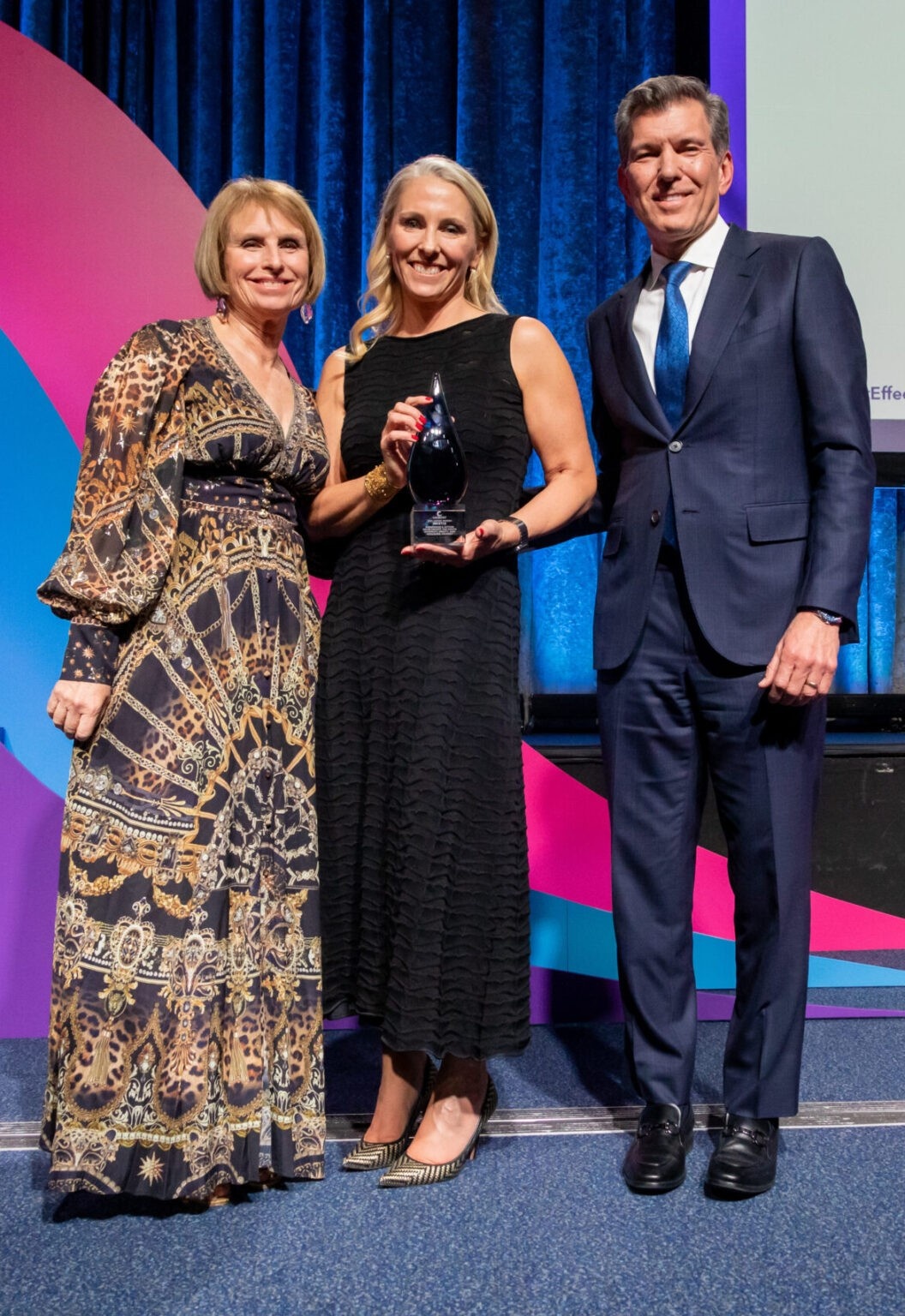
Zoetis received a Catalyst Award in 2024. Peck accepted it alongside Catalyst's Lorraine Hariton and KPMG's Paul Knopp. An award ceremony supplies the photograph; the more interesting question is what people experience between ceremonies. Who is considered for an international role? Who gets access to a challenging assignment? Those are the decisions through which an employer makes its promises tangible.
By September 2026, career development was again part of her public agenda. At Business Roundtable's Workforce Forum in Washington, she joined Zoetis colleague Kristin Kasselman for a conversation about learning and advancement within the company. The pairing gave the subject a useful specificity: an employer's account of opportunity, discussed with someone whose work takes place inside it.
Learning without handing off the homework
Technology has provided another test of how much a CEO needs to learn. Peck and Wafaa Mamilli, then Zoetis's chief information and digital officer, discussed the company's digital transformation together in 2021. The work connected sales, marketing, and analytics with the customer experience. Their joint appearance made the allocation of responsibility clear: a business transformation required a conversation involving both executives.
They returned to that relationship at MIT's Digital Leadership Summit in May 2022, discussing coordination between the CEO and CIO. For a leader whose early career included finance and strategy, it was another expansion of the syllabus. Deciding which questions to ask is part of the job; understanding enough to assess the answers takes continuing effort.
Peck also asks questions in public through her On Purpose interview series. Guests have included former PepsiCo chief Indra Nooyi, executive adviser Eric Pliner, and journalist Poppy Harlow. The conversations explore how people choose their work and respond when a career changes direction. Hosting gives her listening an audience, while allowing other people's experiences to take up the space.
The calendar belongs to somebody
When she returned to Columbia for a leadership conversation in 2024, Peck talked about running, endurance, and taking ownership of her calendar. It was advice about finite time from someone whose responsibilities include the Zoetis board and, since 2021, a BlackRock directorship. An appointment diary is a fairly candid document. It records what received attention, whatever the statement of priorities may say.
In September 2026, she described her outlook as “frustrated optimism.” The phrase suits someone who can see progress and still find a reason to ask for more. She has spoken about curiosity, learning from leaders she trusted, and moving forward without complete certainty. Her childhood ambitions had included playing quarterback for the New York Jets and becoming president. She still jokes that the Jets might have a use for her.
The more revealing ambition is the one that runs through her actual career: finding work worth learning how to do. The teenager at American Equine Products could not have drafted this itinerary. The executive she became has spent years working out how to give other people room to shape theirs.