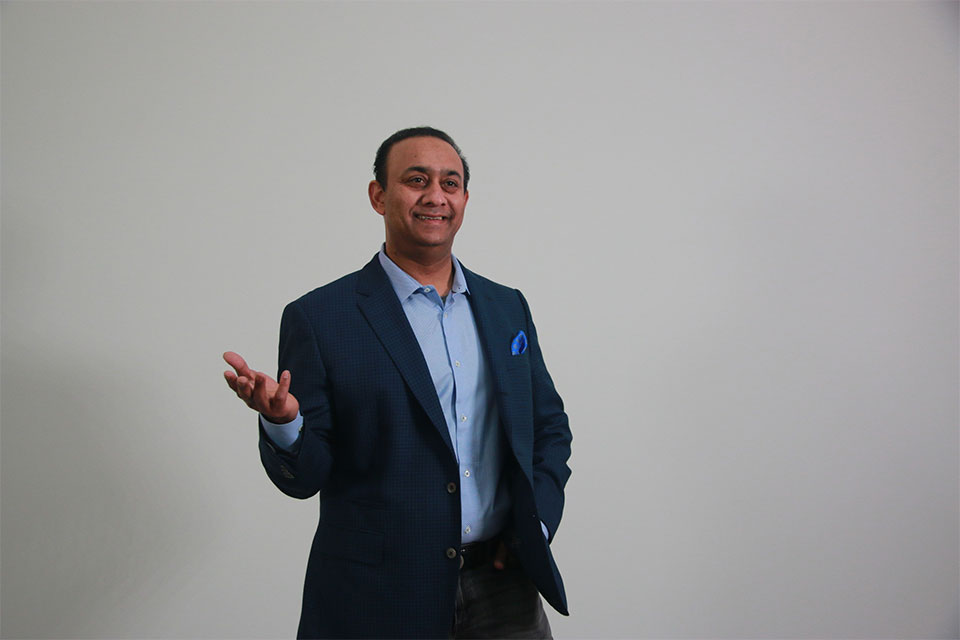
Srikanth Gaddam had accumulated a persuasive collection of reasons to believe in education. An MBA from Ohio State. The Owner/President Management program at Harvard Business School. A doctorate from Case Western Reserve. His fifteen-year-old son, however, had a question. Could someone land a well-paid programming job without going to college? Bill Gates and Steve Jobs had managed rather well without finishing. What if he mastered a couple of technologies instead? Teenagers have a gift for turning a parent's résumé into a discussion topic.
Gaddam did something useful with the interruption. He investigated it. The conversation became the starting point for The Future of Disruptive Technologies, published in 2020, a book about the changes facing businesses, workers and societies. Its intended readers included young people preparing for work and professionals already halfway through careers built around older technologies. A family question had acquired a much larger audience.
The appeal of that episode lies in the father's willingness to pause. His own route had involved formal study, repeatedly. His son's proposed route involved concentrated technical practice. Rather than treating his credentials as the final word, Gaddam allowed the question to become a research project. It is a useful place to begin his story: an executive who had spent years building an organization, encountering a challenge to one of his own assumptions at home.
“And that really made me stop and think.”
Srikanth Gaddam, on his son’s question
Two people, then a different kind of problem
Gaddam is the founder, president and CEO of ERPA, the enterprise technology services business also known as ERP Analysts. The two-person operation of 2003 is a recurring reference point in his public biography. By the time Destination Success appeared in 2017, his author biography described a $75 million business serving clients across 36 states and the Caribbean. Those are historical figures, a snapshot of how far the operation had travelled by that stage.
The work itself supplies a less glamorous, more revealing backdrop. ERPA helps organizations implement, modernize and manage enterprise applications. Its current practice includes PeopleSoft, Workday and Amazon Web Services. These are systems that organizations depend on to carry out ordinary work. Their usefulness is measured in what people can get done with them. The audience for that kind of business is usually less interested in a theatrical unveiling than in a working system on Monday morning.
That setting gives Gaddam's writing about leadership a practical tension. A small firm can depend heavily on a founder's direct involvement. A larger one needs other people to make decisions, develop expertise and carry responsibility. Growth changes the founder's job while the founder is still doing it. His later books return to questions of developing leaders, managing execution and building organizations that can endure. Read beside the business, those subjects have the feel of problems an operator would want to keep working on.
The CEO kept enrolling
His education unfolded alongside his executive career. Gaddam studied at Ohio State's Fisher College of Business in 2008 and 2009, earning his MBA. He attended Harvard Business School's Owner/President Management program from 2011 to 2013. Then came Case Western Reserve, where he studied from 2017 to 2020 and earned his Doctor of Management. A running company and a return to school appear together across much of this period.
The doctorate brought his academic work close to the decisions made in an executive office. His 2020 dissertation was titled Role of a CEO in the Era of Technology Disruption: Influence on Timing of Adoption. Timing is the interesting word. A technology can be available before a company is ready to use it; an organization can also delay until an opportunity has moved elsewhere. The title places the leader inside that decision, with responsibility for when an organization acts.
There is something quietly comic about the resulting family debate over college. A father with three substantial stops in business education was being asked to consider whether college was necessary at all. The record of his response suggests curiosity rather than a reflexive defence of the institution. His own studies and his book's attention to technical learning sit comfortably in the same biography. Both concern preparing people to do work whose demands will keep changing.
- 2008–09Ohio State
MBA - 2011–13Harvard Business School
Owner/President Management - 2017–20Case Western Reserve
Doctor of Management
A bookshelf with an operating agenda
The books make a second timeline of his career. Destination Success: Discovering the Entrepreneurial Journey arrived in 2017. Its interest in entrepreneurial purpose preceded his technology book. The sequence then widened: The Future of Disruptive Technologies in 2020, followed by The Entrepreneurial Guide and The Leadership Guide in 2021. The titles move between starting something, understanding a changing environment, running a business and helping other people lead.
The Entrepreneurial Guide addresses business growth through specific operating questions, including financial adjustments, developing future leaders and managing by numbers. It also considers exit strategies. That is a useful range for a founder's manual. An enterprise has to be built, staffed and understood in financial terms; eventually, its relationship with the person who started it may change. The book's announced scope follows that sequence beyond the excitement of having an idea.
The Leadership Guide turns toward the individual taking responsibility. “Clarify the kind of leader you want to be,” Gaddam advises. It is a modest instruction beside the usual executive vocabulary, and a demanding one. A title can be printed quickly. Deciding how to use the authority behind it takes longer. In December 2021, he discussed the book with interviewer Viki Winterton on Write Now Radio, bringing the same leadership interests into an audio conversation.
“Clarify the kind of leader you want to be.”
Srikanth Gaddam, The Leadership Guide
Learning goes beyond his own desk
Education also appears in Gaddam's work outside ERPA. He co-founded Sponsor Kids Foundation in 2011 to support children, with education central to its work. He also created a scholarship fund for the children of first responders. An unusual feature of that initiative was its operating arrangement: high school students handled the day-to-day work. The young people were being given something more concrete than an encouraging speech.
A scholarship helps someone continue learning. Helping run the organization that provides it introduces another set of lessons: responsibility, coordination and the obligations that come with promising assistance to somebody else. That combination fits the interests visible across Gaddam's books. He writes about developing future leaders while supporting an initiative in which students have work of their own to carry out.
His connection to education extends into public service. Ohio's State Board of Career Colleges and Schools lists him as its chair and a public member from Dublin. The board's March 2026 meeting minutes record approval of the year's officers, with Gaddam as chair. Career education brings the question raised by his son into an institutional setting: how people prepare for employment and how the organizations offering that preparation are overseen.
The board role adds an institutional responsibility to a career often described through entrepreneurship. Its membership includes representatives of schools, students and state education departments alongside public members. Gaddam chairs that group. It is another setting where educational opportunity has to be considered through the practical work of an organization, with different interests represented around the table.
In 2015, Fisher recognized him with its Entrepreneurship and Innovation Award, now listed among the college's previous Entrepreneurship Award recipients. The category recognizes venture creation and commitment to future entrepreneurs. For Gaddam, it sits at the intersection of the two activities that recur through his biography: building a company and helping others learn how to build.
By 2026, the title is Build to Matter
His 2026 book, Build to Matter, carries the subtitle The Entrepreneur's Blueprint for Purpose, Profit, and Lasting Enterprise Value in the Age of AI. It is a long subtitle with several bills to pay. Purpose must coexist with profit. Growth must leave behind something durable. Artificial intelligence joins the agenda, bringing another set of choices for executives already responsible for people, customers and the economics of a business.
The book's description emphasizes trust, culture, disciplined execution and adaptability. It includes practical takeaways and actions for readers to try. These are familiar concerns in his earlier work, now collected around the question of what a company becomes as it grows. The audience includes founders and managers, giving the conversation room to continue beyond the person who first had the business idea.
There is continuity here with the doctoral question about adoption. New tools give leaders decisions to make; the existence of the tool does not make the decision for them. Gaddam's published interests keep returning to the people responsible for choosing, organizing and teaching. His newest book places AI in that continuing discussion, alongside the older work of building trust and giving others room to contribute.
Purpose · Profit · Lasting enterprise value
The next question gets a seat
Gaddam's public life now includes an enterprise services company, a sequence of business books, educational philanthropy and a role overseeing career education in Ohio. Each provides a different setting for the same recurring concern: how people acquire the judgment to take their next step. The settings vary considerably. A student considering programming, a founder planning growth and a manager choosing a technology will each have different constraints.
His most appealing anecdote remains the smallest one. A teenager looked at an educated father's career and proposed another route. Gaddam had enough experience to give a confident answer. He chose to investigate, then write for other people asking related questions. “And that really made me stop and think,” he recalled. For an executive whose job involves making decisions, that pause may be the most useful detail of all.