Sridhar Ramaswamy arrived at Google in 2003 with management experience and chose a job without the management. He had been running a substantial software group. Now he wanted to write code and learn how this peculiar company thought about computing. A career adviser might have suggested preserving his seniority. Ramaswamy apparently had other uses for the afternoon.
The assignment was search advertising. He describes landing there by accident. Over the next fifteen years, that accident became a career: engineer, technical leader, and eventually senior vice president of Ads & Commerce. He helped operate the machinery that turned an everyday question typed into a box into a business transaction somewhere else.
Then he left. After joining Greylock in 2018, he co-founded Neeva in 2019 with Vivek Raghunathan, another Google veteran. Their product would ask people to pay for search and remove the ads. For someone with his résumé, it was an unusually direct experiment in whether a different way of collecting money could produce a different experience of the internet.
The experiment did not become a lasting consumer business. Neeva announced its retreat from consumer search in May 2023. Snowflake acquired the company that year, and Ramaswamy became Snowflake’s CEO in February 2024. His route to the job included a product people were supposed to use instead of Google. It makes for a less tidy biography, and a more interesting one.
Same curiosity. Different business models.
- 2003Google
Engineer → ads executive - 2019Neeva
Co-founder, customer-paid search - 2023Snowflake
Neeva acquired; AI leadership - 2024Chief executive
A wider brief at Snowflake
The teacher with the extra books
Before the Valley, there were several South Indian cities. Born in Tiruchirappalli, often called Trichy, Ramaswamy spent parts of his childhood in Coimbatore and Kumbakonam before his family moved to Bangalore when he was about ten. He remembers an encouraging school mathematics teacher who gave him extra books to read during the summer.
That is a small detail with some weight behind it. He has credited his parents and teachers with encouraging him to attempt IIT, an ambition that was unusual among pupils at his local schools. The books mattered because somebody had noticed a student who might want them. The next step was made imaginable before it was made possible.
He graduated from IIT Madras in 1989 and earned his computer science doctorate at Brown in 1995. His dissertation, Indexing for Data Models with Classes and Constraints, belongs to the period when his professional questions were explicitly about databases. Search engines and executive appointments came later. The interest in organizing information was already there.
His early research work included Bell Labs, Bellcore and Lucent. Brown’s account of his career also records work at the marketing software company E.piphany. Those stops place him in the practical world of data systems well before his name became associated with search. His present job at Snowflake has a long technical prehistory.
An advertising executive’s subscription problem
Google gave Ramaswamy experience across search, display and video advertising, as well as commerce products. During his fifteen years there, Google’s advertising business grew from roughly $1.5 billion to more than $100 billion. He was one of the people helping to build and run it. That distinction matters: the scale was a collective accomplishment, rather than a personal sales receipt.
Neeva began with a disagreement about incentives. Ramaswamy and Raghunathan believed a search service paid directly by its users could concentrate on what those users wanted. An advertising business had another constituency to satisfy. Their proposed alternative was simple to describe and expensive to prove: search without advertisements, supported by subscriptions.
The founders had discussed the idea over hikes and coffee. Raghunathan brought experience in search ads and YouTube monetization. This was a partnership between people who knew the incumbent’s business from the inside. Their shared history supplied technical confidence; it could not supply the customers in advance.
Greylock’s help was concrete. Neeva’s founding team worked from its Menlo Park office. The firm facilitated twenty product feedback sessions and introduced nearly a hundred candidates for critical roles. Before a search company can change anyone’s habits, it has to hire people and decide what to build. Even an argument about the future of the internet needs somewhere to put the desks.
Ramaswamy also resisted turning the venture into a personal feud. He had friends at Google and described its behavior as a consequence of the business model. He said he valued civil discourse. Being a competitor did not require treating former colleagues as villains. It was a useful restraint in a business whose headlines were inclined to supply a duel whether the participants wanted one or not.
“I am a strong believer in civil discourse.”
Sridhar Ramaswamy, 2021
The formidable opponent inside the settings menu
Neeva launched its US consumer service in 2021. Ramaswamy took its proposition into public conversations about privacy, subscriptions and search quality. By 2022, he was explaining the economic trade-offs of supposedly free search: advertisers paid for access to attention, while users navigated the resulting experience. Neeva asked whether enough people would prefer a more direct transaction.
The company also tried to make the search box more useful. It allowed people to connect personal services, including email and files, alongside web search. The ambition was one place to find information that otherwise lived in separate applications. A subscription, Ramaswamy argued, would make the relationship easier to explain: personal information would improve the customer’s results.
But the consumer business encountered a stubborn obstacle. In their shutdown announcement, the founders said persuading people to pay had been less difficult than persuading them to try a new search engine. Changing defaults introduced friction. Some people needed the distinction between a browser and a search engine explained. A product’s advantages were hard to demonstrate to someone who never arrived.
It is an awkward lesson for anyone who believes engineering quality will make its own arrangements with the market. Neeva had built a search stack with a small team. The founders nevertheless concluded that consumer search offered no sustainable path for their business. They planned refunds for unused paid subscriptions and began exploring enterprise uses for their search and language-model expertise.
The ending should remain visible. A promising technical team and a plausible business argument had not made the consumer service sustainable. The subsequent acquisition does not change that result. It does, however, explain why the work did not disappear when the public search box did.
Who pays shapes the product.
A simplified view of the incentive question behind Neeva, rather than a claim about every search result.
A search box finds a different customer
Snowflake announced its Neeva acquisition on May 24, 2023. Its co-founder Benoit Dageville described the attraction in terms of helping businesses discover data and ask questions in new ways. Inside a company, finding the right information is its own difficult problem. A document may exist, yet remain effectively lost to the employee who needs it.
This gave Neeva’s technology another setting. Snowflake later identified Neeva’s search-engine work as the foundation for Universal Search, allowing customers to find relevant material across its data environment using natural language. There was a tangible connection between the acquired team’s experience and a product customers could use.
Ramaswamy initially led AI work at Snowflake. He helped launch Cortex, a managed service intended to make AI capabilities easier to use within the platform. In February 2024, he succeeded Frank Slootman as chief executive; Slootman remained chairman. The former search founder now had responsibility for the whole company.
The technical questions changed in scope. A consumer can inspect a search result and decide where to click. An employee asking a question about business data needs an answer that respects permissions and the meaning of the underlying records. In his conversations about Snowflake, Ramaswamy emphasizes governed data and dependable answers. Fluency alone is a rather thin qualification for handling somebody’s accounts.
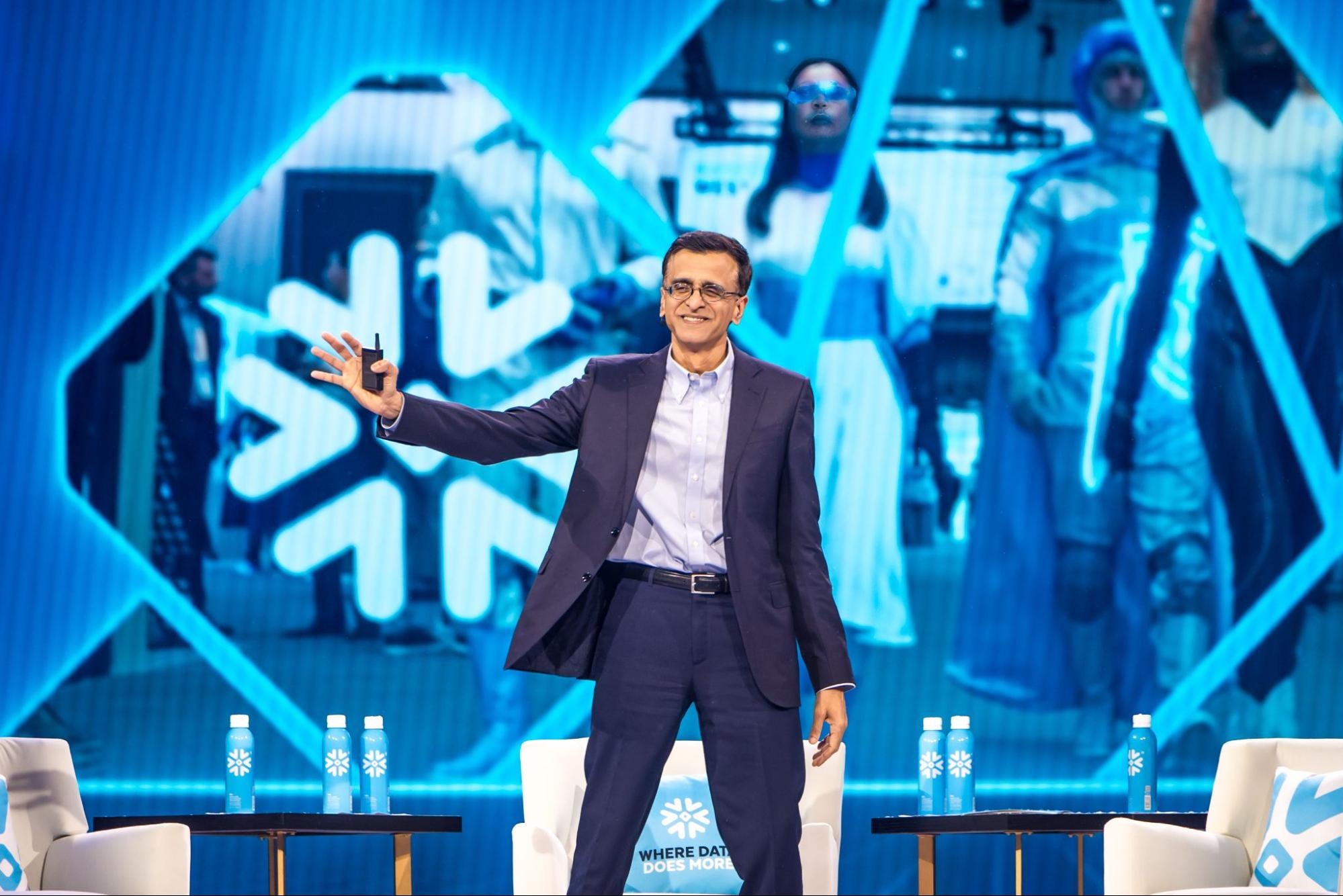
The bill still has to make sense
By August 2026, his public argument had become pointedly economic. Companies were spending on AI, he wrote, but usage itself was an input. The return needed to show up in faster work, lower costs or better products. A growing pile of tokens could describe activity without settling the question of value.
“Usage is an input,” he wrote. Snowflake’s announced response included dynamic model routing in Cortex AI Gateway: choosing among approved models according to a task’s requirements and the customer’s priorities around cost, speed and performance. The ambition was to take some of that selection work away from customers.
The connection with Neeva is an editorial one, but it is hard to miss. Both projects ask what the customer actually receives for the payment. At Neeva, the experiment concerned advertising and subscriptions. At Snowflake, the question concerns compute, models and measurable work. Ramaswamy has changed markets while retaining an interest in the relationship between a system’s economics and its usefulness.
What does the customer
get back?
An extra book, passed along
There is another line through the career, quieter than the product announcements. Brown lists Ramaswamy as a trustee for the 2021-27 term. IIT Madras’s 2024 account of his giving records support for research travel, Women Leading IITM and merit-based financial assistance. These are specific ways of helping students gain access to opportunities.
Under his leadership, Snowflake launched One Million Minds + One Platform in January 2025, backed by a $20 million commitment. Its stated goals included upskilling a million people in data and AI by 2029, with a nearer target of training and certifying more than 100,000 platform users by 2027 at no cost to learners. These are targets, rather than a count of completed achievements.
The student with the summer mathematics books now works at the other end of that exchange. Institutions, teachers and colleagues appear throughout his account of how he learned. His story leaves room for the people who made the next step possible, even when the next step involved giving up a title or admitting a business had reached its end.
Ramaswamy’s career offers several occasions on which he could have stayed with the thing he already understood. He has repeatedly chosen another problem. The consequences have included an enormous advertising operation, a discontinued search service and the leadership of Snowflake. Starting over, in his case, has meant carrying the useful parts of an education into a job whose answer is still being worked out.
Snowflake’s education initiative targets one million people upskilled by 2029. A stated goal, with work still ahead.
Follow the next question
Conversations, writing and the places to follow Ramaswamy.
- Official writing at Snowflake
- Twitter / X
- A conversation about Google, Neeva and Snowflake
- Listen: the economics of Google, search and Neeva
- Watch: Snowflake and enterprise AI with Matt Turck
- Watch: September 2026 CNBC conversation
- Read: the August 2026 argument for AI efficiency
- Read: Neeva’s acquisition announcement
- Read: IIT Madras’s account of educational giving