A user had managed to do several distinctly unromantic things in a few minutes: connect a data source, remove duplicates, clean the records and arrange for changes to keep flowing through. Amar Arsikere celebrated the result in a public post about a DataFoundry test drive. The exclamation marks were his. For most people, a successful afternoon does not involve schema synchronization. For the founder of Infoworks, this was something worth telling everyone about.
There is a revealing scale to that enthusiasm. Arsikere had already worked on enormous data systems at Google and Zynga. Yet the small demonstration offered a different kind of satisfaction: a person could get through a complicated sequence without spending an age assembling it. The impressive machinery had become an ordinary action. That was the proposition he had helped turn into a company.
His professional story runs through several changes in technology fashion: Bigtable, Hadoop, cloud migration and enterprise AI. Underneath those changes sits a practical question. How much work must someone do before the information a business already possesses becomes useful? Arsikere kept building around that question, even as the names on the boxes changed.
A search engineer enters the games business
At Google, Arsikere worked on data warehousing built on Bigtable. His later professional biography describes him leading engineering for an Enterprise in the Cloud initiative. The subject sounds abstract until you consider the purpose of a warehouse: putting information into a form that people can query and analyze. Vast storage is only the beginning of that job. The useful part arrives when somebody can ask a question and get an answer.
Zynga supplied a different setting for his infrastructure work. The company made social games; Arsikere helped build its large-scale database systems. A game presents its players with an inviting surface while an extensive technical operation keeps track of what they do. His conference biography credits him with founding Zynga’s Systems Engineering Group and leading the design and deployment of an in-memory gaming database.
The connection between those jobs is more interesting than a list of employers. Both put him close to the machinery required when information grows too large for comfortable improvisation. He had experience building within companies that depended on that machinery. The next step would ask whether a wider range of businesses could obtain similar capabilities through a product.
There was also a public teaching thread. In 2012, a NASSCOM game developer conference agenda paired Arsikere with Zynga colleague Karthik Viswanathan for a workshop on building mobile social games. Its brief emphasized the challenges of making games social. Years before his later AI workshop listing, he was already scheduled to help other developers work through the practical pieces of a system.
A company built around doing it again
In 2014, Arsikere and Buno Pati co-founded Infoworks. The early pitch applied a familiar idea from web search to the internal disorder of a business: software could discover and organize information automatically. Arsikere described a platform that crawled enterprise databases, brought the data into Hadoop and arranged it into warehouses and other analytical models. A company’s own records were the territory to be mapped.
The September 2015 funding announcement gave that idea a financial and organizational foothold. Infoworks raised $5 million in a Series A led by Nexus Venture Partners, with Knoll Ventures and others participating. Nexus managing partner Naren Gupta joined its board. The company had engineering operations in Bangalore and announced additions in product management and customer success. Arsikere was its CEO.
Those additions mattered to the kind of company he was building. Selling enterprise software requires a route from the engineer’s implementation to the customer’s daily use. Ramesh Menon came aboard to lead product management, and Jitender Nankani took responsibility for customer success. An automated platform still needed people who could understand what customers wanted from it and help them put it to work.
Infoworks expanded the scope of that automation across the data workflow. Finding a source was followed by bringing data in, preparing it, arranging transformations and managing the sequence of operations. Its DataFoundry product offered a graphical way into the process. The appeal was understandable: expertise about a business question could participate without every step becoming another bespoke programming assignment.
Arsikere discussed the approach with Ramesh Menon on the Big Data Beard podcast in 2019, and with Tobias Macey on the Data Engineering Podcast in 2020. The conversations covered enterprise complexity, data pipelines and the design of a unified platform. They place him in the middle of the engineering tradeoffs, explaining a product that had to simplify work while retaining the control large organizations required.
The founder changes chairs
On February 7, 2019, Infoworks announced that Pati would become CEO and Arsikere would take the roles of chief product officer and CTO. Pati had been chairman from the company’s inception and executive chairman since late 2017. David Dorman, the former AT&T chairman and CEO, joined as board chairman. The leadership structure was changing around a business preparing for its next phase.
Arsikere’s explanation was specific: the new role would let him concentrate on building the product and working with product, engineering and customer success teams. That is a useful detail in a founder’s biography because it gives the change an object. The work he publicly singled out was close to the software and the people making it useful.
It would be easy to turn the handoff into a miniature drama about founders and succession. The documented facts offer a quieter story. Two co-founders took different responsibilities. A new chairman arrived. Arsikere continued with product and technology. The continuity is visible in the subsequent releases and in his repeated explanations of why automation belonged across the workflow.
Moving day, with the lights still on
Cloud migration gave that argument another setting. An enterprise moving data out of an on-premises Hadoop environment could not assume that the old system would politely stop changing. Business continued while the move was under way. Infoworks Replicator addressed the problem with ongoing synchronization between the original environment and cloud clusters, alongside automated error handling and fault tolerance.
“Automation is essential to the success of any large-scale data migration.”
Amar Arsikere · Replicator 4.0 announcement, 2022
When Replicator 4.0 arrived in April 2022, Arsikere emphasized computing the changes and differences between the two environments. The detail explains why the work is more demanding than copying a very large file. A migration has to account for what happens while it is happening. Moving day becomes complicated when the furniture continues accepting new orders.
His writing that year connected automation to another limited resource: engineering time. In an April essay, he argued that scarce data science and engineering talent strengthened the case for automating migration work. The underlying organizational question was how to use capable people. Repetitive infrastructure tasks could absorb time that might otherwise go toward a new analytical project or application.
He made a related point on LinkedIn: organizations should separate their workloads from the compute infrastructure beneath them when planning a move to the cloud. Otherwise, he warned, migration could become a continuing project. This concern fits the company’s broader ambition. A successful transfer should leave the customer with a manageable way of working after the transfer is over.
The breadth of data sources created its own demands. By October 2020, DataFoundry supported nearly 200 sources, spanning the varied places where organizations kept information. More connections enlarged the territory the product could cover, but the intended experience remained simple enough to demonstrate. That earlier test-drive celebration, with its cleansed records and ongoing synchronization, gives the feature list a human scale.
The same question reaches AI
In June 2024, Infoworks introduced Infoworks AI. The product used a natural-language interface to help data professionals specify requirements and addressed exploration, preparation and integration. It also combined business-specific knowledge with technical metadata to support generated SQL. The familiar task of making information usable now had an interface shaped by generative AI.
The launch provides a concrete expression of Arsikere’s stated aspiration to broaden data access. Asking for data in everyday language could reduce one barrier, while the platform worked on the preparation beneath it. The idea still required an understanding of the business. A fluent request only becomes useful when the system can connect it to the right information and its meaning.
On December 5, 2024, Uniphore announced it was acquiring Infoworks alongside ActionIQ. Its plan brought data capabilities into an enterprise AI platform spanning data, knowledge, models and agents. Infoworks contributed technology for discovering, organizing, cataloging and cleaning enterprise data. Arsikere welcomed joining Umesh Sachdev and the Uniphore team in a public LinkedIn post.
The transaction makes sense as another chapter in this particular career. The surrounding product became an enterprise AI platform, and the underlying data work remained necessary. Public company directories subsequently listed Arsikere as Uniphore’s head of platform engineering. Alumable, an organization focused on preparing students for the AI era, also lists him as an advisor.
Three hours at the front of the room
A February 2026 event listing offered a smaller, more immediate task: an online workshop led by Arsikere, scheduled to take an AI application from idea to live demonstration in three hours. The promotional material paired a frontend built with Claude AI with a backend using Berry AI. The proposed audience included founders, builders and professionals developing their skills.
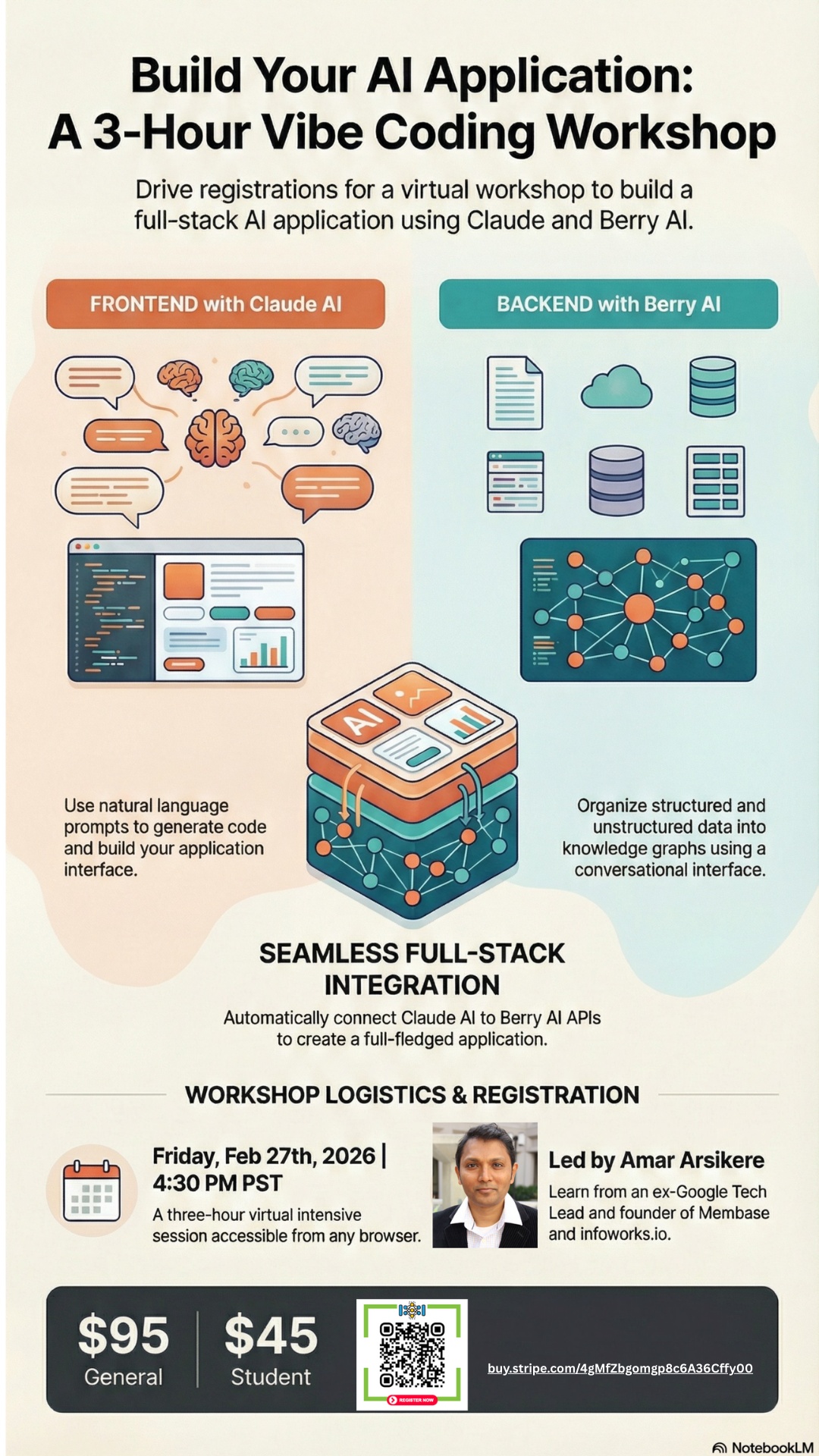
The listing is a fitting later scene for a career spent dealing with what sits underneath an application. Here, the pieces would be made visible to people watching a build. The format placed a practical limit on abstraction: by the end of the session, the advertised goal was a demonstration. Three hours leaves little room for admiring a diagram indefinitely.
Across these chapters, Arsikere’s public work returns to a recognizable ambition: give more people a usable path through difficult technical work. At Infoworks, that meant software that handled recurring data tasks. In a workshop, it meant showing the steps. The satisfaction in that old test-drive post is easy to understand. Someone had reached the useful part, and the machinery had helped them get there.