The first thing Neeva ran out of was not answers. It had plenty of those. By early 2023, its search engine could pull material from the live web and turn it into a short response with links back to the pages it used. It had a web index of its own. It could clear ads from a results page and block trackers as people moved across the web. What it could not reliably do was persuade a person to open the browser settings and make Neeva the place where the next question went.
That is an oddly human ending for a technically ambitious company. Neeva announced in May 2023 that it would close its consumer search product. The service ended on June 2; Snowflake acquired the company that same month. A search engine built to challenge the habits of the web became search technology inside a cloud data company. The useful lesson is not that privacy was unpopular. It is that desire and behavior are separated by a surprisingly stubborn menu.
- The offer: ad-free, tracker-conscious search with controls over sources and, later, AI answers with citations.
- The price: a free tier plus a US Premium plan priced at $4.95 a month in 2022.
- The snag: more than 600,000 users by October 2022, most on the free plan, and too few people making a lasting switch.
- The afterlife: Snowflake uses Neeva search and ranking technology in enterprise search products.
The ad chief who quit the ad bargain
Sridhar Ramaswamy had helped run Google’s advertising business. Vivek Raghunathan had led monetization work at YouTube. Together, in 2019, they founded a company premised on a rather pointed complaint: the company answering a query should serve the person who typed it, not the advertiser paying to sit above the answer. Neeva was a consumer search engine from people who knew, in detail, what the prevailing business model could earn.

The original promise was simple enough to understand in one glance. Search for a product and see results instead of paid placements. Look up a recipe without giving an advertising network a profile of your appetite. Adjust which sources appeared more often, or push unwanted sites down. A user could connect personal accounts and search across those alongside the public web. Neeva offered mobile apps and browser extensions, so its product was a search destination, a privacy tool and, in some cases, a way into a person’s own scattered information.
It was not wholly sealed off from the rest of search infrastructure. Neeva built an independent web index, while reporting in 2023 said it still used Bing for image and video results. That distinction matters. “Independent” described a serious investment in crawling and ranking web pages; it did not mean recreating every specialized search service from scratch.
A subscription against a reflex
Neeva launched in the United States in June 2021 with a subscription model, then added a free basic tier. In 2022, the US premium subscription cost $4.95 per month and included extras such as password management and a VPN benefit. Search itself carried no ads or affiliate links. The company’s commercial proposition was refreshingly legible: if users paid the bill, users were the customers.
The company raised $37.5 million in a 2020 Series A and $40 million in a 2021 Series B, with Sequoia Capital and Greylock among the investors. That capital paid for an expensive sort of ambition: a web index, search engineering, mobile products and the relentless small refinements that make a search box feel dependable. By October 2022, Neeva said it had more than 600,000 users and launched localized service in the UK, France and Germany. It also turned search history off by default, a small decision with a big implication for a product promising privacy.
A number like 600,000 sounds substantial until it is placed beside the job Neeva had chosen. Search is a daily reflex, often wired into the address bar before anyone makes an active decision. Most Neeva users were on the free plan. Later reporting on court testimony put subscription revenue below $1 million at the time the company closed. That does not prove people would never pay for search. It shows the gap between attracting curiosity and building enough paying, repeat use to support a costly general search engine.
“From the unnecessary friction required to change default search settings ... acquiring users has been really hard.”Neeva founders, in their shutdown announcement
The founders’ account is unusually precise about what failed first. Convincing some people to pay for a better experience was less difficult than getting people to try a different search engine at all. A customer might admire privacy, dislike ads and still use the familiar box because it is already there. Neeva had to win a sequence of decisions before it could prove its relevance: be discovered, be installed, become the default and remain the default.
- 01 Hear about a new search engine
- 02 Try a query there
- 03 Change browser defaults
- 04 Return by habit
The answer engine arrived before the audience
As conversational AI altered expectations of search, Neeva moved quickly. A beta of NeevaAI appeared in late 2022; in February 2023 the company expanded it internationally. The product synthesized a single answer from current web pages and linked to its sources. The point was practical: a result that summarized the web should also let a person inspect the web. This was a better format for questions that needed several pages, such as comparing products or understanding a topic. For a simple navigational query, ordinary links could still do the job.
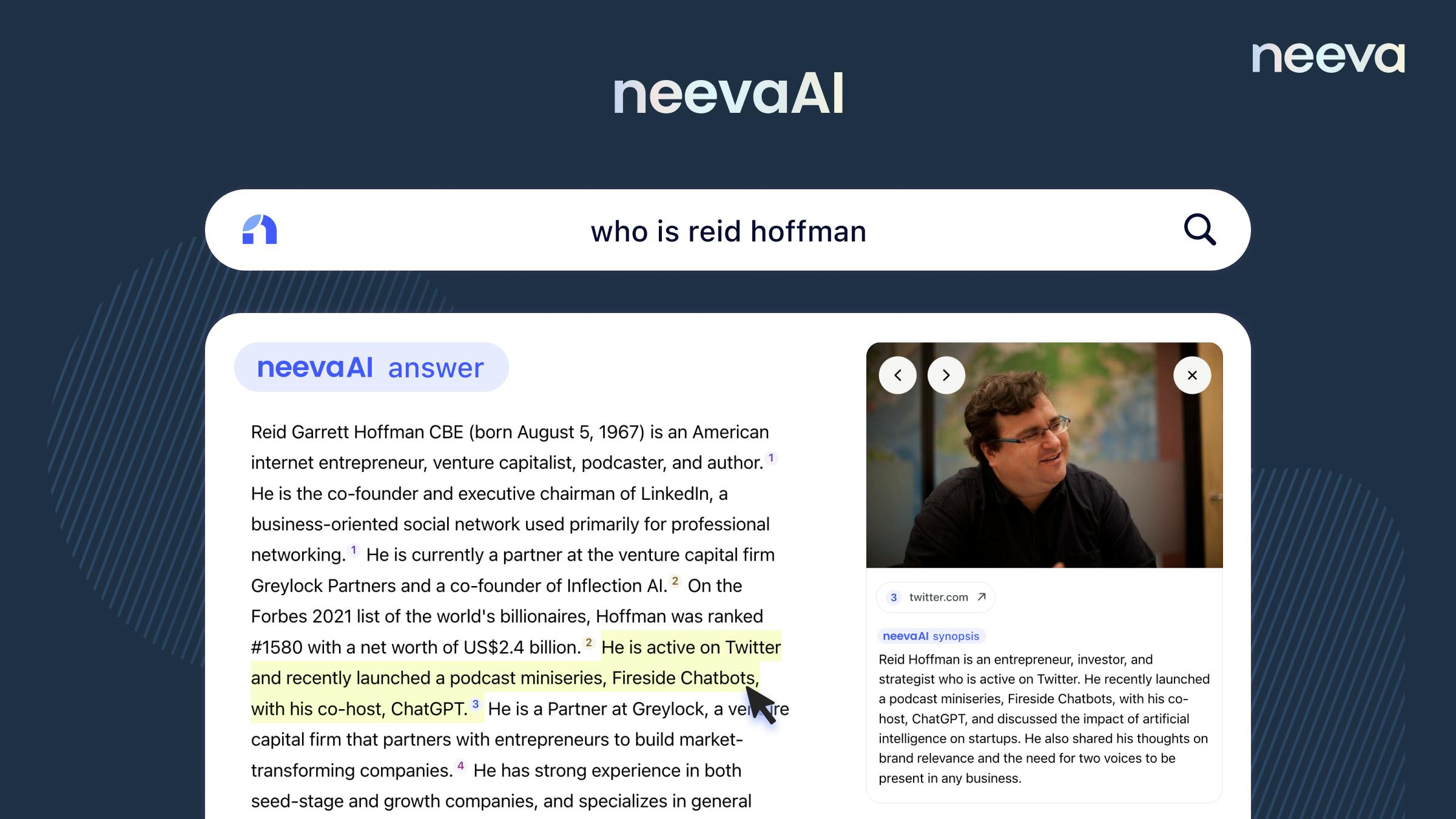
Yet the product shift did not remove the distribution problem. An AI answer still needed a query. By spring 2023, the founders said the economic environment, consumer growth and the rapidly changing search market left no sustainable route for the consumer business. They announced a move toward applying their search and language-model expertise for enterprises. Within days, Snowflake announced the acquisition. Its SEC filing initially described roughly $150 million in cash, subject to adjustment. Neeva refunded subscribers for unused service.
The search box moved to work
Snowflake’s interest explains the unlikely second act. Companies also have search problems, but their questions live inside documents, tables and governed data instead of the open web. In 2024, Snowflake identified Neeva retrieval and ranking technology in Cortex Search, its service for finding information in text data, and said Neeva technology helped power Universal Search across its data cloud. Ramaswamy became Snowflake’s CEO in February 2024; Raghunathan continued in engineering leadership. The consumer destination disappeared, while pieces of its machinery found a different customer.
There is a copyable method here. Neeva made a sharp promise, matched its revenue model to that promise, built an index where it needed control, and showed the source behind an AI answer. A new product team can borrow each of those choices. The more demanding lesson is to test the journey before budgeting for the destination. Ask users to make the actual default change. Watch where they stop. Measure whether they return without a reminder. If the product needs a daily habit and must compete with a preinstalled one, excellence in the result page may arrive too late to pay for itself.
Neeva is therefore a curious kind of defeat. It failed to become the search engine in most people’s browsers, yet it built technology another company wanted inside its own. It answered a great many questions. The one it could not answer quickly enough was where the next query would begin.