The first useful question was hardly cosmic. An employee wanted health insurance. Aravind Srinivas and his fellow founders needed to understand the vocabulary, the providers, the arrangements. In his account of Perplexity’s beginnings, they tried a chatbot in Slack. It answered. Some answers were wrong. A machine that spoke confidently had made a small company’s uncertainty harder to see.
Their response was borrowed from academic life: make the answer show its working. Retrieve material, use it to construct a response, attach citations. A footnote is an unusually modest thing on which to build a technology company. It is also a wonderfully pointed rebuke to a paragraph that expects to be believed because it sounds pleased with itself.
- The product: answers assembled from web sources, with links you can inspect.
- The customer: a curious consumer or a professional who pays to spend less time assembling research.
- The expansion: enterprise tools, developer APIs, an AI browser and software that carries out work.
- The wager: subscriptions can support trusted answers, while publishers still need to be paid.
01The footnote becomes the product
Perplexity describes itself as an answer engine. Ask a question in ordinary language and it searches for relevant material, then uses a language model to produce a response. The small citation numbers connect the response to pages behind it. Follow-up questions let the inquiry continue without starting again from a blank search box.
The work it sells is the assembly. A conventional search can leave you reading five pages, remembering which date belonged to which claim, and translating the result into a useful comparison. Perplexity attempts that middle step. A student exploring a subject, a developer checking documentation or a researcher comparing company announcements can start with a synthesized account and inspect the supporting links.
“all the answers are backed by sources”
Aravind Srinivas · Lex Fridman interview, June 2024
That was Srinivas’s description of the design. The distinction matters: sourcing is a feature you can examine, rather than a certificate that the conclusion is correct. A link can be relevant but old. A source can be accurately quoted and still unreliable. Combining two sound observations can produce an unsound inference. The footnote supplies a place to begin checking.
- 01AskDefine the question
- 02RetrieveFind web evidence
- 03SynthesizeBuild the response
- 04InspectOpen the citations
Its competitive position has narrowed as rivals have added their own web-grounded answers. Google, ChatGPT, Gemini and Copilot give users alternatives. Perplexity’s case rests on the research experience as a whole: retrieval, source visibility, follow-up and tools for turning material into work. Owning every underlying model is unnecessary if the finished service earns a place in someone’s routine.
02A search box acquires ambitions
The company began in 2022 with Srinivas, Denis Yarats, Johnny Ho and Andy Konwinski. Their backgrounds ran through AI research and software companies including OpenAI, Meta, Quora and Databricks. One early experiment, BirdSQL, translated natural-language questions into database queries over Twitter data. It gave the team a bounded place to demonstrate a new way of asking.
Srinivas recalled a less comfortable demonstration in a 2023 Forbes interview. After agreeing funding terms with NEA, he and Yarats saw leaked screenshots of Bing’s chat interface. They worried their investor would retreat. Pete Sonsini called with reassurance: “We trust you, you’ll figure it out.” The incumbent’s arrival was frightening because the idea was plausible enough for an incumbent to want it.
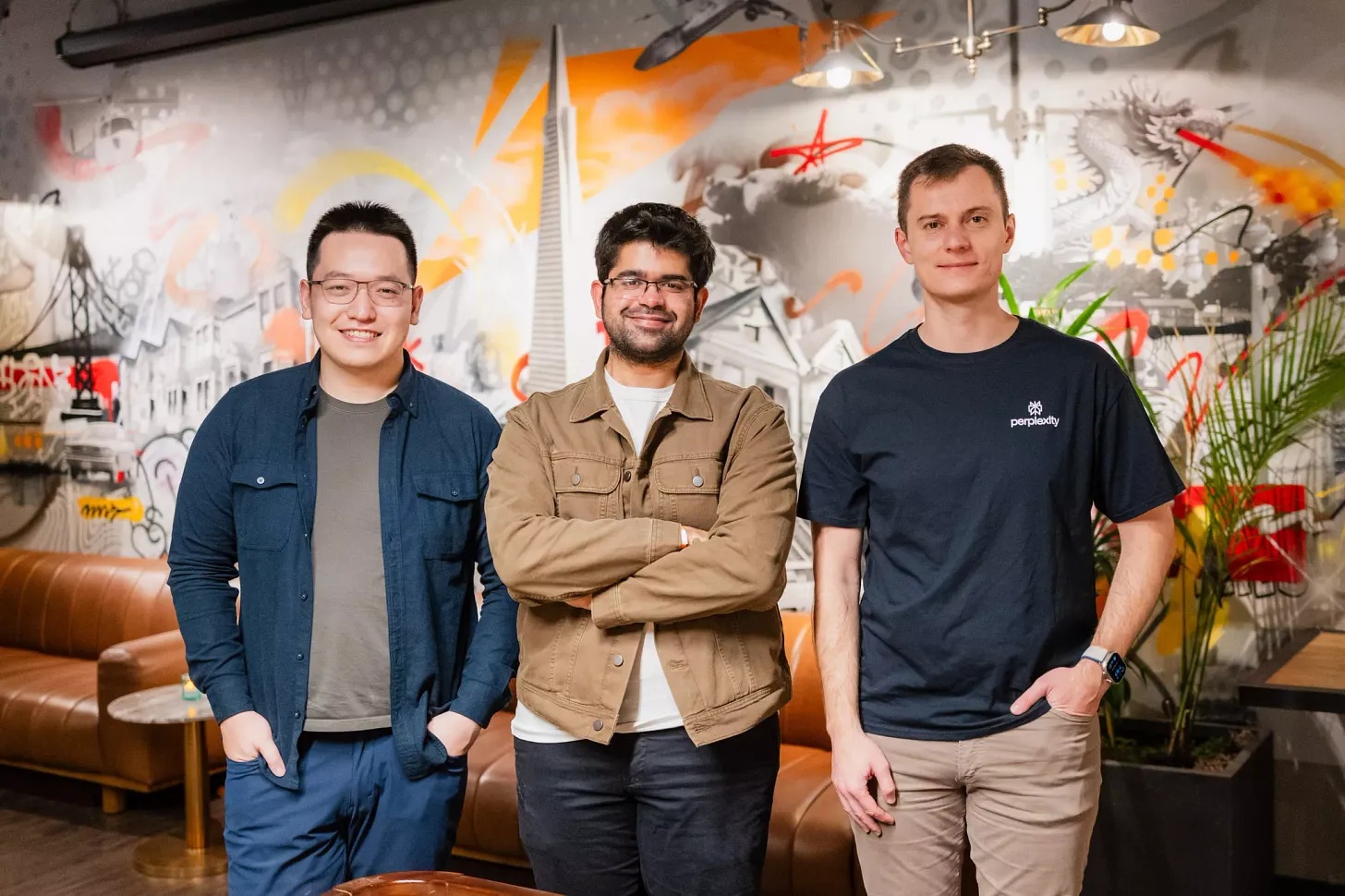
By January 2024, Perplexity reported 10 million monthly active users and more than half a billion queries during 2023. Those are historical company figures. In April 2024, Enterprise Pro introduced a business offering with privacy and access controls. The customer question had changed from finding a public answer to making research useful inside an organization.
Deep Research followed in February 2025, conducting a longer investigation and compiling a report. Sonar supplied web-grounded answers through an API, allowing developers to put the capability inside another product. Zoom was an early integration. SoftBank began selling Enterprise Pro to Japanese businesses in March 2025, extending a relationship that had already included consumer distribution.
Comet arrived in July 2025. An assistant inside the browser can help interpret pages and carry out browser tasks. Computer, introduced in February 2026, goes further: it plans work and coordinates models and tools to create deliverables. Perplexity’s explanation says it launched with nineteen models available behind the scenes. The expertise being sold is increasingly coordination.
The September 2026 hybrid compute release makes that coordination physical. On a compatible Mac, cloud models handle planning and web research while local models handle sensitive steps. A privacy gate controls what information may leave the machine. Perplexity lists Apple silicon, macOS 15 or later and at least 24GB of unified memory as requirements. The old question, “Where did that answer come from?”, now has a companion: “Where did my file go?”
03The bill arrives at the answer
Core search is free. Perplexity publicly lists Pro at $20 a month or $200 a year, with broader research and file capabilities. Max serves heavier users; enterprises buy organizational subscriptions. Developers pay for API usage. These customers have different budgets, but the recurring proposition is saved effort on information work.
Perplexity Pro · or $200 per year
Public US pricing at research time. Feature allowances and other plans have separate terms.There is a substantial cost behind the convenient paragraph: retrieving pages, running models and maintaining the service. API billing makes part of that visible through model usage and tool charges. A profitable consumer subscription has to accommodate those costs without making the product so restricted that the subscriber returns to an alternative.
Venture capital financed the expansion. The announced Series A in March 2023 was $25.6 million, led by NEA. January 2024 brought a $73.6 million Series B led by IVP, with NVIDIA and Bezos Expeditions among participants. Such backing buys time to develop the system. It does not establish that answering a question makes money.
The telling reversal came in February 2026. Executives told reporters the company was stepping away from advertising after experiments begun in 2024. WIRED reported their concern that ads could weaken trust and their renewed emphasis on paying customers. An answer business can lose value when readers suspect its conclusions serve a sponsor. Choosing subscriptions makes the person asking the question a more direct customer.
04The people behind the footnotes
The information has another bill attached. Somebody interviewed the executive, tested the product or assembled the data. If an answer satisfies a reader before the reader visits the original page, the publisher may lose the visit that helped pay for that work. Perplexity’s convenience therefore depends on a supply of material whose economics it can disturb.
Its July 2024 publisher program named TIME, Der Spiegel, Fortune, Entrepreneur, The Texas Tribune and WordPress.com as initial partners. In August 2025, the company announced Comet Plus with a proposed 80% share of subscription revenue for participating publishers. Axios reported a $42.5 million initial compensation pool. The size of the promised share is only part of the story; the revenue being divided must grow large enough to matter.
Other publishers took a legal route. Dow Jones and the New York Post sued in October 2024, alleging unauthorized copying. The allegations are contested claims, rather than findings this profile can pronounce settled. They expose a distinction a tidy interface can hide: being able to retrieve material and cite it does not settle every question about permission or compensation.
05Give it a question worth answering
The useful habit is to give Perplexity a bounded assignment. For a software comparison, specify the budget, required features and date. Ask for original documentation and disagreements between sources. Open the citations behind consequential claims. Then request a table that separates documented capabilities from assumptions. This is an illustrative workflow, not a claim of measured savings.
Thin evidence produces thin research, however handsome the report. Paywalled information, missing data and an ambiguous question can leave important gaps. A fluent response can make those gaps harder to notice. Use the product to organize an investigation, and preserve the decision about whether its evidence is sufficient.
Automation adds a different limit. In August 2025, Brave’s security researchers documented an indirect prompt-injection attack against Comet: malicious webpage text could be treated as instructions. Brave is a browser competitor, which is relevant context for its report. The demonstrated failure concerns the boundary between reading a page and obeying it. Tasks inside logged-in accounts deserve review and constrained permissions.
Perplexity’s practical lesson travels beyond its own product: attach evidence to claims and put the evidence close enough to examine. The company began with an answer it could not trust. Its next test is whether it can keep that useful skepticism alive while doing more of the work itself. An excellent assistant should make the reader better informed, including about the assistant.