In late 2020, Texarkana, Texas, had a software decision to make. The city was preparing to upgrade a server-based system. Then came a ransomware attack. “We lost all our financial data,” assistant chief financial officer Jodie Lee recalled in a Springbrook case study. An upgrade became a reconstruction. The city chose Springbrook’s cloud platform.
- Springbrook connects government finance, utility billing, payroll and payments.
- Its customer stories turn on practical problems: lost records, manual handoffs and aging systems.
- The buying decision includes conversion work, recurring fees and the fit of existing workflows.
The revealing detail is how the rebuilding worked. Staff converted old reports into spreadsheets, imported records and reconstructed payroll one pay run at a time. Cloud payroll went live in April 2021. Moving the application changed where it ran; finance and HR specialists still had to rebuild what it knew.
“It’s nice not having to learn a whole new system.”
Jodie Lee · Texarkana, Texas
Springbrook customer case study
Every water bill has a backstage
Springbrook occupies a corner of technology most people encounter without noticing. A resident pays a utility bill. Elsewhere, someone must post the payment, reconcile the bank deposit and account for the money. A good-looking payment screen solves only the first part. The interesting work lives in the connections behind it.
Established in 1985, Springbrook built its early business around government accounting and utility billing. Today, its customers include municipalities, water agencies and fire districts. The company reports more than 3,000 agencies across its products. The audience matters: a small finance department needs public-sector accounting without becoming a software integration shop.
Cirrus, introduced in 2021, is its cloud ERP platform. ERP means enterprise resource planning, an impressively dull name for keeping an organization’s financial and administrative work together. Springbrook’s version combines fund accounting, payroll, budgeting, utility billing, tax and payments. Tableau supplies reporting and analytics. Staff can reach the software through a browser.
- 01Issue
the bill - 02Receive
payment - 03Post to
the ledger - 04Reconcile
the bank
The resident sees one step. The finance office owns the whole chain.
The expensive space between systems
This puts Springbrook in the municipal software market alongside alternatives such as Tyler Technologies. Its pitch is the combination of government-specific workflows and a multi-tenant cloud service: customers use shared application infrastructure, with updates handled centrally. The claimed benefit is less local hardware administration and fewer disconnected processes. Whether that combination fits is a procurement question, not something a cloud label settles.
At Rogue Valley Sewer Service in southern Oregon, the case for connection was pleasantly concrete. Its Springbrook customer account describes replacing fragmented finance and billing tools with an integrated suite, utility billing and CivicPay. Electronic exports replaced in-house bill printing and cutting. The utility reported completing billing in less than half the previous time. That is a customer-reported result, tied to a particular workflow.
Another customer, Eagle Mountain, Utah, offers a smaller, useful distinction. Its published case study describes real-time integration between Springbrook and Xpress Bill Pay. Staff previously checked two screens when answering account questions. Faster payment visibility helped, especially around shutoffs. The account explicitly says this did not dramatically change workflows or reduce staffing. Sometimes the improvement is simply knowing whether someone has paid.
The cloud comes with an invoice
Springbrook sells software through agency contracts, with recurring subscriptions and separately scoped services. Data conversion and training belong in the calculation. Chanhassen, Minnesota, provides a historical example. Its March 2021 staff proposal put the cloud upgrade at approximately $18,000 more annually, plus implementation and conversion services of up to $8,000.
Chanhassen cloud upgrade proposal. Historical, agency-specific figures.
The reason for moving was equally specific. Chanhassen had delayed upgrades while anticipating a replacement system. Its staff report described aging hardware that prevented integrations and a software version missing newer workflows and analysis tools. Waiting had its own operating cost: staff time spent bridging gaps manually. The proposed upgrade addressed those immediate constraints while preserving a later decision about the larger system.
The city expected savings on hardware and IT work. Its proposed $35,000 first-year cap also covered prorated costs for a separate ClearGov budgeting product. More revealingly, the upgrade bought time while staff considered other vendors. It was a practical bridge. That is a useful corrective to software marketing’s preference for permanent happy endings.
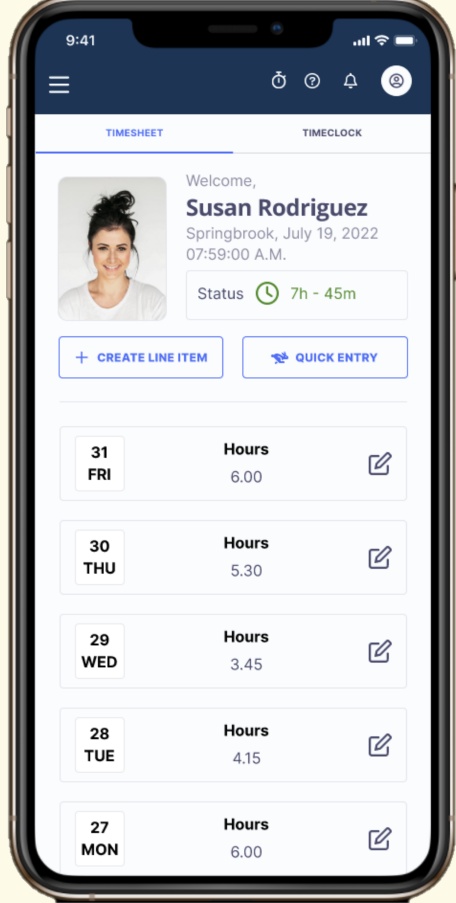
The timesheet
leaves the desk.
Screen shows demonstration data.
AI gets a very specific desk job
In January 2025, Springbrook introduced an AI Document Reader for invoices. Upload a document and the tool extracts vendor details, amounts, invoice numbers and dates, then matches the vendor record. The user selects the general-ledger account. Springbrook says customer invoices are not used to train models. The attraction is easy to understand: less transcription before the accounting work can proceed.
The product boundary keeps expanding. Asset Management arrived in October 2025. Cirrus Permitting & Land Management launched in March 2026, covering applications, planning, zoning, inspections and code enforcement, with citizen access and mobile inspection tools. These additions carry the same proposition further into city hall: information should move with the work.
Buy the handoff, not the slide deck
Springbrook has changed hands, too. Accel-KKR acquired it from Accela in 2020; Five Arrows bought a majority stake in 2024. MAGIQ’s 2021 acquisition expanded its international reach. Chris Dinkler succeeded Rob Bonavito as CEO in December 2025. Training remains visible in the company’s customer programs, including its annual Activate gathering.
Springbrook Express addresses another part of the market: small towns, special districts and cash-basis governments. It packages finance, payroll and utility billing with training and support. That separate offering is a reminder to start with how an agency keeps its books. A product’s breadth matters only when its accounting model and daily routines match the people using it.
For buyers, the copyable lesson is to demonstrate a whole transaction. Bring a difficult bill, an approval exception and a bank reconciliation. Ask who owns each handoff and what conversion requires. A publicly filed Springbrook statement of work excludes custom development from that engagement. Agencies needing bespoke behavior must resolve that fit before signing.
Texarkana’s experience supplies the harder test: what happens when ordinary work becomes impossible? Its recovery depended on records, people who understood them and a platform they could use. For a company selling the machinery behind government, that is a much more interesting demonstration than a dashboard.