At Ciena, a company that builds optical networking technology, unused airline tickets worth hundreds of thousands of dollars were being tracked in Excel. Think about that little administrative arrangement. A business helping other businesses move information around the world was keeping travel credits in a spreadsheet. Its booking systems were fragmented by region. Reports needed manual consolidation. The trouble was accumulating between the systems.
- Spotnana supplies the booking engine, trip data and tools behind other companies’ travel services.
- Travelers and agents work from the same platform, making changes easier to coordinate.
- Its appeal depends on the content, service and commercial terms a particular partner delivers.
Spotnana’s proposition begins in that gap. The New York company builds travel infrastructure: software that agencies, corporate travel programs and financial platforms use to sell and manage trips. You may encounter its technology through Brex or a travel management company. The name above the booking screen can belong to somebody else.
A cereal-box education
The story has an appropriately peculiar beginning. In an account published by seed investor Arjun Chopra, Sarosh Waghmar’s earlier startup failed during the dot-com collapse. Waghmar began a Yahoo Group called Spotnana, helping people find travel deals and redeem rewards. He pursued airline miles through promotions involving Kellogg’s Special K boxes. Travel was a puzzle, and he was learning where the pieces connected.
He subsequently built WTMC, a corporate travel management business. That experience exposed the systems behind the itinerary: suppliers, distribution networks, agency tools and the workarounds needed to connect them. His conclusion was architectural. Better service would require rebuilding the foundation. With co-founder Shikhar Agarwal, he began work on the modern Spotnana in 2020. The platform emerged publicly in September 2021.
“I started Spotnana along with my co-founder Shikhar Agarwal to rebuild the infrastructure of travel”Sarosh Waghmar · Introducing Spotnana, 2021
One trip, one shared picture
Consider a flight change. The traveler needs a new departure. The agent needs the ticket rules, company policy, available credit and payment details. If those facts sit in separate places, somebody must reconcile them. Spotnana brings traveler and agent onto the same platform, with access to the same trips, profiles, policies and content.
Underneath sits a booking engine that automates tasks such as exchanges and unused-ticket handling. A central system of record holds travel data. APIs let partners connect other software or embed travel within their own products. White labeling lets them supply their own branding. Spotnana’s expertise lies in connecting shopping, ticketing, servicing and reporting - the unglamorous sequence that turns a search result into a manageable journey.
The spreadsheet gets a challenger
Ciena selected Solutions Travel as its agency and adopted Spotnana after a competitive evaluation. Its published case study reports online booking increasing from 65% to 90%, alongside 99% policy compliance. For a program with roughly 2,500 travelers and $28 million in travel spend, getting employees to use the tool was consequential. These are results reported in a vendor-published customer account, rather than a promise for every buyer.
Qualtrics offers a second test. Its published case study describes an analysis showing airline costs 9% lower and hotel costs 4-5% lower than alternatives reviewed. Access to airline offers through New Distribution Capability, or NDC, mattered to its decision. That comparison suggests a useful buying habit: compare actual itineraries and servicing capabilities. A negotiated rate tells only part of the story.
The customer behind the customer
The distribution model makes Spotnana interesting. Direct Travel uses its technology for Avenir. Brex incorporates it into its travel offering. JTB Business Travel is a partner. These businesses have their own relationships, service teams and reasons for selling travel. Spotnana supplies infrastructure that can support them.
That puts it in a different position from a straightforward corporate booking app. A company comparing Navan or SAP Concur is evaluating a travel experience; an agency evaluating Spotnana is also deciding which machinery to run. Its cloud platform includes agent queues, configurable fees, workflow automation and analytics. Expense management can come through integrations with other providers.
There is an experienced travel software operator at the controls. Steve Singh, Concur’s co-founder, now serves as Spotnana’s Executive Chairman and CEO. Waghmar leads product as Co-Chairman and Chief Product Officer; Frank Pelzer is President and COO. Their challenge is to make a common platform useful to partners that still need to compete, differentiate their service and keep their own customers.
Building this foundation took capital. Spotnana disclosed $41 million across seed and Series A funding at launch, then announced a $75 million Series B in July 2022 led by Durable Capital Partners. Those amounts describe investment, not the customer’s bill. Current corporate pricing is set by TMC partners. Expensify’s published terms, for example, specify a $25 live-agent modification fee per trip, separate from its booking fee. That is one channel’s arrangement.
More of the journey comes aboard
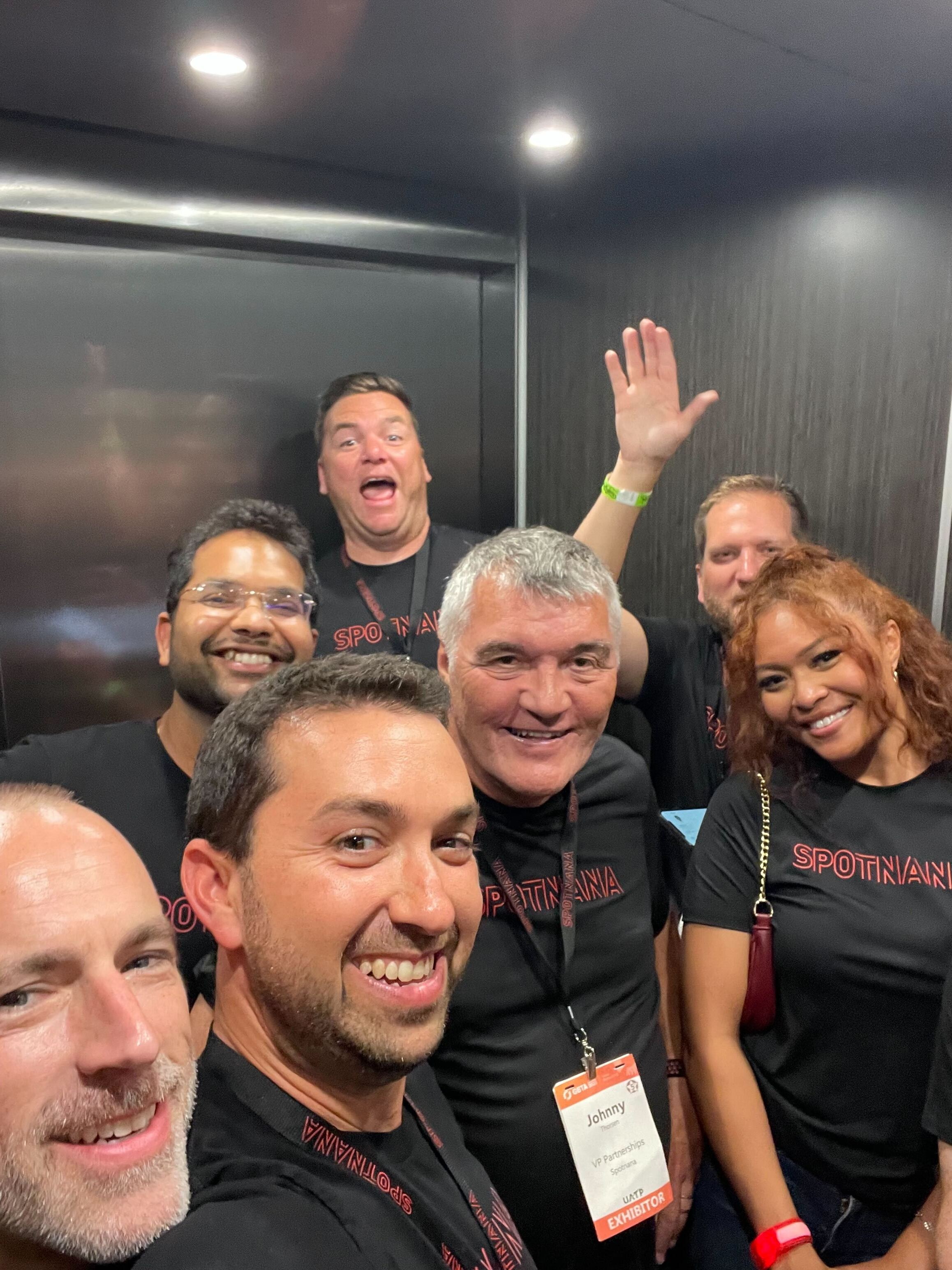
The people building it call themselves Spotters. More than 250 gathered in Dubai for the four-day Converge 2024 offsite. Waghmar even designed a dinner tasting menu. The company also refreshed its values through employee surveys and cross-functional discussions. For a distributed travel business, meeting in person doubles as a demonstration of the product’s purpose.
In 2026, the platform expanded further. July brought specialized AI agents tied to defined APIs and workflows. August brought the acquisition of meeting-planning platform TROOP. September brought a direct connection to Marriott’s reservation system, including authenticated Bonvoy account linking. Each development brings another task or relationship closer to the same underlying infrastructure.
The lesson a buyer can copy is modest: test the handoffs. Ask an agent to change the booking you just made. Check whether the credit, policy and reporting stay connected. Then check your actual routes, countries and support terms. A platform strategy depends on those details; it cannot make an unsuitable service contract or missing supplier connection disappear. The spreadsheet at Ciena is a useful place to begin that conversation.