Michael Share needed someone on the phone the next morning. A colleague had quit midway through a project, and he called Brook Armstrong with a recruitment pitch considerably shorter than the average job description: join the calls, get involved, and “get stuck in and act like you know what you're doing.” It was an economical introduction to corporate travel. There would be plenty of time to discover how complicated everything was.
Share brought Armstrong into the industry in 2015. Two years later, they founded Blockskye. Today they share the chief executive role at a Boston company connecting corporate travel bookings, payments and data. Behind that description sits a career spent understanding the agencies, airlines and commercial relationships that make a business trip possible. Share had already helped build a substantial agency business. Starting again meant applying that experience to arrangements his new company wanted to change.
A president before the platform
By July 2002, Share was president of Advanced Travel Group, a New York corporate travel agency. That month, Advanced joined Sea Gate Travel Group. Share became president of the combined business, with Dan Green as chief executive and Vic Ascrizzi as chairman. The three were its owners. This was a merger of businesses with offices, customers and complementary capabilities, rather than a plan awaiting its first customer.
The companies expected more than $650 million in total annual volume, including over $500 million in air sales. Sea Gate supplied infrastructure and online booking expertise; Advanced contributed sales, marketing and meetings business. The combined operation placed fifteenth on the contemporary ranking of U.S. agencies. Its footprint extended beyond New York to Charlotte, Houston, Los Angeles and Long Island. Share was working at the point where selling travel meant coordinating an organization capable of delivering it.
In April 2005, Hogg Robinson acquired Sea Gate. The purchase price was undisclosed. Sea Gate had recorded $730 million in sales in 2003, and the buyer retained its management. Share was identified with sales and marketing as the business entered the new ownership. The transaction put the agency inside a wider international travel group, where relationships and technology could travel across borders along with the customers.
Those numbers belong to the agency, of course. They describe the scale of the operation in which Share worked, rather than his personal proceeds. They also establish something useful about his later venture: he arrived with experience of combining businesses, serving corporate accounts and selling within the agency model. His familiarity with that model preceded his objections to it.
The fare on the other screen
A corporate booking system has a particularly awkward rival: the airline website open beside it. By 2023, Share was discussing the uncomfortable conversations agents faced when travelers checked their quotes elsewhere and found lower prices. An agent could be doing the job properly and still look like the person standing between a customer and a better deal. Explaining the distribution system rarely improves that conversation.
Share supported New Distribution Capability, or NDC, the airline distribution standard intended to bring richer offers and services into sales channels. His stated attraction was practical: “better technology, better content and better access to what travelers want.” Training and changes to established workflows would take effort. He argued that agencies should make the adjustment rather than assume the way tickets had always been sold was permanent.
That is a revealing position for someone with his background. Share was addressing the work agents actually perform: finding a fare, handling the extras and changing a reservation when plans unravel. His interest in distribution technology can be read through those tasks. A traveler comparing two prices has little reason to care which technical standard produced them. The discrepancy itself becomes the verdict.
“better technology, better content and better access to what travelers want.”
Michael Share · on the appeal of NDC, 2023
Getting the ticket and the money to agree
Blockskye’s early work reached into settlement, the process by which money and transaction records catch up with a booking. In January 2019, Airlines Reporting Corporation announced a completed proof of concept with United Airlines and Blockskye. It tested a private blockchain for reporting and settling direct ticket sales. The experiment placed the company alongside an airline and the organization already operating a major part of travel’s settlement machinery.
In April that year, ARC invested in Blockskye. The ticket test had tracked the journey from issuance through settlement and recognized modifications using smart contracts. Share, then described as president and co-founder, emphasized corporate buyers’ demand for different ways to book and account for travel. The order mattered: there was a transaction problem to test, followed by an investment in the business attempting to solve it.
A shared transaction history connects the booking to what happens next.
For Share, this work extended the agency problem into the accounting department. Selling a ticket starts a sequence. A change, cancellation or unused credit can leave several organizations keeping their own records of the same trip. Blockskye’s approach connects those events through a shared ledger. Its usefulness depends on the people who need the records being able to act on them.
A familiar search box, different arrangements underneath
In September 2023, KAYAK introduced its Enterprise platform with Blockskye supporting direct payments. Flight expense reports could be eliminated within that arrangement, and employees could change reservations in the app. KAYAK also offered round-the-clock agents when needed. The partnership paired a familiar way to search for travel with different arrangements for paying and servicing it.
It is easy to overlook the human negotiation inside such a product. Employers want visibility and control. Employees want convenient booking, useful fares and their loyalty benefits. Airlines want a relationship with the customer. Share’s company was attempting to connect these interests closely enough that using the corporate program would feel reasonable to the person actually boarding the plane.
In 2024, weather disruptions supplied a demanding test. Blockskye reported that 99.5 percent of affected KAYAK for Business travelers on Connected Supplier itineraries during hurricanes Helene and Milton canceled or rebooked digitally. That figure describes a defined group of disrupted itineraries, rather than all customers or every kind of trip. Share treated the result as evidence that travelers could make changes quickly through the connected platform.
By February 2025, Share confirmed that Deloitte had signed with Blockskye and KAYAK BTX for travel technology and servicing. PwC’s U.S. program was already an established customer. Large corporate accounts brought the venture into a different conversation: whether the approach could handle organizations whose travel requirements extend well beyond a neat booking demonstration.
People still have to pick up the phone
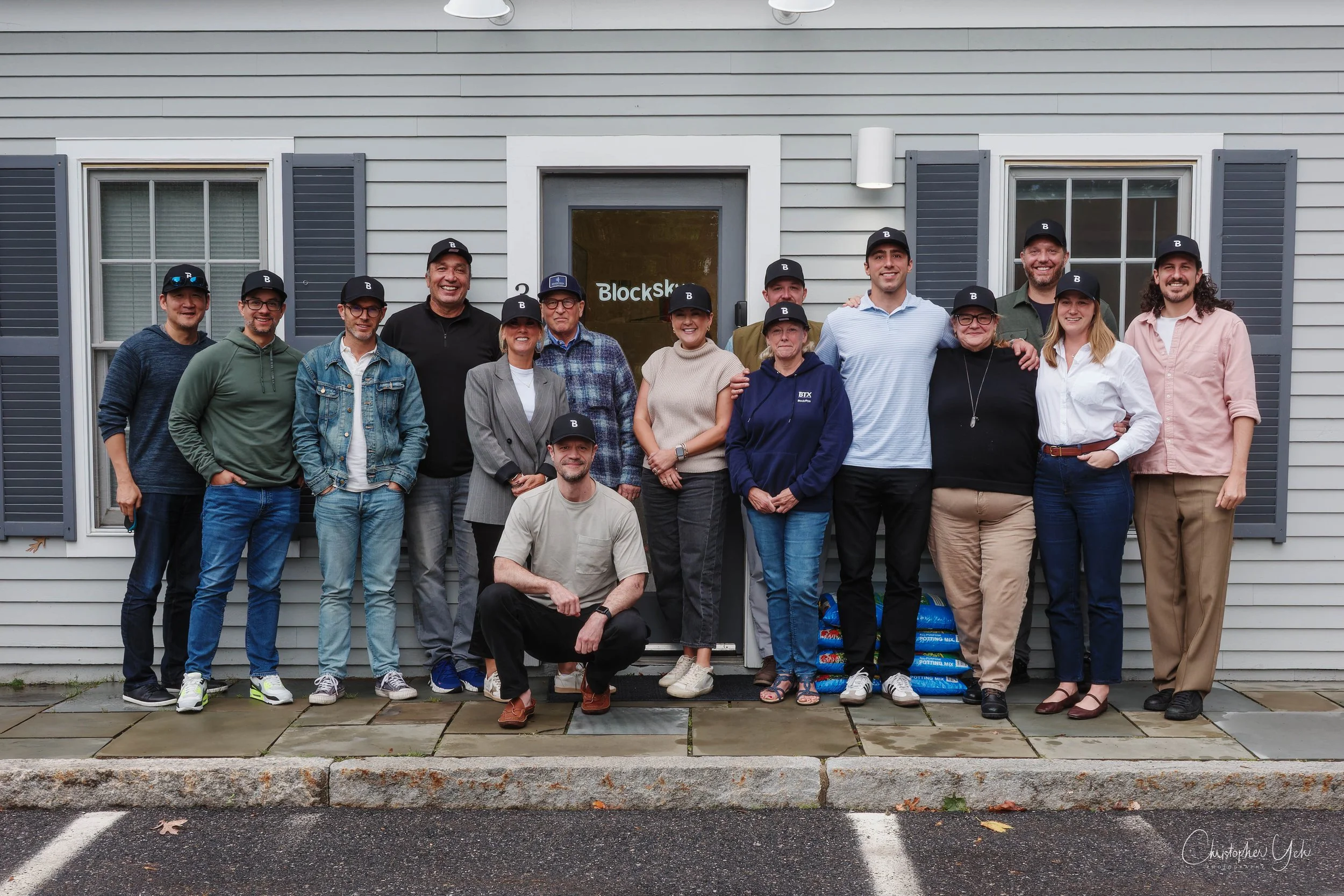
Share’s network remained part of the story. ALTOUR president Gabe Rizzi described a working relationship stretching back roughly a decade through a venture called Next Corporate Travel. Share handled account management and sales while the partner supplied fulfillment. Diageo and Tripadvisor were among the accounts they worked on. A new technology business could therefore draw on relationships formed while doing the older, less glamorous work.
In April 2025, Blockskye and KAYAK for Business selected ALTOUR as a global agency partner, describing support for enterprise clients operating in more than 80 countries. Share emphasized the importance of a trusted partner with international reach. The agreement addressed a basic obligation: somewhere, when software and self-service reach their limits, a traveler still needs help.
Blockskye was also assembling experienced executives. Hank Benedetti, previously American Airlines’ head of corporate sales, became chief commercial officer in July 2024. Erik Magnuson joined as chief operating officer after senior work at CWT. These appointments brought supplier relationships and operational experience into the same organization as the platform. Share’s earlier career had already demonstrated how much a travel business depends on both.
The loyalty points belong in the discussion
In February 2025, Blockskye introduced B360, designed to let companies permit consumer credit cards within managed travel while preserving reporting and corporate oversight. United was the intended launch supplier under an agreement in principle. The proposition recognized an incentive travelers understand without a training session: the value of the rewards attached to how they pay.
In July 2025, Blockskye announced a $15.8 million funding round led by Blockchange, with investors including United Airlines Ventures. The company planned to use the money for payment products, international expansion and its team. At that point it reported $33 million raised in total. The funding enlarged the resources available to pursue the model; the harder operational work still lay in connecting it to customers and suppliers.
A question worth asking before signing
In May 2026, Blockskye, FCM and KAYAK for Business announced plans for a joint enterprise offering. The proposed division of labor was straightforward: Blockskye for data and payments, KAYAK for booking, and FCM for global service. FCM’s footprint covered more than 95 countries. Its parent, Flight Centre Travel Group, also invested in Blockskye. The announcement described a product under development, with availability details to follow.
Share’s wider working life includes mentoring Harvard Business School students in entrepreneurship and independent projects, a role he lists from January 2012. His LinkedIn profile lists French, Spanish and English, alongside study at Paris-Sorbonne in 1983-84. These are small details beside the corporate transactions, but they place him in classrooms and conversations as well as commercial negotiations.
At Business Travel Show America in October 2026, Share urged travel managers to ask their agency a direct question: “How do you make money on my travel program?” It fits a career that has moved from running an agency to challenging its commercial arrangements. Before another booking interface or payment proposal earns its place, he wants the buyer to understand the business behind it. The question is short enough to remember. Answering it may require a longer meeting.
Continue the conversation
Michael Share · travel, payments & people
Michael Share on LinkedIn ↗Explore Blockskye ↗The founders’ account ↗The 2002 Sea Gate / Advanced merger ↗KAYAK’s Enterprise introduction ↗The FCM + KAYAK partnership announcement ↗