Company Dossier
Fintech · Consumer Credit Infrastructure
Est. 2019
Spinwheel
The debt side of your financial life finally has an API - and it needs just two things about you to find it.
The debt side of your financial life finally has an API - and it needs just two things about you to find it.
Here is a fact about consumer finance that sounds obvious once you say it out loud but that almost nobody built a company around: the interesting part of a person's financial life is not the money they have. It is the money they owe. Your checking balance is a number that mostly sits there. Your debts - the student loans, the credit cards, the auto note, the mortgage - are the things that move, compound, and quietly govern whether you can buy a house or refinance or breathe. For roughly a decade, fintech's favorite trick was connecting your bank account. Spinwheel went and connected the other side.
Spinwheel is an Oakland-based infrastructure company, founded in 2019, that sells APIs to other financial companies. The APIs do a deceptively simple thing: they find, verify, and act on a consumer's debts. A lender or a budgeting app or a debt-management firm plugs Spinwheel in, and suddenly it can see a user's full liability picture - balances, servicers, rates, due dates - and, crucially, send a payment against it. This is the sort of plumbing that is enormously valuable precisely because it is annoying to build, which is a theme we will return to.
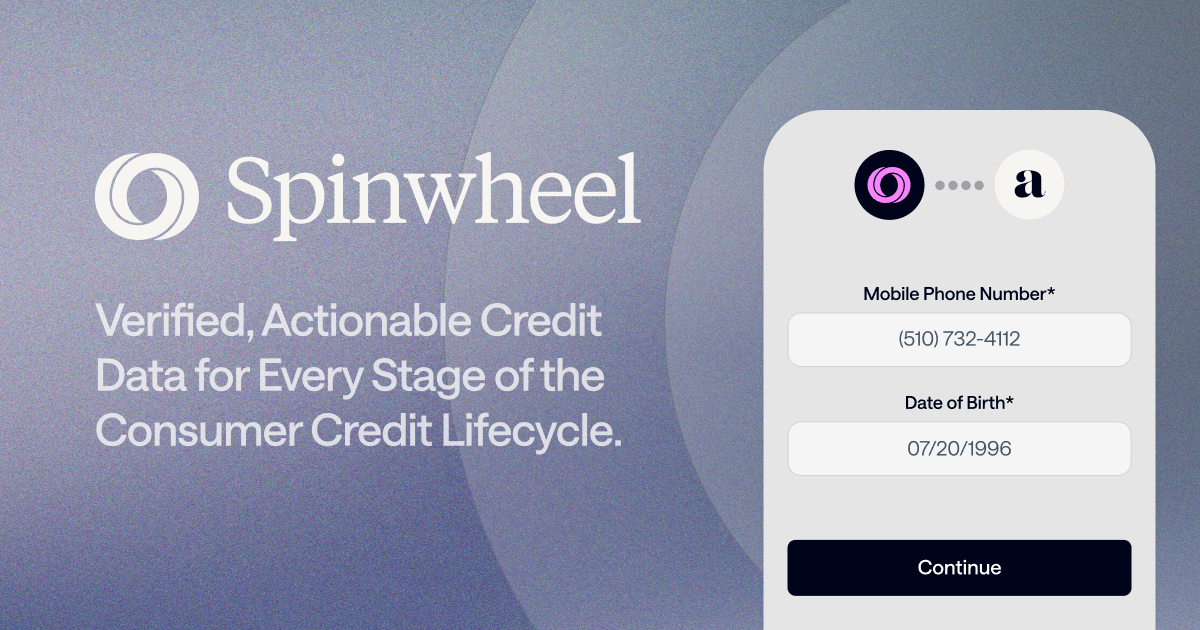
The signature move, the thing that makes engineers at competitors mutter, is what Spinwheel calls its credentialless connection. Most account-linking asks you to log in - to hunt for the username and password to your loan servicer, a servicer whose website you have possibly never visited voluntarily and whose password you have certainly forgotten. Spinwheel skips all of that. It asks for two data fields: your phone number and your date of birth. From those two inputs it assembles a verified profile of what you owe and to whom. Two fields in, a credit profile out.
Now, if you are the kind of person who reads that and immediately thinks wait, that seems like a lot of power for two fields, you have identified exactly why this is a real business and not a weekend hackathon project. Handling other people's credit data at this depth is heavily regulated. Spinwheel operates as a licensed Consumer Reporting Agency - the same regulatory category as the big credit bureaus - which means the compliance machinery, the data-handling obligations, and the legal exposure are all part of the product. That is not a footnote. It is the moat. A clever developer can copy an API design over a weekend. They cannot copy a bureau license over a weekend, and they cannot copy the years of regulated data relationships that sit behind it.
Spinwheel's product line reads like a sentence about a debt: find it, understand it, pay it, and - lately - let a machine reason about it. Each module is a low-code building block a developer can drop into an existing app.
Links a consumer's verified financial and liability accounts in seconds, without asking them to dig up logins for servicers they'd rather forget.
Returns verified debt and credit data from just a phone number and a date of birth - the credentialless core of the whole platform.
Sends instant, verified payments straight to financial institutions and loan servicers, so a payoff can happen inside the app the user is already in.
An agentic-AI environment where financial builders prototype on real-time, verified credit data instead of scraped guesses.
A user enters a phone number and date of birth inside a partner's app - no servicer logins.
Spinwheel matches and verifies the user's liability accounts across lenders and servicers.
Balances, rates, and due dates return as structured, real-time data the app can act on.
The app triggers a verified payment to the servicer - repayment happens in-flow.
In June 2025 Spinwheel announced a $30 million Series A led by F-Prime, with participation from returning backers QED Investors and Fika Ventures plus Foundation Capital. It followed an $11 million round from a few years earlier that QED had also led. The dollar figures are respectable but not, by fintech standards, jaw-dropping. The number that should stop you is the one buried in the press release: at the time of the raise, Spinwheel's network touched more than 15 million users, 165 million connected accounts, and over $1.5 trillion in connected debt.
One-point-five trillion dollars is larger than the annual economic output of most countries. It is the kind of figure that, when a company puts it in a funding announcement, is doing a specific job: it is telling investors that the company sits underneath an enormous amount of financial activity, quietly, as infrastructure. Spinwheel does not owe that debt and does not lend it. It is the layer that sees it and moves against it. That is a good place to be, because the layer that everyone integrates and nobody rips out tends to compound.
The stated plan for the new money is threefold: build out an agentic-AI platform, expand the data sets and product surface, and hire a go-to-market team. The AI piece is the fashionable one and also, to be fair, the logical one. There is a lot of noise about AI agents in finance, most of it demos. Spinwheel's angle is less about the model and more about the fuel: an agent that reasons over your debts is only as good as the data it's fed, and Spinwheel's whole existence is verified, real-time credit data. If agents are going to negotiate, consolidate, or optimize consumer debt, they will need exactly the kind of ground truth Spinwheel spent six years assembling. Models are increasingly a commodity. The verified input underneath them is not.
It is also worth noting who keeps writing the checks. QED and Fika both came back for the Series A, and F-Prime - the venture arm associated with Fidelity - led it. Repeat investors are the quiet signal in a funding announcement; they are the people with the most information deciding to double down. That does not guarantee anything, but it is more interesting than a logo you have never seen before appearing once.
Bars scaled to round size. Seed led by QED Investors; Series A led by F-Prime.
Spinwheel is rewiring how consumer credit data is accessed, activated, and embedded into financial workflows.
Spinwheel was started in 2019 by three co-founders who decided the debt side of finance was both harder and more valuable than the deposit side - a bet that looked stranger in 2019 than it does now.
Tomás Campos, Tushar Vaish, and Rajiv Appana start the company in Oakland to attack consumer debt.
QED Investors leads an $11 million raise, joined by Core Innovation Capital, Fika Ventures, and Firebolt Ventures.
The platform broadens across credit cards, auto, mortgage, and other liability categories.
F-Prime leads a $30 million round as the network passes 15M users, 165M accounts, and $1.5T in connected debt.
The comparison everyone reaches for is Plaid, the company that made connecting a bank account a solved problem. It is a decent analogy with one important asymmetry: bank balances are static and pleasant to look at, while debts are dynamic, unpleasant, and precisely the thing people avoid dealing with. Building on the avoided side of finance is harder - the data is messier, the servicers are worse, the regulation is heavier - which is exactly why there was room to build a company there at all.
What people can actually do with Spinwheel is not use it directly. You will almost certainly never see the word "Spinwheel" while it is working. It lives inside a lender's approval flow, a personal-finance app's dashboard, a debt-management company's onboarding, a payoff button that simply works. The credentialless connection means a user goes from "I owe money somewhere" to "I can see and pay all of it here" without the friction that normally kills these flows. And friction, in consumer finance, is not a minor annoyance - it is the difference between someone paying down a balance and someone closing the tab.
Whether the agentic-AI ambitions pan out is genuinely open. Plenty of companies are gesturing at AI right now, and gesturing is cheap. But Spinwheel's version has a grounding most do not: it already owns the verified data an agent would need, and it already has the regulatory standing to handle it. Doing the hard, boring, licensed version of a thing turns out to be a reasonable strategy - not because it is noble, but because it is difficult to copy. That, more than any single metric, is the case for Spinwheel.
It provides APIs that let companies access real-time consumer credit and debt data and make embedded payments against those liabilities, using a credentialless connection.
Its proprietary credentialless technology needs only two data fields - a phone number and a date of birth - to find and verify a consumer's liability accounts.
Lenders, personal-finance apps, marketplaces, and debt-management companies embed it. Through them, the network reaches more than 15 million consumers.
An $11 million seed round in 2021 (led by QED Investors) and a $30 million Series A in June 2025 (led by F-Prime).
Tomás Campos (CEO), Tushar Vaish (CTO), and Rajiv Appana founded Spinwheel in 2019. It is headquartered in Oakland, California.
Figures - $1.5T connected debt, 15M+ users, 165M+ accounts, and funding amounts - are drawn from Spinwheel's public statements and press coverage as of mid-2025 and may have changed. Revenue and headcount figures cited elsewhere are third-party estimates, not company-confirmed.