A satellite without power is expensive luggage. Its radios go quiet, its processors stop, its thrusters lose their instructions. The solar array is therefore both mundane and existential: a surface that turns sunlight into every useful thing the spacecraft can do. Yet in an industry newly organized around rapid launches and repeated buses, buying that surface can still resemble commissioning a small cathedral.
Source Energy was founded in Longmont, Colorado, in October 2021 around a complaint its founders knew from the inside. Philip Keller had built Roccor's satellite-solar business before Redwire acquired the company. Bryan Mazor had developed and delivered arrays for NASA's Crew Dragon and led the original Starlink array program at SpaceX. They had watched spacecraft teams wait on costly, custom power hardware while the rest of the market learned to move in months.
Their answer is not a miraculous new source of energy. It is an industrial argument: many missions need a dependable quantity of watts more urgently than they need the most efficient cell money can buy. Source uses monocrystalline silicon, standardized mechanical interfaces, repeated modules, automated assembly, and a growing catalog. The company says an available module can ship in under a month and standard arrays in under six.
The wrong watt can cost too much
Traditional space photovoltaics often use high-efficiency III-V cells, including gallium arsenide. They are exceptionally capable and remain the sensible choice for missions where area, radiation, or mass makes every percentage point valuable. They are also expensive, exposed to a narrower supply chain, and frequently paired with long qualification schedules. A low-Earth-orbit commercial spacecraft does not automatically need the same answer as a communications satellite expected to spend 15 years in harsher radiation.
Source's wedge is that difference. Silicon gives up efficiency per unit area, but it inherits decades of terrestrial investment, abundant suppliers, familiar automation, and a much friendlier cost curve. In August 2026, Source and Germany's Fraunhofer Institute for Solar Energy Systems ISE announced a shingle-matrix module made from overlapping silicon cell strips. Conductive adhesive joins the strips in a brick-like pattern. The 321 by 209 millimeter module averages 15.6 watts, weighs 64 grams, and reaches a stated 252 watts per kilogram.
The production tool is part of the product story. Source installed an M10 Solar Equipment shingle-matrix stringer in Colorado in June 2026 after a prototyping phase at Fraunhofer ISE. Under the announced arrangement, Source has exclusive access to that machine for making space-industry shingle-matrix modules. Mazor said the process can manufacture photovoltaic panels for less than $5 per watt. That is a manufacturing claim, not the final invoice for a qualified deployable wing, but it reveals the company's ambition: attack cost before a panel accumulates aerospace labor.
“They supported our team with a reliable product that met our aggressive mission timeline.”Carl Haken, director of avionics at Impulse Space
A product ladder, not a single panel
The smallest useful way to understand Source is as a set of building blocks. Its available MOD-0015-02 is a 16.31-watt silicon module. A customer may bond modules directly to a spacecraft surface, use an easier preinstalled bond interface, or put them in a bolt-on frame. Source also sells the labor and process around the module: wiring, inspection, performance characterization, quality records, and integration onto a customer-supplied substrate.
The rigid family is deliberately constrained. One composite honeycomb panel produces about 183 watts at the stated beginning-of-life condition. One can sit on the bus; up to five can hinge into a wing delivering as much as 915 watts. The panel, hinge, and harnessing repeat. Customers choose panel count, restraint mechanism, stringing, and a few interfaces rather than paying to invent the stack again. This is the kind of design choice that looks almost comically plain on paper and becomes valuable when the twentieth spacecraft must match the first.
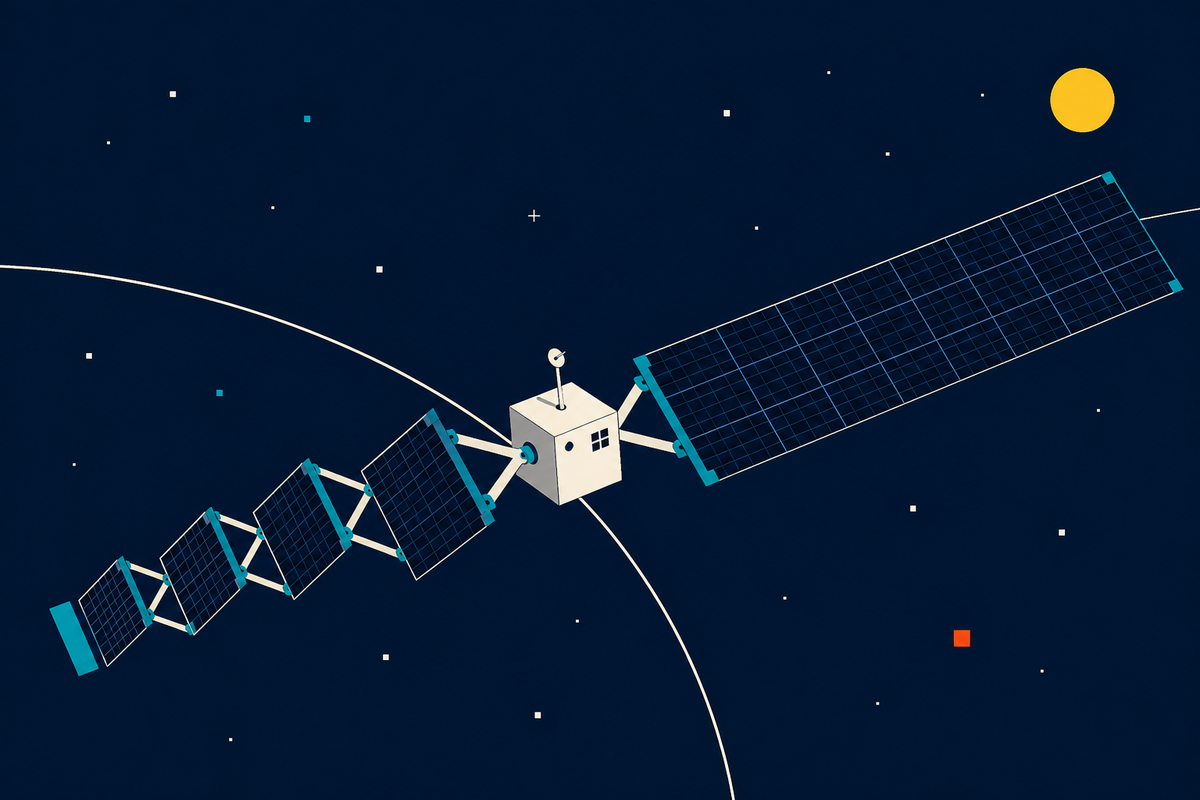
At the other end is a flexible blanket roadmap for power-hungry missions. Standard designs are listed at 4, 10, and 24 kilowatts. The photovoltaic blanket folds at hinge lines and can be sold alone or with a pantograph deployment structure and aluminum restraint cage. Stored strain energy opens the boom, avoiding a deployment motor. The planned 24-kilowatt blanket is roughly 28 meters long, with the complete wing expected to span about 32 meters. These products are scheduled for first delivery in 2027 and remain subject to qualification.
The customer is buying time
Source sells to satellite manufacturers, in-space vehicles, defense programs, telecom constellations, specialty missions, and the emerging category of on-orbit computing. These customers may buy hardware outright, hire Source to configure an array from existing platforms, or hand over their own structure for integration. The business is B2B manufacturing with engineering attached: product revenue by module, panel, wing, or watt, plus design and integration work where the bus does not fit a catalog answer.
The clearest public customer is Impulse Space. Source supplied the primary solar arrays for Mira, the company's orbital transfer vehicle, which launched on its first mission in November 2023. This mattered beyond the logo on a customer slide. A young power supplier had hardware operating on a young spacecraft whose entire job is to maneuver payloads after launch. When Source emerged from stealth in May 2024, it said it had delivered primary-power solutions to five spacecraft manufacturers and that two had flown. Its current site reports more than 25 programs delivered or customers served.
The market position sits between component vendor and prime array supplier. Source will sell a customer a module, a finished rigid wing, a flexible blanket, or the engineering needed to turn one into a mission-specific system. That breadth is useful for small teams without a deep power-systems bench. It also gives Source more control over whether a low-cost cell survives the expensive steps between a factory line and orbit.
Flight heritage meets factory discipline
Space solar is not made cheap by pretending space is friendly. Launch vibration, deep thermal swings, radiation, ultraviolet exposure, micrometeoroids, and years without repair are the bill. Source lists electroluminescence imaging, light and dark current-voltage testing, hot-vacuum and thermal-shock chambers, vibration work, and a 10-meter gantry for deployment tests. Its modules use redundant electrical paths and space-stable materials. The company says its designs have completed 40,000 thermal cycles and have been reordered after launch.
A 2026 partnership with nearby deployment specialist Dcubed shows the less glamorous side of reliability. Source adopted Dcubed's resettable release nut, which holds an array during launch and lets it go in orbit. Unlike one-shot hardware, it can be reset through repeated ground deployments. That saves technicians from breaking configuration and replacing parts between tests. The customer ultimately buys fewer interruptions, fewer opportunities for handling mistakes, and a more believable rehearsal.
The technology menu is also widening. A strategic collaboration with Japan's Idemitsu Kosan is developing thin-film CIGS cells for high-LEO and medium-Earth-orbit missions. CIGS offers a lightweight, radiation-resistant alternative between low-cost silicon and conventional III-V products. It is a pragmatic hedge: Source's thesis is not that one chemistry wins everywhere, but that a manufacturer should match sufficient performance to the actual orbit.
The hard part starts at scale
Standardization does not remove aerospace risk. Source still has to qualify new blanket architectures, hold quality as volume climbs, and prove that lower component cost survives integration, testing, and warranty. Established suppliers have deeper flight records, broad product families, and long relationships with conservative programs. For a satellite whose revenue depends on 15 years of service, efficiency and heritage can outweigh the price on day one.
Source has raised a publicly disclosed $6.5 million seed round, led by Alpine Space Ventures with backing that also includes Boost VC, and received a $250,000 Colorado advanced-industries grant. It reports 10 megawatts of annual capacity today and a roadmap to 100 megawatts in 2027. Reaching that number would require not just machines but booked constellation demand, trained technicians, disciplined suppliers, and the ability to make the hundredth array unremarkable.
Unremarkable is the opportunity. The new space economy has plenty of spectacle: rockets returning to towers, private lunar landers, proposed data centers circling Earth. Beneath each one is a power budget and a procurement schedule. If Source succeeds, its contribution may be noticed mainly by the absence of drama. The array arrives. The spacecraft closes. The wings open. The invoice contains fewer zeros than expected.