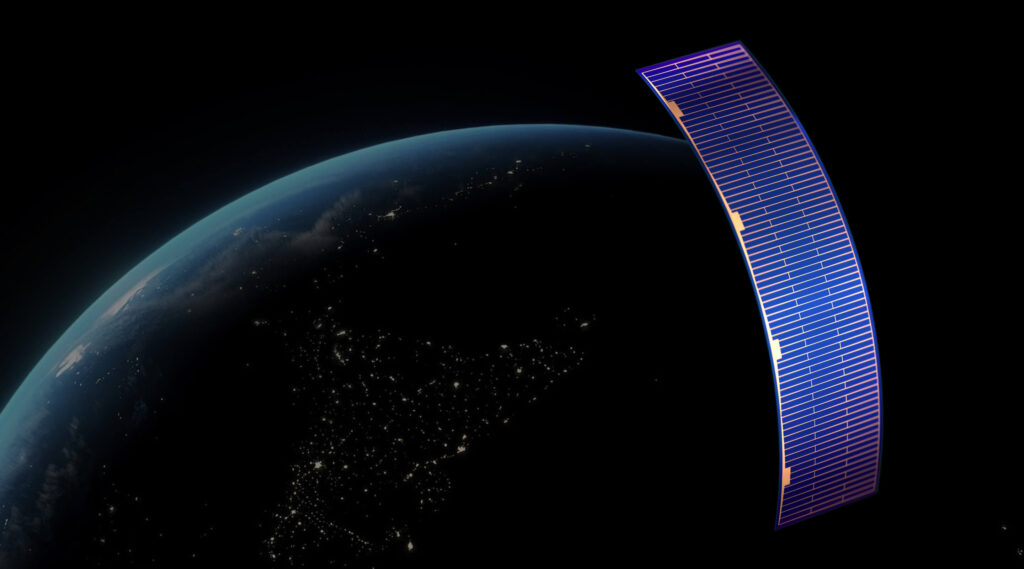
Walk into a low warehouse off Warner Road in Tempe and the first thing you notice is how little it looks like a rocket facility. No clean-room theater. No hangar doors. Just a 30,000-square-foot floor where machines are turning silicon wafers - the same stuff in your phone's chip - into ribbons of solar cell thin enough to roll.
This is Solestial. Right now, today, it is one of the very small handful of companies on Earth that can manufacture space-grade solar power modules at production volume, and it is doing it from Arizona. The cells are about 30 microns thick. They flex. They have flown. They keep flying. And, in a detail that sounds like marketing until you read the physics, they heal their own radiation damage while sitting in the sun.
The team here is 56 people. The customer list reads like a roll call of American space: NASA, the Air Force Research Lab, Space Systems Command, Boeing, SpinLaunch, Lynk. The mood is less startup-pitch-deck and more "we have a delivery deadline."
The Problem They Saw
A power crisis in low-Earth orbit
For sixty years, the solar panels on spacecraft have been built from a class of exotic semiconductors called III-V multijunction cells. They are extraordinary. They are also extraordinarily expensive, hand-fabricated, and produced by a tiny number of suppliers at a tiny number of plants. For Apollo-era satellites - a few per year, each one a national-budget event - this worked.
Then someone announced a constellation of ten thousand satellites. And then someone else did. And then someone did the math.
"By 2018, plans for large satellite constellations requiring tens of megawatts of solar power emerged, and the team identified a widening gap between demand for space-grade solar power modules and available capacity." That's the company's own retelling of the moment they decided to bet the business on space. It is, in classic engineer fashion, an understatement. The gap is not widening. It is a chasm.
The Founders' Bet
Two physicists, one university, a stubborn idea
Stan Herasimenka and Mikhail Reginevich met in 2010. They were working at Arizona State University on something that sounded, at the time, almost contrarian: novel metallization for silicon heterojunction solar cells. Silicon, the old workhorse of terrestrial rooftops, was widely considered the wrong material for space - too fragile, too vulnerable to radiation, too crude.
They thought otherwise. In 2013 they founded Regher Solar (the name was their last names, mashed together, which is the kind of detail that makes you trust the engineers more than the marketing department). They started running a NASA project to test the radiation hardness of ultrathin silicon. Something unexpected happened in the lab.
Stan Herasimenka
Belarusian-born physicist; ASU researcher turned space-solar lifer. The scientist who decided silicon belonged in orbit.
Mikhail Reginevich
The other half of Regher. Builds the machines that build the cells. Quiet, mechanical, indispensable.
The ultrathin silicon, it turned out, did not just survive radiation. It self-cured the damage at normal operating temperatures - the kind of temperatures a spacecraft experiences when it is, you know, in sunlight. Which is when you would like your solar panels to work anyway. Convenient.
In 2022 Regher Solar rebranded as Solestial and dropped the terrestrial business entirely. By 2023 the Tempe factory was open. President and CEO Margo de Naray, a veteran operator, came in to run the company. CFO Nicolas Miltgen handled the books. Lisa Morris took operations. The lab became a company.
The Product
What they actually make
Three things, in increasing degree of assembly. First, the cell itself - a flexible 30-micron silicon heterojunction wafer about the thickness of a sheet of office paper. Second, the Flexible Solar Power Module, where many of those cells are laminated together for stowed deployment or unconventional spacecraft surfaces. Third, the Integrated Solar Power Module, which bonds the flexible module to a rigid or semi-rigid panel for satellite buses that still want to look like satellites.
Solestial doesn't usually deploy the array itself - that goes to a partner mechanism company. The point is the cells and the modules. The point is the volume. The point is that this can be made on automated equipment in Arizona, not hand-built in a clean room.
Company Milestones
- 2010Stan and Mikhail meet at Arizona State University.
- 2013Regher Solar incorporated to commercialize silicon heterojunction research.
- 2018The team identifies the megawatt-scale supply gap in space solar - and pivots toward it.
- 2022Rebrands as Solestial, abandons terrestrial markets, goes all-in on space.
- 2023Opens 30,000 sq ft production facility in Tempe, Arizona.
- 2024Congressman Greg Stanton visits the factory; flight heritage crosses seven spacecraft.
- 2025Closes $17M Series A to scale manufacturing.
The Proof
Numbers, customers, and a measure of caution
It is easy to make claims about space hardware. It is harder to fly. Solestial has eleven years of cumulative flight heritage across active spacecraft, and seven different satellites currently carrying its product. That is not the entirety of the global market. It is, for a company that has not yet finished raising its growth round, a real number.
Solestial in numbers
A bar chart of a company that mostly wants to be measured in deliveries.
Who's buying
Customer logos are the second-best form of validation. The first is a P.O. number.
There are still open questions. Cell efficiency in silicon is lower than in III-V multijunction, and Solestial's pitch isn't "we beat them on performance" - it's "we beat them on cost per watt at scale, and we are good enough." This is a perfectly fine bet, but it is a bet, and it depends on the constellation economics continuing to favor volume over peak efficiency. So far, they do.
The Mission
Industrializing space power
Solestial does not use the word "abundance" anywhere on its website, which is a relief. The mission, distilled, is industrialization: take a thing that has always been bespoke and turn it into a thing that can be ordered, in volume, on a delivery schedule. That is not an inspirational poster. It is a supply-chain decision.
It is also, oddly, a climate story. The same silicon-heterojunction process pipeline that Solestial built for orbit traces back, line by line, to terrestrial photovoltaic research. The skills overlap. The talent overlaps. And the broader question - how do you make solar cells at the lowest possible cost per watt - has been answered, on Earth, in factories. Solestial is taking the factory back to the lab the technology came from.
Why It Matters Tomorrow
If the constellation era is real
If the next decade really does put tens of thousands of satellites in orbit - communications, observation, defense, on-orbit servicing, the lot - then someone has to make power for them. That someone will not be a tiny clean room hand-tweezing III-V chips. It will be a factory. There are not many factories. There is one in Tempe, on Warner Road.
Whether Solestial becomes the supplier or a supplier is the open question. The company is not trying to corner a market. It is trying to be the first to scale one. Those are different problems with different answers, and Solestial seems unusually honest about which it is solving.