A satellite passes over a wildfire and takes the picture everyone needs. It then does something maddeningly ordinary: it waits. The spacecraft can store the image, but the next suitable ground station may be out of view. By the time the pixels reach an analyst, the fire has written another chapter. Hedron was founded around that interval - the stretch between knowing something in orbit and knowing it on Earth.
- Hedron, originally Analytical Space, proposed a data relay service for other people's satellites.
- Its design accepted data through familiar radio links and aimed to move it through an optical relay network.
- Radix reached orbit in 2018; a 2021 defense contract and Series A backed the larger plan.
- The public milestones establish demonstrations and financing, not a verified continuously operating global service.
The distinction is practical. Earth-observation companies already spend heavily on cameras, radar, sensors and launch. Yet a fine image delivered too late can be a poor product. Hedron's 2021 brochure estimated that observation satellites spend 70% of their orbits in connectivity blackout zones. That was the company's estimate, not a universal figure; a satellite's actual access depends on orbit, ground stations and communications hardware. Still, it described a real constraint with a pleasingly simple image: a machine in space waiting to make a call.
The shoebox with an address book
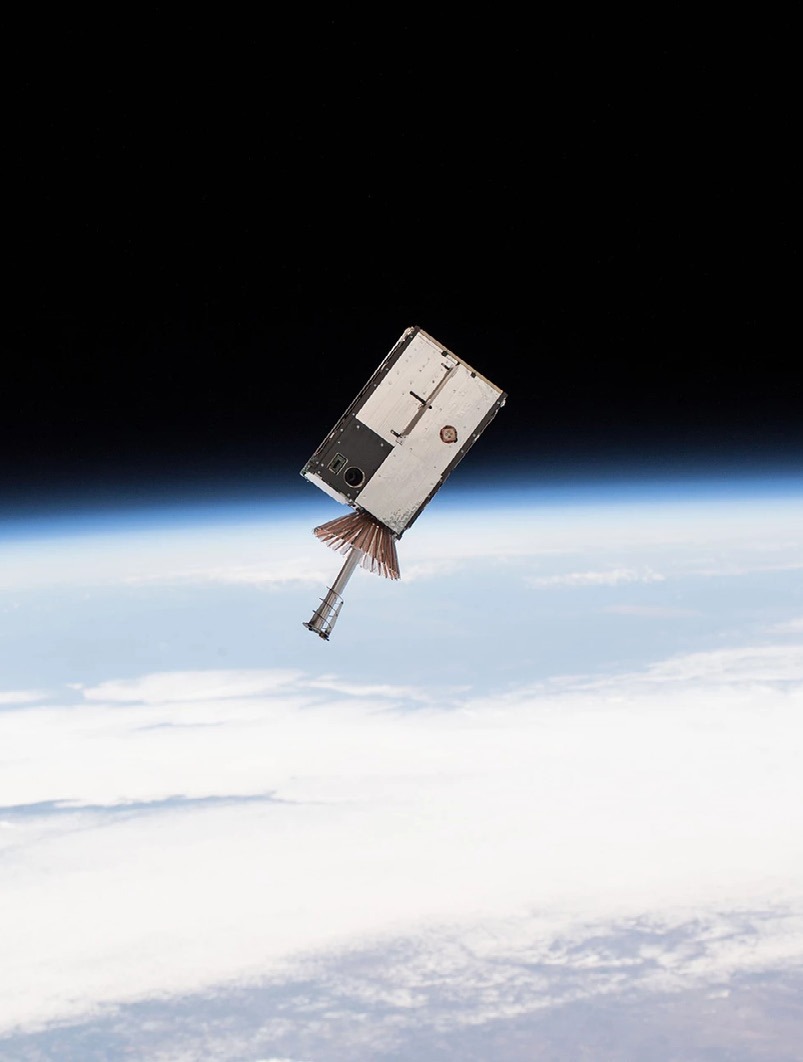
Justin Oliveira and Daniel Nevius founded the venture in 2016 as Analytical Space. Oliveira had worked at NASA and the White House, and the idea took shape during his time at Harvard Business School with Nevius. In 2018, they got a physical argument into orbit. Radix, a roughly shoebox-sized 6U CubeSat, rode to the International Space Station and deployed from it. The point was to test pieces of a hybrid relay: receive data by radio, hold it, and send it down using a high-speed path that could include optics.
Radix was a proof of concept, and Hedron said its trial campaign involved government and commercial beta partners. The company later said it had deployed two technology demonstration satellites by early 2021. Those are meaningful milestones in a business where even an experiment must survive launch, deployment, power, pointing and the unforgiving customer service department known as orbital mechanics. They are also smaller claims than a live network promising constant access.
The team's proposed answer became the Fast Pixel Network, also described in Hedron's brochure as the Halo Network. A customer's low Earth orbit satellite would offload data to a relay node. Software-defined radios would accept signals from a range of existing spacecraft, including older imaging platforms. The network would then route data through orbital links and downlink it by radio or laser to a ground provider or end user. Hedron also proposed “converter satellites” for valuable spacecraft whose existing communications hardware limited their options.
The proposed route / simplified
The diagram describes Hedron's planned service, not a measured end-to-end performance result.
A network that doesn't ask for a new radio
The backward-compatibility promise was the clever commercial move. Satellite operators cannot casually replace hardware after launch. Even before launch, redesigning a radio or antenna means engineering work, qualification and schedule risk. Hedron wanted to make buying faster delivery easier than rebuilding a spacecraft. The value proposition was aimed at remote-sensing fleets, defense users, civil agencies and the analysts waiting for their data, rather than consumers browsing a map.
That put Hedron between two familiar businesses. Ground-station operators such as KSAT sell opportunities to receive data when satellites pass within range. An orbital relay can add another contact path when the customer's satellite cannot see the right station. At the other end, networks such as the European Data Relay System used laser links to accelerate delivery from orbit. Hedron's proposed difference was a low Earth orbit, hybrid radio-and-optical layer meant to serve existing spacecraft as an open network. The commercial service would have sold access to that delivery capacity; public pricing was not disclosed.
The examples were not hard to find: wildfire response, maritime monitoring, weather, agriculture and national security. The more urgent the decision, the more expensive the wait. For a map that will be used next week, a conventional ground pass may be fine. For a vessel moving out of view or a fire crossing a road, shaving delivery time can change what a user can do with the data. This is where Hedron's pitch had teeth: it sold the usefulness of a minute, not the romance of a laser.
What the checks actually bought
In February 2021, Analytical Space announced a $26.4 million, three-year U.S. Air Force STRATFI contract, with Space Force and Air Force research involvement. The announced plan called for research, development, launch and deployment of six Fast Pixel satellites and two hosted payload nodes, matched by private investment. A government contract is a development commitment, not equity financing, and an announced deployment plan is not proof that each planned node flew.
Eight months later, the company raised a $17.8 million Series A led by Fine Structure Ventures, with Lockheed Martin Ventures among the participants, and changed its name to Hedron. The new name shortened “polyhedron,” a reference to its network topology and optical design. The company said it would deploy an initial operating demonstration beginning in 2022. Its brochure projected that the resulting service could allow Earth-observation customers to downlink up to six times as much data. That sixfold figure was a design claim, not an independently documented customer outcome.
The company also made a revealing partnership choice. In January 2021, it announced work with Addvalue Innovation and Inmarsat. Addvalue's intersatellite relay technology, using Inmarsat's geostationary network, would give Hedron's own low-orbit nodes an “always-on” telemetry, tracking and control link. In plain language, the proposed network for keeping other satellites in touch needed a dependable way to keep its own satellites in touch. Addvalue said Hedron placed an initial order for that capability. As late as July 2023, Addvalue described Fast Pixel in a shareholder response as a planned high-speed optical network.
The expensive space between prototype and habit
What failed first was the calendar, at least in the public record. A February 2021 company release said a third demonstrator, Cornicen-1, was slated for late 2021. The October rebrand announcement moved the initial network demonstration to 2022. An amateur satellite database later listed Cornicen as a future satellite rather than an in-orbit one. That sequence does not establish what happened inside the company. It does show why a prototype, a funded deployment plan and a working, continuously available constellation should be treated as three different things.
Hedron's case is instructive beyond space. The first step was to identify an idle interval in a customer's workflow; the second was to build around the customer's installed equipment. A founder in a less glamorous industry can copy both moves. Find the moment when valuable work is finished but unavailable, then remove the handoff delay without asking customers to replace their entire system. Hedron's compatibility bet made its story more credible than a pitch that required every satellite owner to order a new spacecraft.
The limit follows from the same logic. A relay makes economic sense when time saved is valuable enough to pay for extra infrastructure, when enough customers are in useful orbits, and when the network has enough nodes and ground connections to make its promise routine. Slow-moving data can tolerate an ordinary ground pass. A sparse constellation cannot honestly sell 24-hour reach. The hard commercial question is therefore less poetic than the vision: how many urgent bytes must move, at what price, before a constellation pays for itself?
Hedron understood something that satellite imagery marketing often hides. The image does not become intelligence when the shutter closes. It becomes intelligence when it arrives. Between those two events sits a market, a network engineering problem, and, sometimes, a very long wait for a phone call.