A balloon drifts. A satellite races. A ship turns toward port. To a conventional network diagram, all three are unruly guests: the line that existed a moment ago may soon be somewhere else. Aalyria's business begins with a deceptively plain question. What if the network knew that the line was going to disappear before anyone tried to use it?
The short version
- Spacetime predicts and coordinates changing links among satellites, aircraft, ships and ground equipment.
- Tightbeam supplies laser terminals for high-capacity links through the atmosphere.
- The company sells to satellite operators and public agencies; named work includes Telesat, NASA, ESA and U.S. defense programs.
- Its proof is specific: Loon operating history, public customer agreements and measured optical tests. A global, interoperable network is still a project in progress.
The balloon that left a map behind
Aalyria's origin has an unusually honest first act. Alphabet's Loon sent internet equipment aloft on high-altitude balloons, then had to keep those wandering nodes connected as wind moved them. The balloons worked well enough to provide service in places including Kenya. The business did not. When Loon closed in 2021, its chief executive said the team had not found a way to get costs low enough for a sustainable business.
The network software had a different fate. It had spent three years in production helping Loon coordinate moving links. Aalyria's founders, Chris Taylor and Brian Barritt, built a company around that experience and optical communications inventions developed across Alphabet and Lawrence Livermore National Laboratory. The change of customer mattered: rather than own a fleet of balloons to sell internet access, Aalyria could sell the machinery for coordinating fleets that other organizations were already planning to operate. That is an inference about the business model, but it is visible in the contracts that followed.
Today Barritt is CEO. He moved from the chief technology role in July 2026, after Taylor had led the company through a $100 million Series B. Aalyria's stated valuation in that round was $1.3 billion; reported funding over its seed, Series A and Series B rounds totals about $135 million. Those are the costs of building and financing a company, rather than a public price tag for a customer installation.
A router cannot steer a satellite
Ordinary network routing begins with a set of available connections and chooses a path. Aalyria tries to work one step earlier. Spacetime models where platforms and antennas are, how they will move, which beams can meet, what weather or terrain may interrupt them, and how spectrum is allocated. It can schedule a physical link, assign radio resources and then route data across the links it has arranged. That combination is what the company calls temporospatial software-defined networking.
Imagine a satellite carrying an image toward a ground station. The satellite will pass below the horizon; a storm may also spoil the link. A controller that waits for packet loss has already wasted time. Spacetime's proposition is to foresee the handoff, point another antenna or select another provider, and prepare the route before the old one fades. Operators can set policies and keep a human approval step for consequential changes. Its documented interfaces let other applications request service, equipment report observations, and separate networks offer one another spare capacity.
A moving link, in four beats
That distinction separates Aalyria from a satellite operator. It does not need to own the constellation to manage a connection across it. It also separates Spacetime from a conventional terrestrial controller, whose topology is relatively stable. The alternative for an operator is to build custom scheduling software and integrate ground stations, antenna controls, spectrum management and routing itself. Aalyria's pitch is that this work can be bought as a managed platform and connected through open interfaces. The public repository contains API definitions; access to a production Spacetime instance still requires customer credentials.
Choose among links that already exist. Recover after a link degrades or disappears.
Predict which links can exist next. Schedule the physical connection, then route over it.
The beam is real; the weather is too
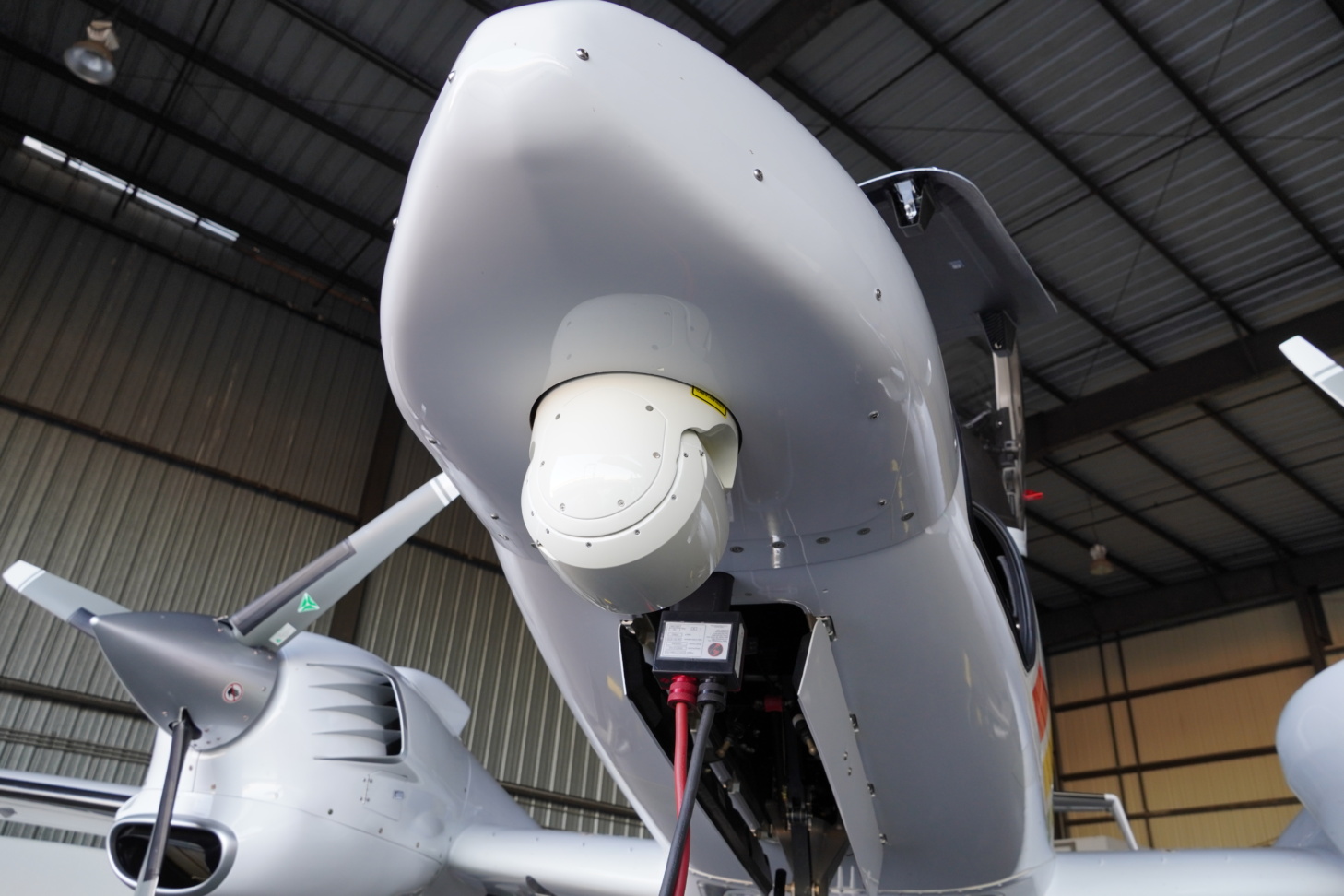
Tightbeam provides the other half of the story. Its fixed and gimballed terminals send data through the air as a tightly directed optical beam. Aalyria advertises rates up to 100 gigabits per second, and in 2025 it reported maintaining that rate across a 65-kilometer link between Northern California mountaintops. The company also reports ground-to-air tests approaching 200 kilometers. A 2026 technical paper describes the terminal architecture and recent airborne results. Those demonstrations say something meaningful about capacity and tracking; they do not turn every patch of atmosphere into dependable fiber.
Optical links need a usable path and precise pointing. Cloud, fog, turbulence and obstruction can make a nominally elegant route a poor one. A ship's roll, an aircraft's motion and a satellite's orbit add their own geometry. Spacetime becomes especially useful under those conditions because it can select radio, optical or ground paths according to what is available. The most convincing Aalyria installation may be the one that treats a laser as one tool in a mixed network.
Who pays for the handoff?
The customer list shows why Aalyria chose this problem. Telesat agreed to use Spacetime to orchestrate traffic on its planned Lightspeed low-Earth-orbit constellation, where satellites are constantly moving relative to customers and gateways. ESA has backed work to extend open radio interfaces for 5G and 6G non-terrestrial networks, and in 2026 awarded Aalyria a project for a delay-tolerant networking operations center. That latter design uses a store-and-forward logic suited to deep space, where an uninterrupted live link cannot be assumed.
NASA awarded Aalyria a roughly $393,000 study contract in 2024 for network orchestration and management. In June 2026, NASA said it would work with the company on enterprise service operations for its PExT wideband demonstration. PExT had already proved that a spacecraft could communicate through government and commercial networks; Aalyria's announced work concerns the management framework for such services. The Defense Innovation Unit has also selected Aalyria for Hybrid Space Architecture and a separate resilient-network prototype. These are precise forms of validation, each with its own stage of delivery.
Commercial partners broaden the picture. Antaris announced an integration between its satellite simulation system and Spacetime. SpinLaunch plans to use Spacetime in the architecture of its Meridian constellation. An Airbus UpNext demonstrator includes Aalyria's network optimization for 5G from orbit. A 2023 maritime memorandum with HICO contemplated as many as 200 laser links on ships; a memorandum is an intention, and the present count of deployed shipboard terminals should not be inferred from it.
What an operator can copy today is less glamorous than a satellite render. Model movement and expected link quality before designing routing rules. Give equipment a way to report what it actually sees. Let peer networks advertise capacity through documented interfaces. Rehearse changes against a digital twin before switching live traffic. Those are practical habits even when the hardware is radio, the fleet is small and the network never leaves Earth.
The uncomfortable lesson from Loon remains: clever connectivity still needs viable economics. Aalyria's current model shifts the cost toward operators with expensive assets and urgent traffic, while asking them to trust a shared controller across equipment and administrative boundaries. Its open interfaces help, but integration and permission are as important as prediction. In orbit, on a ship or under an aircraft, the handoff only works when someone has agreed to take the call.