In 2021, when Gundbert Scherf helped found Helsing, the proposition was software. European militaries had sensors, aircraft and ships that produced torrents of information. An artificial intelligence company might help them make sense of it quickly enough to matter. Five years later, the Munich-founded company is building strike drones, developing an uncrewed combat aircraft and raising money on a scale once reserved for the continent's industrial giants. The change is written all over Scherf's career. He has sat close to the people who buy defence systems. Now he leads a company that wants to build them.
Scherf's short public statement of purpose is almost severe in its economy: “I believe in a strong Europe.” It appears on his LinkedIn profile without a second sentence. The work behind it is less tidy. Strength in his field involves ministries with long procurement cycles, engineers working at software speed, factories that can deliver in quantity and arguments about the proper boundaries of autonomous weapons. Helsing is where those worlds are being made to meet.
An insider learns the slow parts
Before the company, there was an unusually useful sequence of jobs. A 2016 career notice lists Scherf as an adviser in the Bundestag office of Werner Hoyer from 2005 and at McKinsey from 2008. Between 2014 and 2016, he served as a special representative in Germany's Federal Ministry of Defence, working on the strategic management of national and international armaments activities. He returned to McKinsey as a partner in 2017, covering aerospace, defence and parts of technology. The institutions supplied different views of the same problem: how a government decides what it needs, and how an industry might actually provide it.
His studies had been just as European in geography. Public speaker biographies place his graduate and postgraduate work at the Free University of Berlin, Sciences Po in Paris and the University of Cambridge, where he was a Marie Curie Fellow. There is no need to pretend that a list of schools explains a person. In Scherf's case, though, it fits the ambition he later attached to Helsing: an enterprise that can operate across borders while keeping its technology and supply chains in European hands.
Friends of Europe named him a European Young Leader in 2022. The title suits his chosen arena. Military equipment is usually a national business, even when governments praise cooperation. Helsing's pitch requires German, British, French, Swedish and other institutions to accept that the useful unit of scale may be larger than any one of them.
Three founders, one awkwardly large question
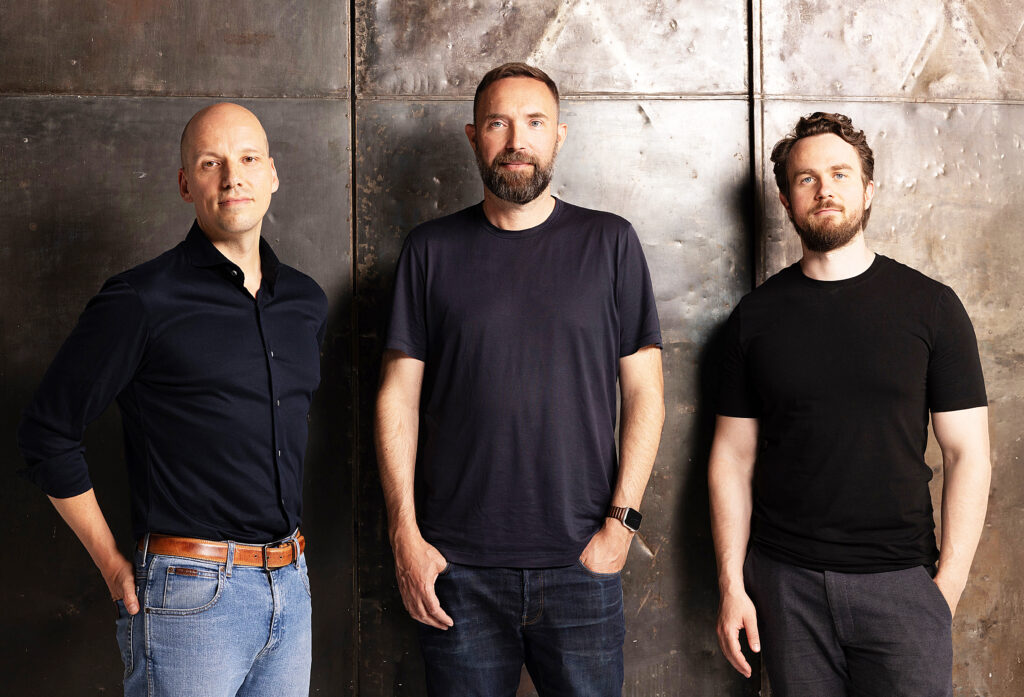
Scherf founded Helsing with Torsten Reil and Niklas Köhler in Munich in 2021. Their backgrounds were complementary: Reil had built a technology business; Köhler was a machine learning engineer; Scherf knew the machinery of defence policy and industry. That mix matters more than the familiar origin story of a start-up finding a market. The market here consists of states, armies and manufacturers, each with its own timetable and its own understanding of risk.
The initial idea was to put artificial intelligence to work on information that forces already collect. But the company's announcements soon began to move from interpretation toward action. It expanded into software for electronic warfare, systems for maritime surveillance and, eventually, its own hardware. Helsing says it has been active in Ukraine since 2022. The war gave the founders an immediate, unforgiving context for claims that would otherwise have remained conference material.
The financial chronology tells a parallel story. Helsing announced a €209 million Series B in 2023, a €450 million Series C in 2024 and a €600 million Series D in 2025. In July 2026 it announced a $1.8 billion Series E at an $18 billion valuation. These are company financing figures, not a scorecard for the performance of every product. They do show that investors have backed a far bigger project than an analytics tool.
What a factory adds to an algorithm
The HX-2 strike drone made the shift visible. Unveiled in December 2024, the electrically powered X-wing device was designed to be mass producible. Helsing described a range of up to 100 kilometres and onboard AI intended to resist jamming. When the company announced an additional order of 6,000 HX-2 drones for Ukraine in February 2025, it also announced that its first “Resilience Factory” was operating in southern Germany, with initial capacity above 1,000 units a month.
Scherf called the idea “precision mass.” It is a compact expression for an expensive tension. Precision has traditionally been associated with scarce systems; mass implies something a country can make, replace and sustain. The industrial work is less photogenic than the drone itself. Someone has to secure components, organise production and make sure a system built in one country can be maintained and ordered by another. Scherf, who has worked on the purchasing side of that relationship, now has a reason to care about the screws as much as the software.
“NATO has important lessons to learn, and fast.”Gundbert Scherf, on Helsing's HX-2 production plan, February 2025
That speed creates a test of its own. In January 2026, Helsing publicly disputed reporting that Ukraine was holding off on new HX-2 orders. The company's statement said Ukrainian units had asked for more drones after frontline testing and that deliveries continued. The disagreement is a reminder that battlefield adoption is harder to assess than a factory's advertised capacity. Scherf's argument depends on both: production at scale and systems that users continue to request.
The Baltic flight
If HX-2 is the story of quantity, Centaur is the story of integration. In May and June 2025, Saab and Helsing tested the company's air combat AI agent aboard a Gripen E fighter over the Baltic Sea. During the test, the pilot handed control to Centaur for manoeuvres in a beyond visual range combat scenario against another Gripen. A safety pilot remained aboard and could take back control. That detail belongs in the same sentence as the achievement. It defines the demonstration more accurately than a dramatic claim about machines replacing pilots.
Scherf had already described autonomous air combat as an area in which Europe needed capable, safe uncrewed systems. The Gripen test gave the idea a platform with wings and a pilot's seat. It also illustrated Helsing's method: work with an established manufacturer whose aircraft and military relationships already exist, then develop software that can be inserted into that hardware. The six months from the defined test scenario to flight, reported by Saab and Helsing, is a short interval by aviation standards.
The next move was more ambitious. In September 2025, Helsing unveiled a full size design study of CA-1 Europa, an uncrewed combat aircraft it said would combine Centaur with the aircraft design and manufacturing capabilities of its Grob Aircraft subsidiary. The word “study” matters. Showing a full size model is a milestone; an operational aircraft is a much longer undertaking. In February 2026, Helsing and Hensoldt announced a partnership on CA-1, adding sensors and other systems to the project. It was another example of Scherf's preferred arithmetic: combine new software with established European industrial capability.
The turn from software to systems
A map drawn through partnerships
Helsing's geography has become part of Scherf's work. The company announced a joint statement on AI defence collaboration with Estonia in 2024. It partnered with Sweden's Saab on Centaur and on electronic warfare software for the Eurofighter. Airbus agreed to work with Helsing on an AI system for its Wingman concept. A maritime line brought in Blue Ocean Marine Tech Systems, Ocean Infinity and QinetiQ. In December 2025, Helsing and Norway's Kongsberg announced plans for European space capabilities. These relationships are varied, but the repeated verb is connect.
The Stockholm office, opened in April 2026, gave that approach a physical address. Scherf welcomed Swedish defence leaders and called Sweden a new “home market” for Helsing. The phrase is interesting because it suggests an expanding idea of home for a company founded in Munich. European sovereignty, in this version, is a network of national strengths rather than a single flag over a single plant.
It is also a demanding political claim. A company can promise sovereign technology; actual independence requires rights to use and improve it, secure supply chains, reliable production and governments willing to cooperate. Scherf's career has prepared him to discuss those conditions in the language of both ministers and engineers. Whether each partnership delivers its planned capability is a question that contracts, tests and time will answer.
“What wins wars is not individual systems, but the ability to connect them.”Gundbert Scherf, on Helsing's partnership with Systematic, September 2025
The weight of a short sentence
There is an odd economy to Scherf's public persona. His LinkedIn line is six words. His CV moves through elite European schools, consulting and a defence ministry. His present job involves drones, fighter aircraft, underwater surveillance and a valuation with eleven zeroes. One could write an entire profile by listing the hardware. Yet the interesting part of his story is the change in direction: the former adviser to the system now trying to alter its tempo from outside it.
Helsing has said its systems retain human control and oversight. Those words deserve careful attention as autonomy becomes more capable. So does the company's argument that democratic countries need the ability to build their own tools. Scherf's work sits precisely where these two claims meet: speed and restraint, engineering and governance, national procurement and continental scale.
By September 2026, the story is still being written in factories, test flights and agreements rather than in a finished European defence architecture. That is why Scherf's path matters. He has seen the slow side of this industry, then chosen to build a company premised on moving faster. The distance between those two worlds is now Helsing's working space. It is also the measure by which his spare declaration about Europe will be judged.