Darcy Zhang has a product specification more severe than any procurement checklist. He asks whether he would personally entrust his life to the thing on a battlefield. For a founder building autonomous defence hardware, it is a useful sentence because it leaves so little room for decorative thinking. A pitch can be polished. A prototype can behave while the camera is rolling. Trust begins after the spectators have gone home.
Zhang is the co-founder and CEO of Greypoint Industries, a four-person company in Y Combinator's Summer 2026 batch. Its public mission is compact: make warfighters harder to kill. Its disclosed products are less compact. LEGION, short for Linked Emitter Geolocation Network, is designed to identify, geolocate and track radio emitters across the battlefield. ARROW is an autonomous interceptor intended to act against hostile drones. One system tries to reveal the hidden picture. The other is built to move once that picture becomes clear.
The distinction matters. A drone is visible only when it arrives in someone's sky. A control signal, jammer or command post may expose a larger system before that final approach. Greypoint's thesis is that distributed sensors carried by drones and vehicles can turn those emissions into a shared operating picture. In the company's sequence, detection comes first, location follows, and interception comes last. The expensive verb is not always “shoot.” Sometimes it is “see.”
Find radio emitters without alerting the target.
Fix positions from distributed drones and vehicles.
Cue autonomous interceptors against hostile drones.
A business education with field consequences
Zhang's route into hardware did not begin with an engineering degree. He studied commerce at the University of Calgary from 2022 to 2026. On campus, he became president of the university's firearms association after serving as its vice president. An archived executive page lists his discipline simply as “Business” and gives him the cheerfully unserious club title “Chief LARP officer.” It is a small scrap of biography, but a useful one: the future defence CEO was already comfortable putting a joke beside a subject people tend to discuss with either solemnity or swagger.
The more consequential line in his background is infantry service in the Canadian Armed Forces. Zhang has not published an expansive account of that chapter. He has published the standard it gave him. When Greypoint announced its place in YC, he wrote: “The philosophy is simple: build something that I would personally entrust my life with on the battlefield.” His own exposure to the user environment is therefore not set dressing in the company biography. It is the benchmark he chose to state in public.
“Build something that I would personally entrust my life with on the battlefield.”Darcy Zhang, announcing Greypoint's YC S26 acceptance
There is a practical advantage to having a commerce graduate lead three colleagues whose roles cover operations, engineering and product. Nic Chu is Greypoint's COO. Jordan Khoo is CTO, with prior work on autonomous aerial systems. Steven Xu is CPO, with experience in quantum sensing and passive radar research. Zhang's job is not to pretend those disciplines collapse into one. It is to make the technical pieces, the customer and the manufacturing argument move in the same direction.
His public language is telling. He calls the interceptor man-portable. He emphasizes cost, range and a shortened kill chain. He thanks people by name, many of them, when milestones arrive. In his YC announcement, the list stretched from his three co-founders through investors, advisors and early supporters before ending with “all the quiet professionals.” Defence technology loves a heroic machine. Zhang's acknowledgements make room for the relay of people required to get one built, tested, bought and carried.
The public test bench
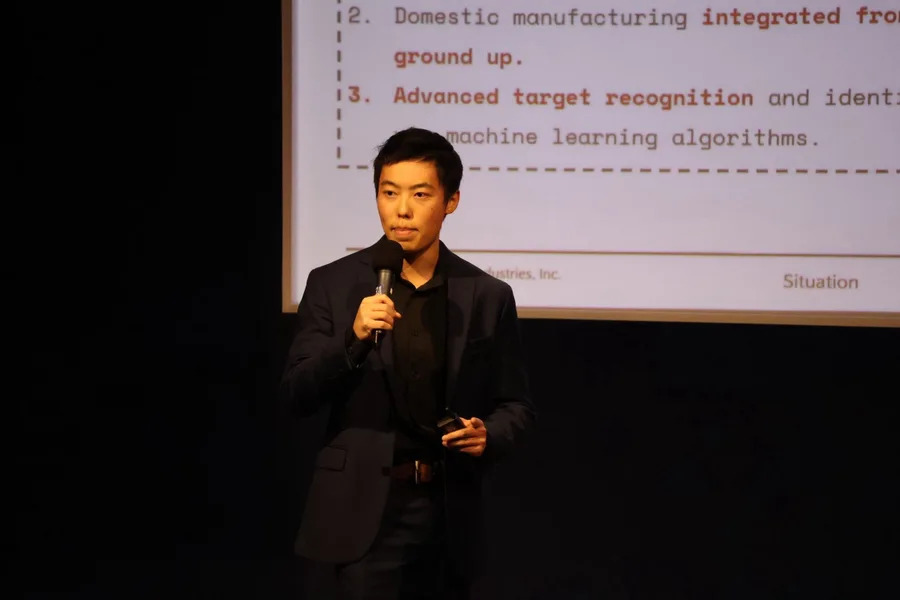
Greypoint's early record is a series of increasingly demanding rooms. In fall 2025, the company entered Innovation UBC's Venture Founder program through an affiliation with UBC's Faculty of Applied Science. Zhang presented Greypoint at the university's Venture Showcase that November. The audience voted the company its People's Choice selection in the “Sneak-a-Peek” category. The name is charmingly modest. The venue held more than 360 attendees, and the pitch had to make a complicated military system legible from a theatre stage.
By February 2026, Greypoint had joined more than twenty Canadian-owned and controlled firms as a founding member of the Alliance of Canadian Defence Companies. The alliance was formed to coordinate a domestic industry voice around procurement, industrial capacity and sovereign capability. For Greypoint, membership placed a four-person startup beside a broader argument: Canada should be able to design, manufacture and sustain more of the equipment on which it depends.
Then came Y Combinator. Zhang described himself as a first-time founder and Greypoint as a first-time applicant. The company was accepted into the Summer 2026 batch and announced that it had signed its first contract. Greypoint also said it had demonstrated with the Canadian Armed Forces and successfully geolocated a target using its aerial platform. These are early milestones, not a verdict. They do show the progression a hardware company must make: club and classroom, workshop and field, stage and customer.
Commerce at the University of Calgary, alongside leadership in its firearms association and service as a Canadian infanteer.
Zhang presents Greypoint at UBC's Venture Showcase; the company wins its category's audience vote.
Greypoint becomes a founding member of a new Canadian defence-industry alliance.
The company joins YC S26 on its first application and discloses its first contract.
The signal beneath the story
Zhang's founder story arrives at a moment when cheap drones have forced militaries to reconsider the economics of protection. Greypoint's response is deliberately systemic. LEGION is meant to fuse multiple observations into a live map. ARROW is meant to use that map. The company says the sensing layer can interoperate with other command-and-control platforms and effectors, which suggests an ambition larger than selling a single airframe: become a useful node in whatever system soldiers already use.
That ambition carries hard questions. Radio environments are noisy. Adversaries adapt. Autonomous systems must work with communications degraded, terrain unhelpful and users under pressure. Manufacturing in North America adds another test involving suppliers, cost and speed. None can be settled by a slogan. Zhang's chosen slogan at least points in the right direction. Personal trust is not a technical metric, but it forces the metrics to matter.
The company also keeps its intended user close to the sentence. Zhang does not describe an abstract modernization program. He writes about soldiers on the ground and products they can carry. His co-founders use similarly concrete language: practical solutions, threats on the modern battlefield, Canadian manufacturing. The shared vocabulary is less about futurism than equipment. Even “autonomous swarm warfare,” the phrase attached to Greypoint in public founder showcases, eventually has to fit inside a case, boot up and behave.
There is wit in the contrast. Zhang went from “Chief LARP officer” on a university club page to chief executive of a company dealing with real autonomy and real weapons. The joke survives because he has not inflated the past to fit the present. His public biography remains short. His company is young. Its claims are specific enough to be tested, and its first external tests have begun.
A pitch can make a machine sound inevitable. A field test asks the impolite questions.The difference between theatre and trust
Four people, one severe promise
Greypoint's compact team is part of the story. Four founders must cover product, engineering, operations, customers, financing and the peculiar choreography of defence procurement. Their experience spans the Canadian infantry, General Dynamics, Bosch Quantum Sensing, TerraSense Analytics and university research. The company website lists partners that include National Defence, the Canadian Armed Forces, NVIDIA, Innovation UBC, TerraSense Analytics and Y Combinator. The network around the four is already much larger than the payroll.
Zhang appears comfortable saying so. His milestone posts are crowded with other people's names. That habit offers a useful clue about the operator behind the headline. He makes the mission personal without making the company solitary. The distinction is important in a field where confidence is necessary and mythology is cheap.
What comes next is the unglamorous middle: more testing, more manufacturing, more customer scrutiny, and proof that sensing and interception can work as a chain rather than two attractive diagrams. Greypoint's aspiration is clear enough. It wants to reveal threats earlier, give friendly forces time to act and build the equipment in the West. Zhang's role is to convert that aspiration into reliable objects.
His severe question will travel with them. Would I trust this with my own life? It is impossible to answer from a profile, a stage or a launch video. That is precisely why it is the right question for the company to keep asking.