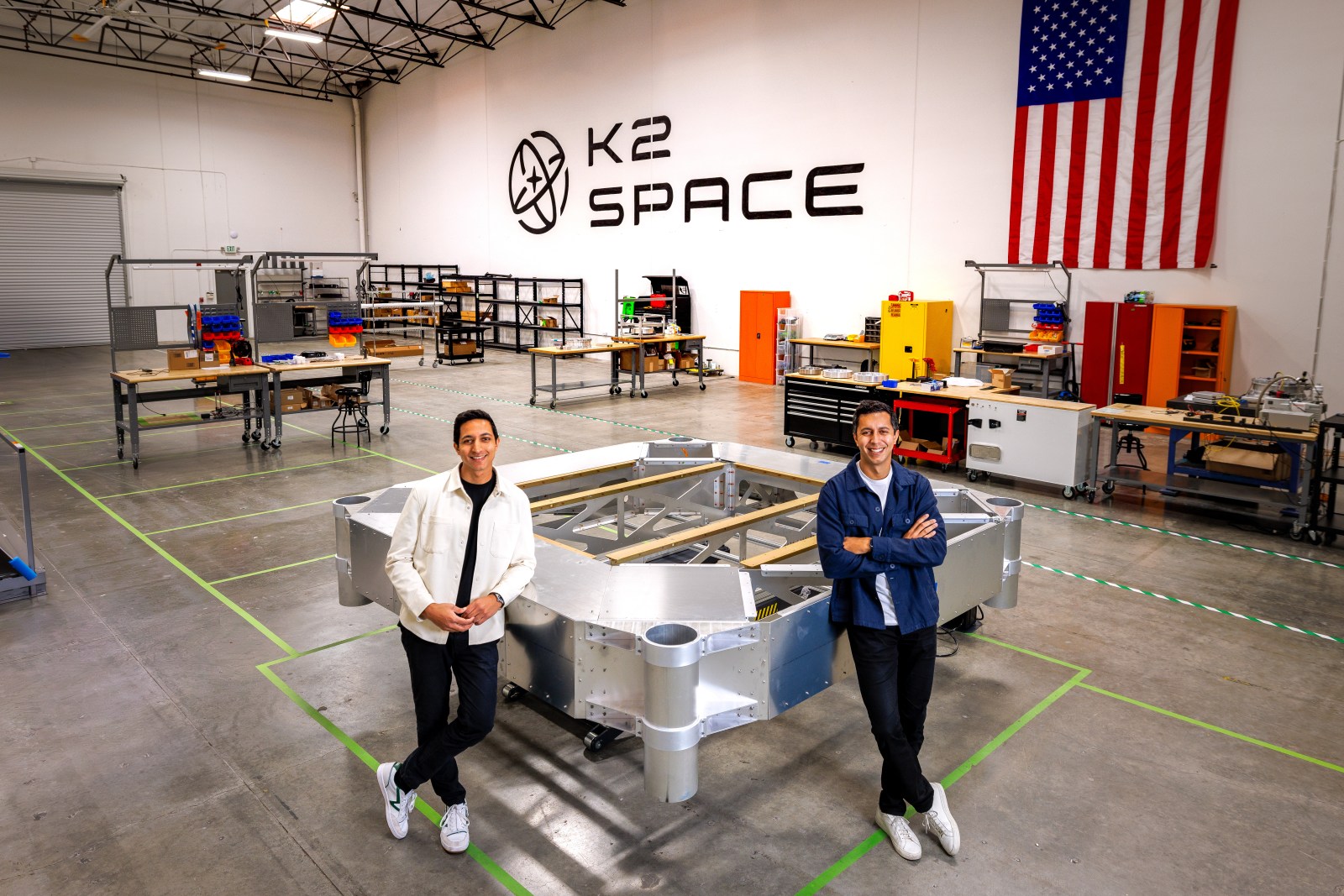
At K2 Space’s factory in Torrance, California, a window looks down on the work below. Karan Kunjur and his brother Neel put it there on purpose. Their grandfather’s office in India had a window overlooking a textile factory, and the brothers grew up with that view of industry: people, materials and unfinished things becoming finished things. The new window looks across a different sort of production floor. On it, the brothers have laid out the full-scale outline of a satellite with solar arrays planned to extend farther than a football field. The family resemblance is architectural. The change in ambition is measured in kilowatts.
Karan is K2’s chief executive. Neel, formerly a SpaceX engineer who worked on Dragon spacecraft avionics, is its chief technology officer. They founded the company in 2022 with a premise that ran against a powerful habit in the satellite business. For years, the industry had learned to make spacecraft smaller, lighter and quicker to launch. The brothers believed cheaper access to orbit could open room for spacecraft that carried far more electrical power and much heavier payloads. Their first full-size satellite, Gravitas, launched in March 2026 and is listed by K2 as operational in orbit.
A satellite bus is the working body of a spacecraft. It supplies power, propulsion, control and a place to mount the equipment that does the mission. Make the bus more capable and the payload can ask for more. That is the business Karan chose to enter. It is also a long way from where his working life began.
A detour with a purpose
Karan joined Boston Consulting Group as an intern in the summer of 2008, after his junior year at college, and returned as an associate in 2009. He worked in Chicago and São Paulo, attended business school at INSEAD, and stayed with BCG until 2018. Toward the end he helped established companies start new businesses. A proposal might turn into an app operating in ten markets within six months. He learned to make decisions quickly and to look for the assumptions hidden inside a plan.
Yet the experience left a hole he could name only after leaving. Consulting gave him a view from the outside. It offered less of the ordinary, stubborn detail of operating a company: hiring, selling, adjusting and living with yesterday’s decision when the answer turns out to be wrong. Karan later described the gap as a limit he had not even known he had. It is an unusually frank assessment from someone who had spent years advising executives.
Space was already on his mind. During his transition from BCG, he spent months talking with young space companies. He found interesting technical projects, but no business he felt ready to join. So he took an apparent diversion into machine learning. At Text IQ, an early-stage company, he offered to do whatever was useful and went on to build its commercial business. The company was sold in 2021. Its founder, Omar Haroun, later recalled that Karan had announced in his interview that he intended to learn how to build a company and then start one himself. Haroun hired him anyway, and later invested when Karan raised K2’s seed round.
“Life is long, and it can be a winding journey—and you should just be okay with that.”Karan Kunjur
The detour made the later choice more deliberate. Karan had learned how a business worked from inside its machinery. Neel had learned how spacecraft worked from inside SpaceX. When they returned to the space question together, each brought something the other did not. A brother can also say what an outside co-founder might leave unsaid. Their trust predated the company by decades, and so did the factory window.
The power problem
The small-satellite boom solved real problems. It gave operators cheaper, faster ways to put many craft in orbit. Karan’s objection was specific: small platforms had not escaped the trade-offs that come with a limited supply of electricity, room and mass. A spacecraft with less power has less to give its instrument or communications payload. A smaller aperture can constrain what it can observe. Fuel and useful cargo compete for the same scarce capacity. In a 2025 interview, Karan argued that the industry had learned to lower cost and speed development while sacrificing capability.
K2’s answer was to treat growing launch capacity as a design change, not merely a discount on freight. If rockets can take more mass to orbit, a satellite designer can stop shaving every gram. Some components can be heavier and cheaper. More room can accommodate more demanding equipment. More electrical power can widen the range of missions a single platform supports. Karan compared the transition in launch capacity to the jump from dial-up internet to broadband. New infrastructure, in his view, creates businesses that could not fit through the old connection.
The argument in one measure / K2 platform figures
Power shown as a platform comparison, not a measure of every satellite in either class.
The drawing board came with a manufacturing question. K2 chose to build much of its satellite hardware in-house, including a reaction wheel, the part that helps point a spacecraft. Karan told Ars Technica in 2025 that the company had brought that part’s cost down dramatically through repeated internal designs. He said about 80 percent of satellite production was vertically integrated. The figure matters because K2’s pitch depends on making large satellites repeatedly at a price customers can use, rather than producing a few exquisite one-offs.
There is an amusing inversion here. A company known for big hardware must be obsessive about very small decisions. A reaction wheel is easy to overlook next to a solar array; its price still changes the economics of the whole machine. Karan’s consultant years taught him to question a requirement. His operator years taught him that someone then has to buy the parts, hire the team and finish the build.
The factory starts counting
K2 began with two founders in a WeWork. At the start of 2024, Karan said, it had 25 people and a 15,000-square-foot factory. By that year’s end it had 89 people and was moving into a 181,000-square-foot facility. At its fourth birthday in June 2026, the company described a team of 275 and a factory of roughly 180,000 square feet in Torrance. Those figures chart the distance between a thesis and an industrial operation. They also show the size of the payroll that arrives before the whole argument can be proven in orbit.
The first flight, Heritage, launched in January 2025 to demonstrate critical subsystems. Gravitas followed on March 30, 2026, carrying the full-scale platform into orbit. K2 describes it as a 20-kilowatt satellite and says its solar arrays and electric thrusters have been exercised in flight. That is a meaningful step. It is still a test mission, designed to return lessons as well as demonstrate hardware. Karan has said the team would need to learn, change and put improvements into the next spacecraft quickly.
That appetite for feedback reaches into hiring. Karan says he conducts the final interview for every person who joins K2. He asks engineers to question requirements and to own a problem rather than wait for a long chain of instructions. It is a hard culture to sustain as a team grows, but it fits a company that must discover failures on the ground, where they are cheap, instead of in orbit, where they are very expensive. His own favorite lesson from BCG was intellectual rigor; his later lesson from Text IQ was that rigor has to survive execution.
The company’s customers have begun to ask for more than demonstrations. SES, the Luxembourg satellite operator, announced in March 2026 that it would pair its own payloads with an initial 28 K2 platforms for its planned meoSphere network. K2 has also won government work. In July 2026 it announced a $500 million Series D at a $6.8 billion valuation. Karan had said in June that the company had signed more than $1 billion in contracts. None of these numbers can fly by itself. Their force is that customers and investors have given the factory a schedule to meet.
A bigger definition of success
Karan and Neel did not start with a fascination for size alone. Karan has described reading the studies that set out possible NASA science missions and seeing how few could fit within expected budgets. He and Neel wanted a lower-cost way to send capable scientific spacecraft beyond Earth. The nearer market includes communications, national security and, potentially, computing in orbit. The farther horizon includes deep-space relay networks and more frequent exploration. One platform must first prove useful in the prosaic work of production, delivery and service.
Karan’s own measure of success is revealing. He has said he will look at what fraction of economic activity in space is built on a K2 satellite. That is an infrastructure measure, less glamorous than a single spectacular mission and far more demanding. It asks the company to be useful to many different customers, in many orbits, over many years. K2’s planned Trinity mission in 2027, three satellites operating across three orbital regimes, is the next public step in that direction.
A founder’s story can become too tidy once the first spacecraft flies. This one has a useful untidiness. Karan looked for a route into space in 2018 and chose a machine learning company instead. He traded the authority of advising executives for the work of building a sales organization. He returned to the subject that had held his attention, found his brother ready to build alongside him, and turned a disagreement with prevailing satellite design into metal and solar cells. From the window above the floor, the view remains full of unfinished things. That is where the next part of the story will be made.