At 13:25:28 UTC on March 30, 2026, a ground station in Pretoria, South Africa, acquired a signal from a new satellite. The spacecraft had separated from a Falcon 9, steadied itself, unfurled two solar arrays and begun making electricity. For the team in California waiting on the other end, those eight minutes after separation carried four years of work. Neel Kunjur had spent much of his career close to spacecraft. This one was different. He had built a company around the idea that it should exist.
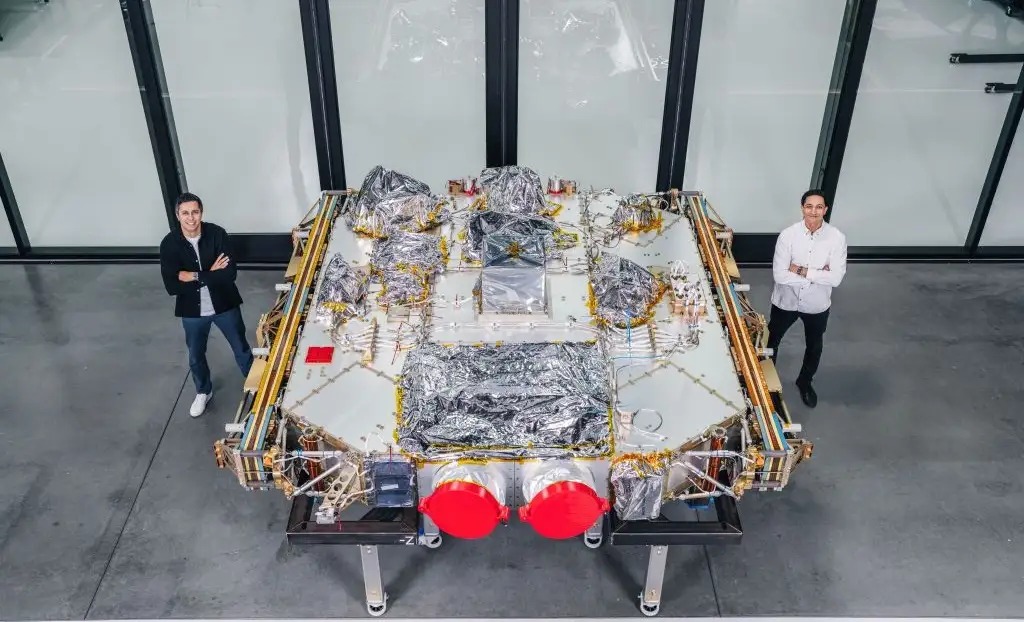
Kunjur is the co-founder and chief technology officer of K2 Space, which he started with his brother Karan in 2022. The company builds large satellite platforms that supply electrical power and room for other people’s missions. Its first Mega-class craft, Gravitas, was designed around a 20-kilowatt power system. In an industry that spent years making satellites smaller, the brothers gave their company an awkward instruction: build bigger. The first radio exchange from Gravitas showed that the instruction had at least survived launch.
There is a nice symmetry in the scene. Neel had previously worked at SpaceX, where he helped develop and integrate avionics for Dragon spacecraft and served as a mission director. Now a SpaceX rocket had carried his own company’s machine to orbit. The symmetry would have been useless if the satellite had not answered back. Space is unsentimental about narrative structure.
A career measured in hardware
Kunjur studied electrical engineering at Northwestern University between 2010 and 2014. A 2013 engineering scholarship profile described his interests then as computer vision and signal processing. The next chapter put him much closer to the wiring and logic of a spacecraft: six years at SpaceX working on Dragon avionics. He later became a senior electrical systems engineer at Kittyhawk, the electric aircraft company. Those jobs placed him in industries where an elegant diagram must eventually survive a real machine, a production floor and a test that cannot be talked into passing.
One early SpaceX memory still informs how he describes risk. The first spacecraft he worked on was lost in the 2015 CRS-7 launch failure. In his later account of Gravitas, he recalled what it feels like when years of work vanish in a moment. He did not write as though confidence could make that possibility disappear. Before the K2 launch, the team divided success into three tiers: first control of a working satellite, then proof of its systems and customer payloads, then a more ambitious set of orbital maneuvers. That order made the essential test clear before anyone was tempted to move the goalposts.
There was another launch in his personal history. In a 2026 podcast conversation, Kunjur said his entire space career had hinged on the SES-8 mission aboard Falcon 9. The comment says something about the contingent path into this field: a flight goes well, a career opens, and years later an engineer is asked to trust another launch vehicle with a spacecraft he helped conceive. K2 has since found SES on the customer side of the table, with the operator selecting it for a planned medium Earth orbit network.
The brother with the other half of the plan
Neel did not start K2 alone. Karan, his brother and the company’s chief executive, brought a background in consulting and company building. In an interview with investor ICONIQ, the pair traced part of their family story to their grandfather’s factory floor in India. The line from that factory to a spacecraft factory in Torrance is appealing, but the useful detail is more prosaic: both brothers had reason to think about how a product is made, not just what it does after delivery.
They founded K2 in 2022, when small satellites were the fashionable answer to expensive launches. Small craft can be launched in numbers, and they have enabled many useful missions. The Kunjurs were looking at a different constraint. If rockets could take up more mass for less money, why keep treating every kilogram on the spacecraft as an enemy? Neel’s answer was to spend some of that mass on simpler, more manufacturable systems and on a much larger power budget.
“The industry went small. We asked: what happens if you go the other way?”Neel Kunjur, K2 Space
The sentence is brisk enough to fit on a wall, but the engineering underneath it is less tidy. A large spacecraft needs arrays that unfold, batteries that store considerable energy, electronics that handle it, wheels that steer a heavy body, and propulsion capable of changing its orbit. K2 chose to make many of those parts itself. Kunjur has argued that a company should own whatever component is the bottleneck for its system. With Gravitas, more than 80 percent of the subsystems were designed in house. That gives engineers more work. It also gives them a direct route from a flight problem to a revised part.
Neel’s public explanations tend to return to that relationship between mass, power and production. He has said heavier systems can be easier and faster to make. It is an engineering permission slip with a bill attached: extra weight is useful only if the resulting spacecraft can be built and launched economically. The company’s planned Giga class would push the same logic further, toward a 100-kilowatt platform. Gravitas was the smaller, essential examination.
The day the theory answered
In February 2026, the first Gravitas craft was ready ahead of its March 6 shipping target. Kunjur wrote that the team integrated 11 distinct customer payloads in less than a week. It then went to Vandenberg Space Force Base for SpaceX’s Transporter-16 rideshare mission. A first launch attempt was scrubbed. The team ran the recycle procedure it had rehearsed, and Gravitas lifted off on March 30 at 11:02 UTC.
The satellite flew powered on, giving the team visibility into its condition during ascent. After separation, it slowed its tumble with torque rods, deployed its two 18-meter arrays and settled into a stable orientation. The Pretoria contact came on the first planned ground pass. By Kunjur’s own definitions, the first tier was met: they had a spacecraft they could command and learn from. It is a modest sounding standard until one remembers how many things have to work before a ground controller can ask a new machine a question and receive an answer.
Separate, deploy, generate power and establish two-way contact.
Run the payloads, propulsion and a full software update.
Use propulsion to explore higher orbits and collect more flight data.
The second tier took less than nine days. Operators powered and communicated with all 11 customer payloads, started both Hall thrusters and uploaded a full software update. K2 had allotted roughly two weeks. The propulsion system was a particular test: its electric thrusters operated at a power level far above previously flown Hall thrusters. As impressive as the figure is, the more revealing achievement may be the update. A spacecraft that can accept new instructions after launch lets a team improve how it flies while it is flying.
That capacity was needed almost immediately. After a conjunction warning, operators performed a collision avoidance maneuver on April 11. Kunjur’s mission report says the maneuver reduced the estimated collision probability from 7.5 × 10⁻⁴ to 1.6 × 10⁻⁶. The team had prepared for that possibility. A satellite’s power to move is an advantage for its owner; using it responsibly matters to everyone else sharing the orbit.
The useful blemishes
The first months also produced a less photogenic list. Star trackers took longer than expected to solve in orbit. Navigation signal interference lasted longer than preflight estimates. Some exterior sensors ran warmer than predicted. Parts of the solar arrays produced less power than the model suggested. One payload’s data flow lagged. Ground-station settings caused missed passes. Kunjur itemized these problems in an August 2026 account, along with the adjustments made in software, operating procedures and manufacturing. The point of flying a test article is to let reality mark up the drawings.
The solar-array discrepancy is particularly instructive. The team reproduced the effect on the ground and changed the manufacturing process for future modules. Gravitas retained enough power margin to continue, while operators adapted the burn plan. That small sequence contains the whole promise of K2’s approach: make a part, fly it, discover where it differs from expectation, and feed the correction into the next unit. A company can tell a good story about scale in a slide deck. The manufacturing change is where scale begins to become a practice.
By mid-August, Gravitas had operated for more than 125 days. Kunjur said it was still executing planned objectives and had begun changing orbit for the mission’s final phase. He described a revised trajectory that would raise the high point of the orbit while keeping the low point near atmospheric drag, a precaution in case the spacecraft failed during the experiment. The design allowed the team to test higher-altitude performance without leaving an uncontrolled object in orbit indefinitely.
What the next factory shift must prove
The Kunjurs have built a company with more than a first satellite. K2’s factory in Torrance expanded to 180,000 square feet, and the company said in 2026 that its team had grown beyond 300 people. It has a contract with SES for an eventual medium Earth orbit constellation and work tied to United States national security programs. In July 2026 it announced a $500 million Series D to support production. Those commitments put a sharper edge on the engineering story. One spacecraft can demonstrate a design; a line of them must meet schedules, costs and different customers’ needs.
The next named step is Trinity, a group of vehicles planned for the first half of 2027. The lessons from Gravitas are meant to travel with them: the altered solar-array process, updated flight software, revised models, operating routines and the confidence earned by a real signal from Pretoria. Neel has said the brothers prefer to put their heads down, build, and point upward once the hardware is there. It is a sound preference for a field where the sky is both a proving ground and an exceptionally unforgiving fact checker.
There is a little humor in the name K2. The company invokes a Kardashev Type II civilization, a future able to use energy on a stellar scale. The present job is humbler and harder to skip: make the next satellite work, then make the one after it. Neel Kunjur’s bet is that a larger spacecraft can give more missions a practical place to live. Gravitas has given that bet its first substantial evidence. The factory will write the rest.