In 1990, a company built to understand submarine sound helped Hollywood make submarine sound believable. Paramount hired Sonalysts to help produce and record effects for The Hunt for Red October. For a firm that began with Navy sonar analysis, this was an unusual booking. It was also a remarkably sensible one. The customer had changed; the importance of getting the sound right had survived the journey.
That small episode offers a better introduction to Sonalysts than a catalogue of contracts. The company has accumulated a peculiar family of businesses: military training, operational research, simulation software, airline weather systems, animation, and recording facilities. Read them as separate industries and the list seems untidy. Read them as applications of expertise and a pattern begins to appear.
- The core: engineering and training for military and government customers.
- The bridge: acoustics, computing, and simulation applied to commercial work.
- The ownership: an ESOP begun in 1979, with full trust ownership since 1998.
- The useful lesson: design with the operator, then ask where the underlying skill can travel.
The sound of a transferable skill
Dave and Muriel Hinkle incorporated Sonalysts in Waterford, Connecticut, in 1973 after Dave left the Submarine Force. Its early work supplied acoustic analytical support to the Naval Undersea Warfare Center. A submariner's experience was becoming a civilian service: interpreting what instruments detected and helping others make use of it.
The technical base broadened. By the early 1990s, Sonalysts was producing animation for television as well as software and submarine training for the Navy. In a 1992 interview, then president John Markowicz explained the move with a refreshing lack of corporate embroidery.
“We got into the animation business not because we knew anything about animation, but because we’re used to computers.”
John Markowicz, then president · The Christian Science Monitor, 1992
The distinction matters. Sonalysts was describing an adjacent capability, rather than a sudden revelation about the entertainment business. Computing knowledge gave it an entry point. The submarine film gave its acoustic knowledge another audience. Neither required the company to pretend that its past was an embarrassment.
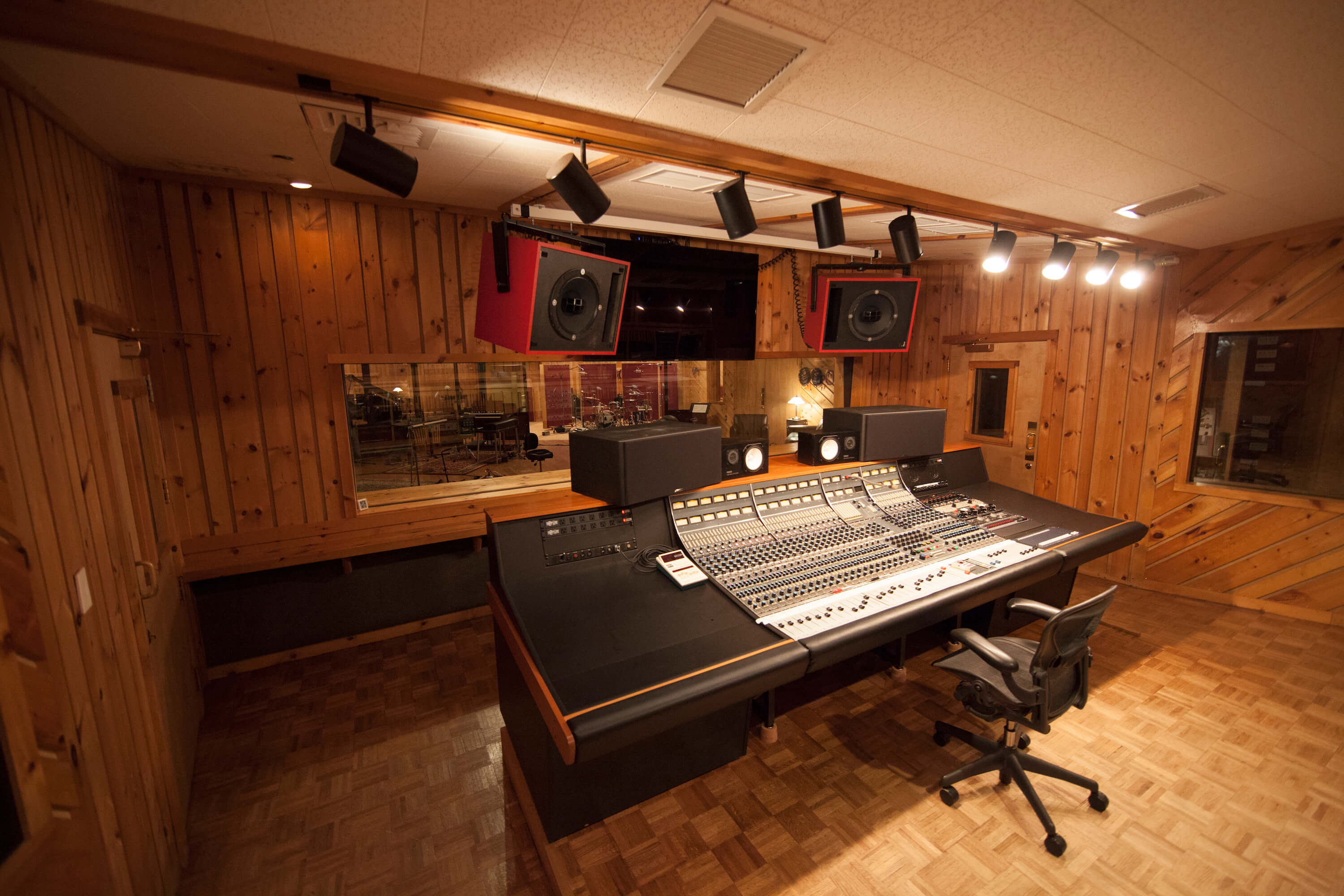
Power Station New England arrived in 1995, built around the design and acoustics of the original New York studio. Its main recording space has a 35-foot dome. The studio's history describes a vintage Neve console that previously lived at Electric Lady and Pachyderm. This is a commercial recording operation with its own physical craft, sitting inside a company whose other work can involve satellite operators.
A rehearsal for the difficult decision
Defense remains central to the business. Sonalysts supplies operations analysis, custom software, systems engineering, training, and decision support. Its military customers include the Navy, Space Force, Air Force, Marine Corps, Coast Guard, and Army; it also works with defense prime contractors. Those customers buy expertise and systems that fit particular operational problems.
Consider the training work. Sonalysts' teams combine subject specialists, instructional designers, technical editors, media specialists, and software engineers. Its Submarine On Board Training work includes interactive instruction, a video series, and conversion of modules to HTML5. Its Standard Space Trainer includes scenario-generation tools and features for instructors to monitor student performance. The lesson has to be teachable, usable, and assessable.
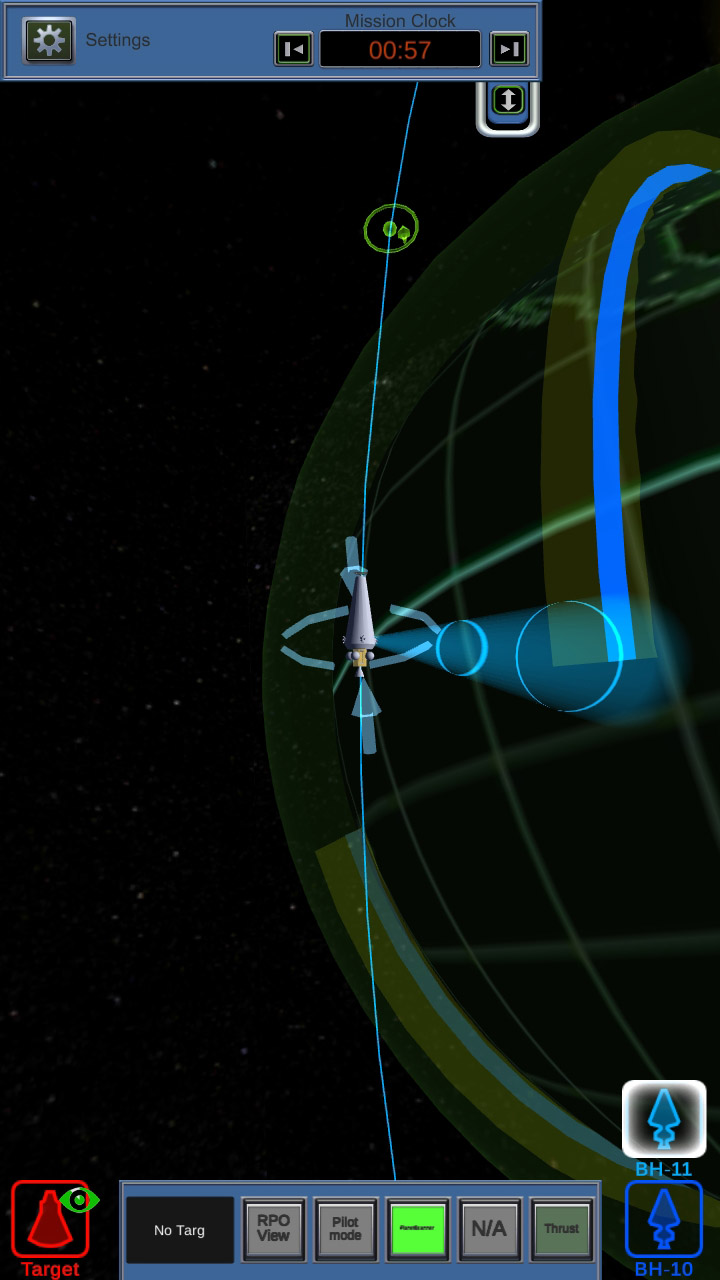
Black Horizon makes the same point in a different form. It is a mobile-friendly spacecraft engagement simulation developed for Air Force and Space Force training. Players learn satellite control and progressively more complex orbital maneuvers. Mission goals connect to learning objectives. A game structure gives practice a sequence; the underlying physics supplies the discipline.
PING brings multiplayer game design to anti-submarine warfare sonar training. Developed under a Navy Phase II Small Business Innovation Research project, it ties team roles and operational displays to learning objectives. Sonalysts describes adapting sonar and undersea-environment modeling from its simulation framework, while using Unity for browser-based displays. The product page describes plans to integrate it into tactical-system and classroom training environments.
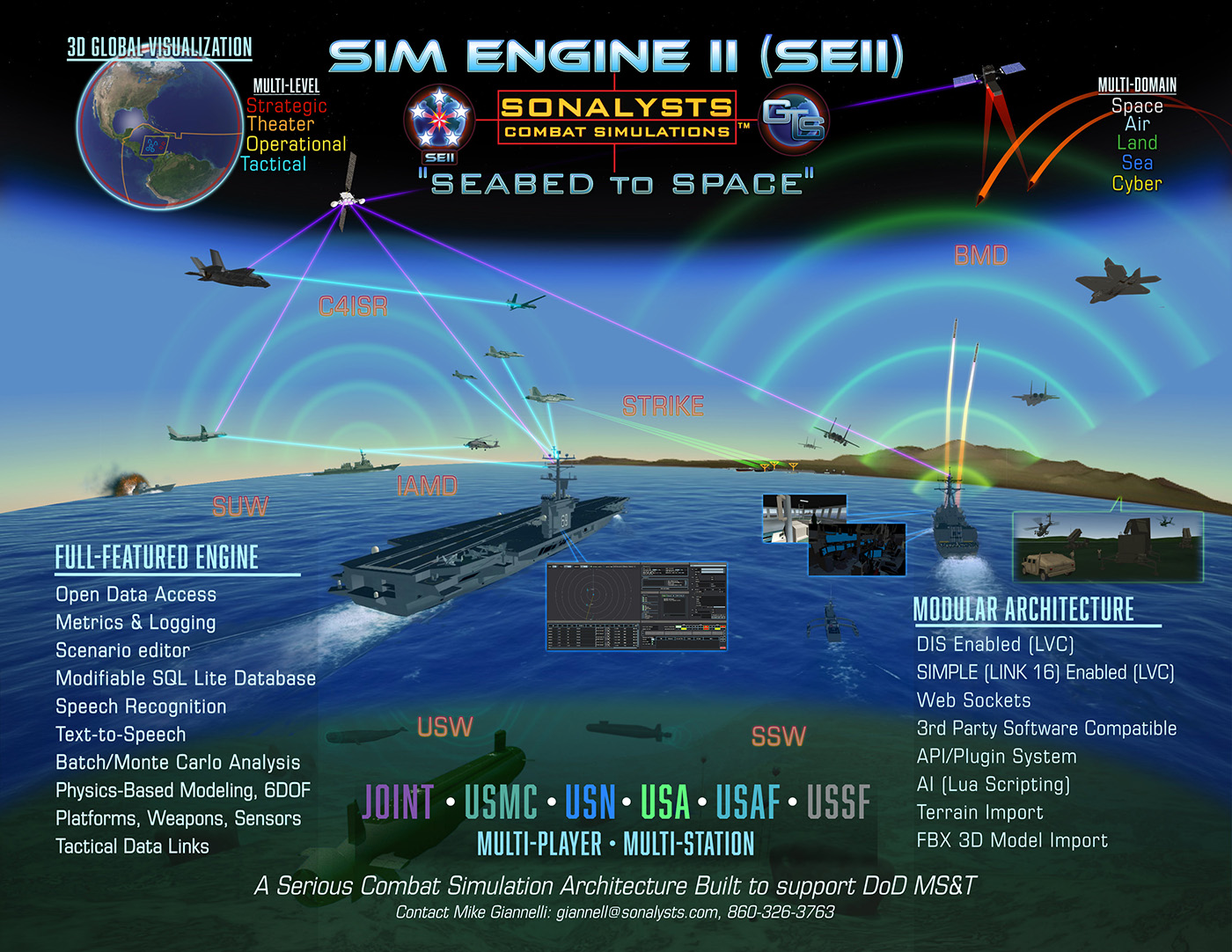
The larger technical foundation is Simulation Engine II, a commercial off-the-shelf combat simulation engine. It supports multiple domains and levels of operation, from strategic scenarios to individual operator stations. Sonalysts uses domain packages within a common architecture. That gives it a way to carry software foundations between assignments while still representing each customer's particular world.
The airline dispatcher is part of the design
The commercial aviation business is less theatrical than the recording studio, and just as revealing. Sonalysts' wXstation processes weather, flight-following, and operational data. Dispatch Weather Client presents integrated views and alerts to dispatchers, meteorologists, and managers. The company says the software operates around the clock at airlines and aviation service companies internationally.
Sonalysts describes computer scientists developing wXstation directly with meteorologists and dispatchers. Its product examples include Korean Airlines and NetJets flight displays. The system combines changing weather with flight information, so users can examine hazards in relation to current and planned operations. A weather map becomes useful through the work someone needs to perform with it.
That relationship between user and system runs through the defense work too. Sonalysts operates a Human Autonomy Interaction Laboratory to study people interacting with complex systems. Its facilitated design sessions bring operators, engineers, and program managers together. A 2020 consortium profile explains the practical concern: a product can satisfy its requirements and still fall short of the operator's needs.
- 01Understand the operatorWhat decision or task must improve?
- 02Model the situationWhich signals and constraints matter?
- 03Build, rehearse, assessCan a person use it effectively?
Ownership with a long memory
The Hinkles wanted to share ownership with the people working at the company. Sonalysts established its Employee Stock Ownership Plan in 1979. Since 1998, the ESOP Trust has owned 100% of the corporation. The company calls employees partners and links ownership to responsibility for customers and one another.
Its public description reports that more than 40% of employees have military experience and more than 75% are degreed professionals. Those measures describe overlapping groups. A veteran can also be an engineer; an analyst may bring practical knowledge that a specification leaves out. The combination helps explain why the company's training work puts subject expertise beside software and media skills.
ESOP established
100% ESOP Trust ownership
The mechanisms are more interesting than the slogans. Sonalysts says its Innovation Group mentors and incubates promising projects, and tuition reimbursement supports further education. At its October 2024 employee meeting, the chief financial officer gave an open-book review of company finances. Shared ownership becomes easier to understand when the owners can discuss the books.
A trainer keeps costing after delivery
Sonalysts' business model includes government and commercial contracts, proprietary software, and media services. It lists arrangements ranging from time-and-materials work to indefinite-delivery/indefinite-quantity contracts, along with GSA schedules and SeaPort NxG. Engineering and training assignments sit within procurement systems; a studio session belongs to a different buying process.
Published contract figures show what continued support can involve. A December 2024 government announcement reported a $7,943,026 modification for 2025 sustainment of fielded Standard Space Trainer hardware and software. A December 31, 2025 announcement reported a $10,067,623 modification for 2026 operational test and training infrastructure sustainment and Delta on-site support.
Modification announced December 31, 2025 for 2026 sustainment and on-site support.
Rounded from $10,067,623. A specific contract modification, not company revenue or the cost of launching Sonalysts.These figures make maintenance visible. A deployed trainer needs continuing hardware, software, and operational support. Information protection is another concrete requirement: in March 2025, Sonalysts announced Final CMMC Level 2 certification following an independent assessment, reporting a score of 110. The certification belongs to the practical infrastructure of doing defense work.
Borrow the method, respect the conditions
Sonalysts occupies a junction between specialist defense services, training technology, and creative production. Buyers comparing military simulation capabilities can also consider Ternion's FLAMES-based work or CAE's training systems. The distinctive feature here is the particular combination of operational experience, engineering, instructional design, and media facilities within an employee-owned organization.
The transferable lesson is modest enough to use. Identify the expertise beneath the product you already sell. Test where another customer needs it. Bring that customer into the design before a requirement becomes an expensive assumption. Reuse the software architecture where it fits, and give the new domain its own attention.
There are conditions attached to that lesson. As an editorial inference, a common engine cannot by itself establish that a model represents a new environment accurately, that a lesson teaches the required skill, or that a system fits an operator's workflow. Different physics, security controls, and procedures demand their own work. Sonalysts' public examples are useful precisely because they show specific people and problems behind the extensions.
A submarine soundtrack, an airline dispatch display, and a spacecraft training game appear to have little in common. Each asks someone to interpret a world they cannot conveniently hold in front of them. Sonalysts has spent decades building representations of those worlds. The recording studio is the part you can hear.
Go a little deeper
Explore Sonalysts, its simulation engine, aviation tools, and Power Station New England.
Watch the media production demo reel. Follow the company on LinkedIn, X, or Facebook, and the studio on Instagram. Read its cybersecurity announcement.