The first clue that Solsten is not a normal analytics company is the question it keeps asking. Not what did the user click? Not how long did the session last? Not whether a 34-year-old urban professional fits a media plan. Solsten wants to know why a person clicked, stayed, bought, quit, or came back. Its answer is a blend of psychometric assessment, behavioral data, affinity signals, and machine learning. The output is meant to help a team choose the product, message, feature, or audience before the expensive part begins.
That is a bold job description for any model. It is also more practical than the phrase "psychology-powered AI" makes it sound. Solsten’s best examples are not futuristic agents reading souls. They are game teams confronting ordinary, costly confusion: a new title loses players after day one; a beloved license could be built two different ways; an ad reaches people but the opening game experience fails to match the promise. In those moments, another chart of past behavior is only so helpful.
The Minneapolis-based company was founded in Berlin in 2018 by Joe Schaeppi, a clinical-psychology and user-experience practitioner, and Bastian Bergmann, a former BCG consultant and venture-studio founder. The two met in high school. Before there was a company, they co-wrote a 2016 Harvard Business Review article arguing that psychological assessment could improve group creativity. Solsten is that argument scaled up, commercialized, and pointed at customers instead of co-workers.

Gaming was the laboratory, not the ceiling
Solsten first sold into games because games produce dense feedback. Players make repeated choices under pressure, reward, uncertainty, and social competition. A studio can change an onboarding sequence or event, then watch retention and engagement move. Schaeppi has said Hasbro became the first customer from a prototype, with paid work from the start. That is a neat founder lesson: begin where the pain is expensive enough that a buyer will fund the proof.
The product family originally formed around two complementary views. Traits measures an existing audience through an adaptive assessment placed inside a game or app, then groups users by motives, values, communication styles, and other psychological characteristics. Navigator looks outward at prospective audiences, brands, interests, and market opportunities. Instead of asking only who already plays, a studio can ask who might care, how those people differ from a competitor’s audience, and what kind of experience would fit them.
The usable version of the Solsten loop
- Define one audience and one costly decision
- Measure motivations, values, and affinities
- Change the product, message, or creative
- Test the real-world metric that should move
The distinction matters. Behavioral analytics can tell a game team that players vanished at the tutorial. Solsten is designed to suggest why a particular segment found that tutorial flat and what emotional payoff was missing. It competes less with one neat category than with a messy budget: survey platforms such as Qualtrics, audience tools such as GWI or Audiense, product analytics such as Amplitude, synthetic-research startups, outside consultants, and the team’s own intuition.
“Most systems infer from what people do. Solsten helps infer why they do it.”Solsten’s current technology brief
What failed first
Plantopia, a card-based strategy game from Voodoo, entered early testing with weak day-one retention. The first temptation in game development is often additive: more content, more polish, another feature. Voodoo instead used Solsten data to focus the first-time user experience on progression and productivity, giving players a quicker feeling of empowerment and accomplishment. In Solsten’s published case study, day-one retention rose by 14 percentage points after the redesign.
The sharp point is not that psychology sprinkled magic on a dashboard. It changed the team’s mind about what to build. The initial problem looked like insufficient stuff. The research reframed it as insufficient emotional payoff. That is a copyable move: before adding inventory to a struggling experience, identify the motivation the opening minutes are supposed to satisfy.
MobilityWare faced a different failure risk before development. Was Monopoly Solitaire fundamentally a Monopoly game with Solitaire elements, or Solitaire dressed in Monopoly? Navigator helped the studio examine overlap between the two audiences before it wrote code. The team chose a direction, aligned around it, and integrated the license deeply. Solsten reports launch acquisition costs 70 to 80 percent below the wider Solitaire space, more than 60 percent day-three retention, and costs still 20 to 25 percent below the genre ten months later. Those are vendor-published customer results, but they connect the research to a decision and the decision to a metric.
The product moved up the stack
The gaming wedge worked well enough to reveal a larger market. Product teams, advertisers, and consumer brands all wrestle with the same gap between observation and explanation. By 2025, Solsten launched Elaris, an AI workspace that lets marketers question psychology-based synthetic audiences, generate ads and briefs, test ideas before spending, and keep the output tied to a brand. The company says the models are grounded in real first-party psychological research rather than scraped internet chatter.
Elaris changes both the buyer and the cadence. Traits can require an assessment, integration, and expert interpretation. Elaris promises an always-on focus group and creative workstation. Current plans use custom pricing and monthly credits rather than public fixed dollar amounts. The broader Solsten platform remains enterprise-led, with demos and sales conversations. In other words, there is no honest universal answer to what it costs. A buyer should count the software, integration, internal research time, creative production, and the test budget required to validate the recommendation.
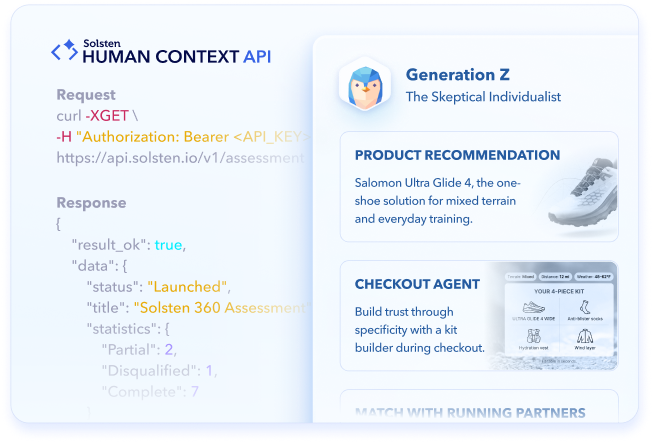
The company has also introduced a Human Context API, moving the idea from a destination dashboard into infrastructure. The pitch is that AI agents and personalization systems can draw on measured psychology and behavioral context instead of treating the entire internet as a customer profile. The current site says Solsten has more than 2 million psychological profiles, 140 million gameplay records analyzed, 200,000-plus digital-twin audiences, and 16 patents. Its 2026 validation page details a study of 497,161 people across 4,510 affinity groups and reports that adding psychographics improved predictive accuracy over demographics alone.
The money and the market
Public funding records put Solsten at roughly $30.7 million in equity financing through 2022: a reported $1.9 million early round, a $7 million Series A, and a $21.8 million Series B led by Konvoy. That last round included Inventure, GFR Fund, Sisu Game Ventures, Bascom Ventures, Galaxy Interactive, Dentsu Ventures, and Warburg Serres. In September 2025, Decathlon Capital Partners added growth-debt financing on undisclosed terms to accelerate Elaris and new AI-agent work. A supplied company record estimates total funding at $38.7 million, though public announcements do not disclose enough to reconcile the difference.
The business model is B2B software with data and expertise wrapped around it. The market is similarly layered. At the bottom are measurement and psychometric assets. Above them sit audience discovery, user research, product validation, segmentation, and creative optimization. Elaris and the API carry those assets into generative work and automated systems. This is a sensible expansion because the expensive part of research is often not learning a fact; it is getting the fact into the place where someone makes something.
What a smaller company can steal
- Pick a laboratory, not a total addressable market. Solsten used gaming because choices are frequent and outcomes are measurable.
- Start with a decision. “Which concept do we build?” beats “Tell us about our audience.”
- Translate traits into product changes. A persona has little value until it changes a screen, mechanic, offer, or sentence.
- Measure the metric after the insight. Retention, acquisition cost, sessions, and conversion keep a psychology story honest.
- Expand only after proof. Gaming supplied the cases; broader marketing and AI supplied the larger market.
Where the model stops
Psychographics can sharpen a hypothesis. They cannot turn a group-level tendency into certainty about one person. The approach weakens when the sample is unrepresentative, the audience is vague, the proposed segments are too small, or the team cannot change the product. It also fails quietly when a polished persona becomes theater - admired in a meeting, ignored in the build, and never tied to a test.
There is an ethical condition too. The same insight that can make a tutorial more satisfying can make persuasion more precise. Solsten says its data is first-party, anonymous, and privacy-conscious. Buyers still have to decide what they should optimize, obtain appropriate consent, avoid sensitive inferences, and keep humans able to contest automated decisions. “It converts” is evidence of performance, not evidence of benefit.
Do not buy this kind of tool if...
- You cannot name the audience, decision, and success metric in one paragraph.
- Your team wants research to bless a decision it has already made.
- You have no channel for testing or changing the real experience.
- You plan to treat predicted group traits as facts about individuals.
Solsten’s most interesting achievement is not that it has found a new synonym for segmentation. It has built a bridge between research and making: from a trait to a creative brief, from a motivation to an onboarding change, from an audience model to an API call. The company’s future depends on whether that bridge holds outside the unusually measurable world of games. The reader does not have to wait for the answer to copy the method: choose a painful decision, study the motivation beneath it, change one thing, and make the result earn the story.