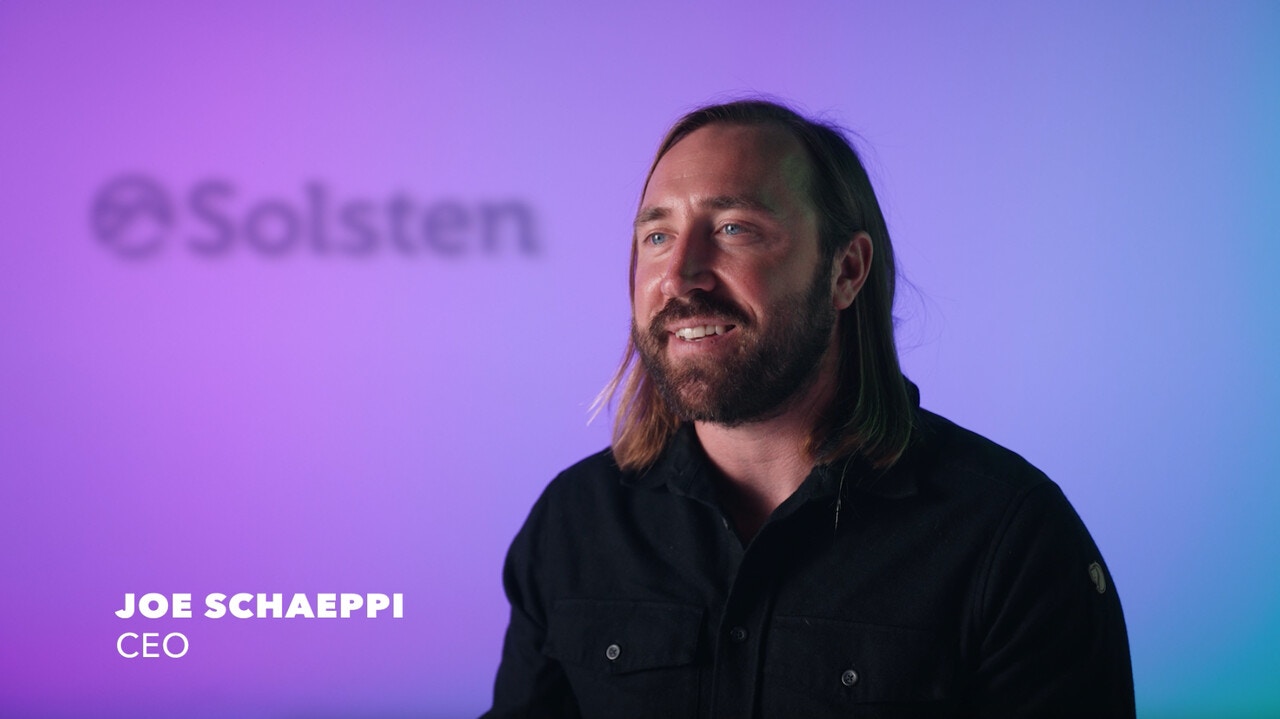
The first useful thing to know about Joe Schaeppi is that he does not trust a click to explain itself. A click is evidence of motion, not motive. It tells you where a thumb landed, while leaving the interesting part offstage: the hesitation, the appetite, the identity, the tiny private argument that ended in yes. Schaeppi has spent much of his career trying to bring that missing human context back into view. Today he does it as co-founder and CEO of Solsten, the Minneapolis-based audience-intelligence company born in Berlin under the name 12traits. Long before the software, though, he was already studying designed environments and the people moving through them.
His résumé reads like several curious lives stitched together. He volunteered as an orderly in a Minneapolis emergency room. He studied at the University of Wisconsin-Madison, where sailing and freestyle skiing appear beside the academics on his public record. He worked in adventure-based psychotherapy, became a ski athlete ambassador for The North Face, made photographs, designed digital experiences for large companies, and ran user experience at Big Fish Games. The switches look dramatic from a distance. Up close, they share a subject: how people behave inside experiences.
A mountain, a game and a phone screen each present choices. They reward attention, punish bad assumptions and reveal something about the person navigating them. Schaeppi’s peculiar gift has been to treat those settings as relatives. The skier reading snow and the player choosing a strategy are not data points wearing different costumes. They are humans revealing themselves through action.
The product was hiding in the pattern
In 2010, Schaeppi and his brother Nick founded Epicstoke, a self-funded design venture built around wind, snow, waves and sustainably sourced products. One project turned reclaimed highway billboard vinyl into wallets, bags and backpacks. The wallets reached Kickstarter in 2013 and raised $21,955 from 547 backers, comfortably clearing their goal. Each piece was made from a different portion of a billboard, so industrial waste returned as a one-of-one object. It was entrepreneurship with dirt under its nails, before audience intelligence meant a dashboard.
Then came agency work. At MRM McCann, Schaeppi worked on demanding digital programs for brands including Verizon, ExxonMobil, Intel and Cisco. A colleague later praised his combination of human-computer interaction, behavioral psychology, brand thinking and business sense. By 2016, he was senior manager of user experience at Big Fish Games. The medium changed, but his frustration sharpened: companies could collect oceans of behavioral data and still know remarkably little about the person producing it.
That year, Schaeppi and Bastian Bergmann co-wrote an article about using psychological assessment to assemble creative teams. The pair argued that companies should learn from the mix of traits inside a group while resisting the urge to trap anyone in a neat box. It is an important caveat. Psychological language can illuminate a person or turn into a fancy label maker. Their interest was in the first use: more context, less caricature.
Schaeppi saw games as an unusually rich setting for that work. Surveys capture what people say about themselves. Play adds decisions under pressure, trade-offs and patterns over time. His old affection for Ultima Online and The Legend of Zelda: Ocarina of Time suddenly belonged in the professional argument. Games were not merely entertainment inventory. They were places where people made revealing choices.
The Schaeppi loop
+ play
context
creative decisions
The cold email before the capital
Solsten was established in 2018 as 12traits. Schaeppi and Bergmann had gone to school in Minnesota together, while Bergmann brought a professional network in Berlin. Job postings drew a strong response there, so the founders anchored the team in the German capital while keeping the company American. Schaeppi later returned to Minnesota during the pandemic. The result was not a fashionable address chosen for a pitch deck. It was a practical bridge between places where the founders already had trust, talent and reasons to stay.
Before the rounds and product names, Schaeppi had a prototype. He has described starting with cold outreach to investors and potential customers, without warm introductions or guarantees. One email led to the first serious company agreement. It gave the young venture more than revenue. It supplied proof that someone outside the founders’ heads needed what they were making.
This is the practical idea hiding inside his more philosophical language: ask before you assume. Schaeppi applied it to selling, then made a company out of applying it to audiences. Founders often talk about conviction as though the market should admire a beautifully maintained certainty. His version is more useful. Have a theory, put it in front of another human and allow the response to damage it.
Solsten raised a $7 million Series A in 2021. A year later, Konvoy led a $22 million Series B, with reported total funding then reaching roughly $31 million. Dentsu Ventures joined the round and described three products: Traits for psychological characteristics, Navigator for audience discovery and experience design, and Frequency for predicting how creative assets might resonate. The names changed and the platform broadened, but the founder’s complaint remained intact. Age, gender and a favorite game are a poor substitute for knowing a person.
How much does a signal explain?
Conceptual illustration, not measured performance data.
Empathy as an operating discipline
There is an easy way to make “human-centered” mean nothing: print it on a slide and continue behaving exactly as before. Schaeppi’s public habits make the phrase more concrete. Asked how he stays open-minded, he said he follows accounts he vehemently disagrees with and tries to walk through the reasoning that brought each person there. Understanding does not require agreement. It requires enough patience to reconstruct someone else’s route.
The habit mirrors the product thesis. A customer segment is not a crowd of miniature versions of the founder. Schaeppi has repeatedly warned against treating one’s own taste as the audience’s. Product teams naturally design from inside their experience; his work asks them to step outside it, with evidence. Empathy here is neither softness nor theater. It is an information-gathering method.
His management description follows the same line. In an early interview, Schaeppi said his role was to help the team feel empowered, supported, challenged and fulfilled, while carrying the company vision through science, clients, fundraising and sales. Then he offered short advice for anyone entering games: “Be kind. Be friendly. And most of all, be helpful.” This is not the sort of maxim that start-up culture usually engraves on steel. It may survive contact with Monday morning better than most.
By 2025, Solsten was describing Elaris as a platform for creating ads, products and strategies informed by psychological audience models. The company announced growth funding from Decathlon Capital Partners that September. In January 2026, Schaeppi appeared on the Inside Startup Investing podcast to discuss a self-serve direction, and Solsten announced an exclusive partnership with Super League around audience intelligence for marketing programs. The business had traveled beyond its early gaming wedge without leaving play behind as an intellectual foundation.
A gentler tap on the shoulder
Schaeppi once imagined that marketing might eventually feel like “a gentle tap on the shoulder from a very good friend.” It is a revealing ambition because it gives personalization manners. The industry’s usual fantasy is perfect targeting: the right message, the right person, the right instant. His metaphor adds a harder requirement. A friend knows when to speak, what matters to you and, crucially, when to leave you alone.
That standard puts pressure on the technology and its makers. Psychological insight can be used to understand or merely to press harder on a vulnerable button. Schaeppi’s published work emphasizes anonymity, responsible design and experiences aligned with the audience’s interests. The tension cannot be solved by a slogan. It has to be managed in product choices, data practices and the incentives of customers. A tool for understanding people must be judged by what that understanding permits and what it refuses.
The useful lesson in Schaeppi’s story is not that every founder should become a psychotherapist, skier, photographer, UX director and game executive before breakfast. It is that careers often repeat a question long before the person recognizes it as a thesis. His question appeared on mountains, in agency workshops, inside games and in a recycled wallet company: what does this experience ask of a human, and what does the human bring to it?
Solsten is his attempt to make that question computational without sanding off the person. The company will be tested by the ordinary demands that test every ambitious platform: accuracy, usefulness, trust and whether customers keep paying. But the founder’s premise is sturdier than fashion. Behavior without context is a silhouette. If technology is going to shape more of daily life, its designers ought to know who is standing there.
A click still matters. It simply does not get the final word.