Spring had an appointment. The shirts missed it. Ryan Giese’s menswear brand, Tehillah, had prepared a collection for spring 2024, full of the colors a wardrobe might welcome after winter. The collection arrived in August. By then, the season it had been designed to inhabit was slipping away. A calendar is a surprisingly stern fashion critic.
Giese described the frustration in April 2025, when the clothes finally had another spring to meet. Tehillah had chosen to hold the collection rather than force a fall introduction. The name, A Time to Define, acquired an accidental second meaning. A business can choose its prints and its packaging. Choosing when the goods arrive is sometimes a more complicated negotiation.
For a profile of someone who also works at Anaconda, the Python and AI software company, that is a useful place to begin. Here is Giese dealing with a physical product, a missed season, and the unglamorous consequences of waiting. Before the software vocabulary enters the picture, there are shirts that need a rack and a reason to be there.
August was the wrong kind of early
There is a particular awkwardness to receiving something too late for one season and too early for the next. Giese’s account of the delay makes that awkwardness tangible. The collection was ready to be seen; the surroundings had changed. He chose to describe the disappointment openly in the brand’s journal, alongside the eventual decision to bring it out in spring 2025.
That decision gives the story its stakes without requiring a triumphant sales figure. Inventory has to wait somewhere. A collection intended for one moment has to survive until another. The words “spring collection” make a promise about timing as well as appearance. A floral print cannot negotiate an extension with September.
The clothes in Tehillah’s photographs are cheerful company: stripes, paisley, coral, blue. Their appeal depends on a person imagining somewhere to wear them. Holding a collection changes that invitation. Instead of persuading a customer to overlook the season, the brand gave the season another chance to do part of the persuading.
A Saturday with shirts on the table
On April 19, 2025, Tehillah held its first Men’s Spring Fashion Trunk Show at Christopher James Menswear. The collection had a room to enter at last. Giese’s account gives the morning the texture of a Saturday gathering, with coffee, croissants, and people who already knew the brand mingling with people encountering it for the first time.
A trunk show has an advantage over a product page: someone can pick the thing up. A sleeve can be turned over. A color can be held against a face. Questions have people attached to them. The occasion lets a shirt graduate from a picture into an object, with all the useful scrutiny that entails.
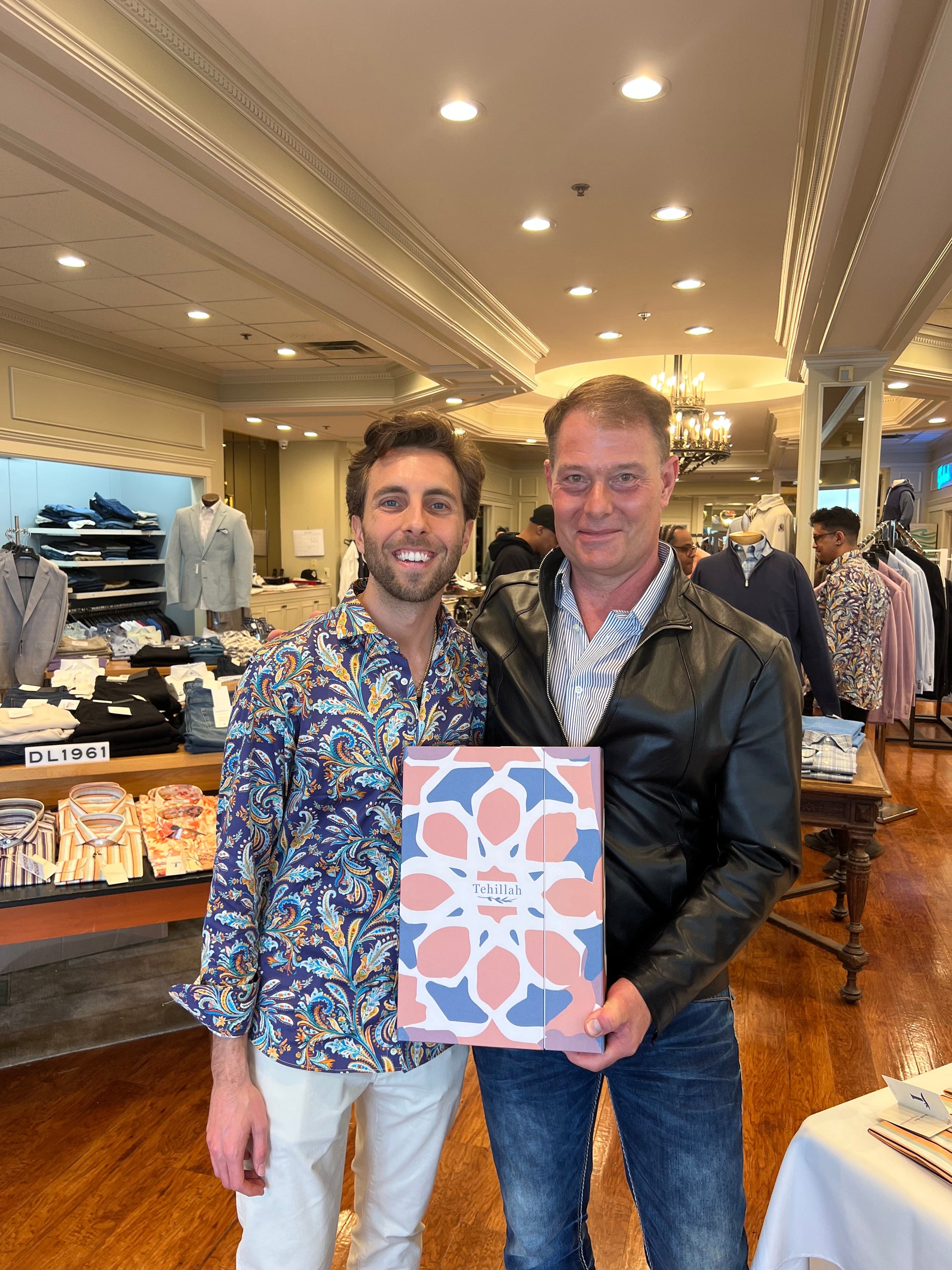
Look at the event photograph. Giese wears a paisley shirt; beside him is a large patterned Tehillah box. Behind them, folded clothes occupy tables and jackets hang on racks. The packaging has as much appetite for color as the garments. Nothing in this picture suggests an ambition to disappear politely into the background.
For customers, the room offered a straightforward proposition: come close enough to decide. That is a modest achievement for an event, and a consequential one for a business. A carefully arranged photograph can attract attention. A shop floor lets attention turn into a question, a fitting, or an opinion delivered without a comment box.
The box makes its own introduction
Tehillah’s store describes shirts made in Italy through a family-owned manufacturer and fabric mill, with limited production runs and cotton fabrics. Those are the particulars a customer can consider before the broader language of luxury gets involved. Geography, material, and production scale give the product a shape that an adjective alone cannot supply.
The brand’s own origin account treats clothing as a creative medium. Color matters. So do the materials and the work of the people making the garments. The aim is to make clothing that remains useful in a wardrobe rather than depending entirely on the excitement of its first outing. That is the intention the brand sets out; the wearer supplies the eventual verdict.
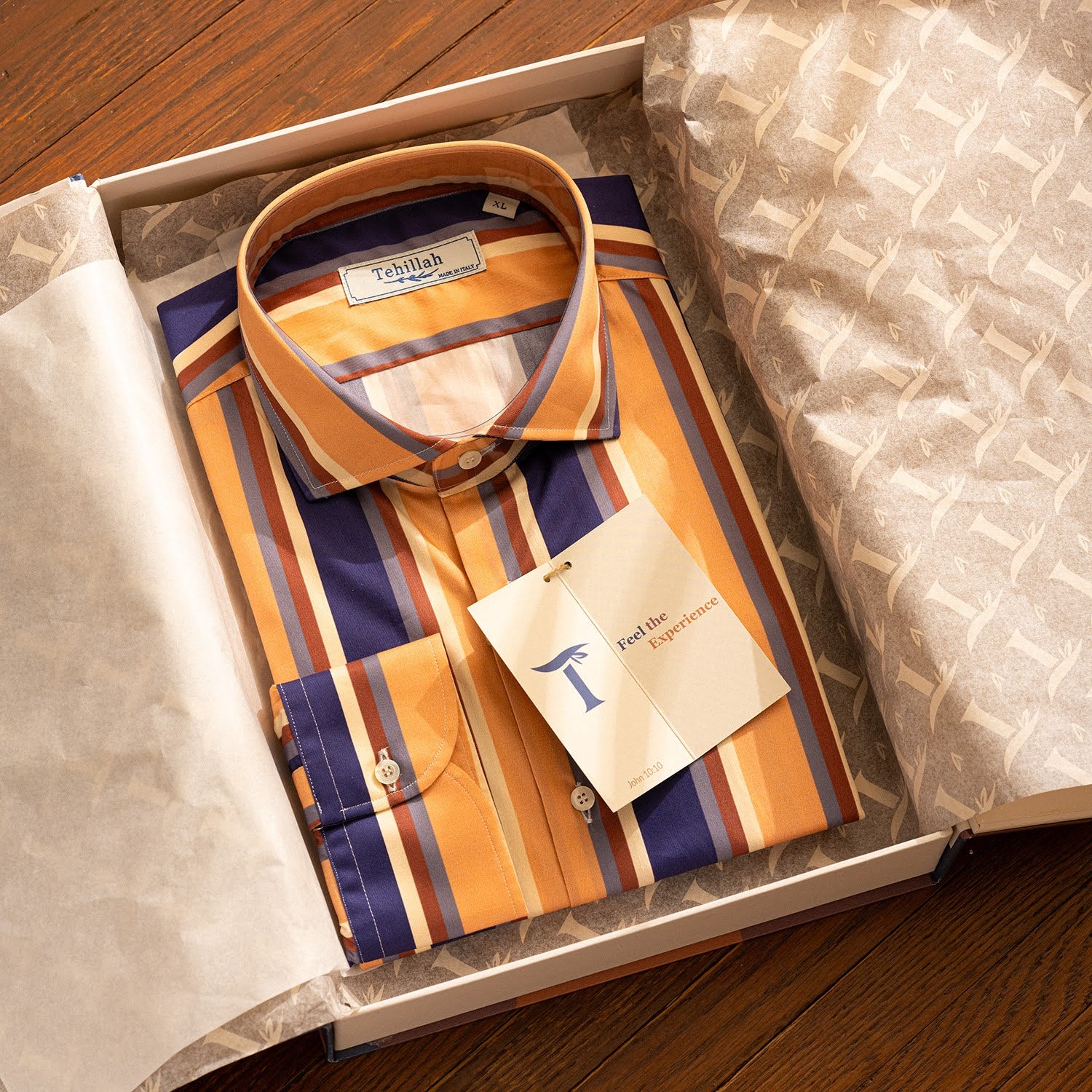
The presentation box makes the point visually. Its print extends the attention paid to the shirt into the moment of opening it. Packaging gets only a short performance, but it has the stage to itself. Here, it prepares the customer for a product whose maker would like the details to receive a little time.
Fort Wayne supplies the setting
Giese’s public profile places him in St. Petersburg, Florida. Tehillah’s journal keeps returning to northeast Indiana. In May 2025, he wrote about a collaboration with Spoke & Ivy in Fort Wayne, taking the clothes into a restaurant setting. The collaboration gave the garments a social life beyond the neutral background of a catalog.
That matters to the way Giese presents them. A shirt at a table becomes part of an evening someone might recognize. The setting makes room for conversation, company, and a reservation. A customer is invited to imagine an occasion as much as an outfit. The photograph has a job to do before anyone checks the available sizes.
In July, the journal moved to Fuel Social Club in Auburn for Watches, Wine, Whiskey & Wheels. Tehillah participated in an event organized around several kinds of objects people enjoy discussing at length. Watches and cars are especially obliging conversational accomplices. Put enthusiasts in the same room and the objects rarely need much introduction.
These outings give the brand a specific map. Fort Wayne and Auburn recur as places to meet people, collaborate, and show the clothes. They also keep the founder’s writing anchored to actual rooms. His idea of a menswear business includes the surroundings in which the product will be noticed, handled, and worn.
Another kind of product conversation
At Anaconda, Giese works in business development. In an October 2025 post, he described being a little over a month into the job and discussed a company case study involving Python development at a scientific instruments business. His interest was in how teams could expand their work while maintaining controls around it.
The language changes: workflows, governance, scalability. The need to explain a product remains. Someone considering a software platform has to understand how it fits the work already happening around it. Someone considering a shirt has to understand the fit rather more literally. Each conversation eventually reaches the particulars.
There is an obvious temptation to turn these two occupations into a grand theory about innovation. The smaller connection is more useful. Giese spends time presenting things to people who must decide whether those things will work for them. A buyer’s question can interrupt the loveliest prepared explanation. That interruption is often where the useful conversation begins.
“I think the problem is in my prompt but I can’t get it better.”
Ryan Giese, asking for help with AI imagery for Tehillah
His own experiments with AI make the connection practical. He asked publicly for help getting image-generation tools to produce the aesthetic he wanted for Tehillah’s marketing. The question came with frustration rather than a polished demonstration. Technology, in this instance, had been invited into the clothing business and still needed some direction.
The founder who asks for help
In a separate exchange with Angie Carel about AI product photography, Giese welcomed the chance to try new mockups for Tehillah and thanked her for what he had learned. The exchange is small, but revealing about the work itself: marketing involves experiments, other people’s knowledge, and tools whose results need inspection.
A founder may have a clear taste and still need help translating it into an image. That gap is familiar to anyone who has commissioned creative work. Describing the desired result is its own task. A machine can supply another version almost immediately; deciding whether that version belongs to the brand takes a human judgment.
For Giese, the question has somewhere concrete to land. Tehillah has actual fabrics, actual patterns, actual packaging. Those objects provide a reference against which an attractive image can be assessed. A convincing picture needs to serve the thing being sold. Otherwise the marketing has wandered off wearing somebody else’s shirt.
A Countach is a fairly ambitious souvenir
The journal also contains a less workmanlike ambition. After the 2025 Labor Day gathering at Worldwide Auctioneers in Auburn, Giese wrote about sitting in a Lamborghini Countach and wanting a future visit to end with driving one away. He also entertained the appeal of a 1955 Mercedes-Benz 300SL Gullwing. The shopping list had become considerably less portable than a shirt box.
The anecdote is enjoyable precisely because it stays an aspiration. It gives the founder a taste for machines with theatrical outlines and distinctive design, alongside his taste for patterned clothing. Cars offer another setting in which people inspect craftsmanship, compare details, and attach stories to objects. The journal follows that pleasure as readily as it follows a collection launch.
His December 2025 entry turns to a more accessible occasion: Christmas prime rib. Giese recounts adopting the meal as a family tradition after enjoying it with a friend’s family. The story moves from an invitation at someone else’s table to a ritual at his own. The centerpiece changes, but the interest in making an occasion returns.
Read together, these scenes give his working life a recognizable scale. There is the software conversation, the collection that waited, the shop gathering, the car he hopes to drive, the dinner saved for a holiday. The spring shirts eventually found their season. Around them, Giese keeps finding reasons to bring people into the room.