Ella Peinovich came home from Nairobi with an extra suitcase. Inside were things local artisans had made, beautiful enough to sell at her family’s art gallery in Wisconsin. The suitcase was proof of demand. It was also a terrible distribution system. A maker in Nairobi could produce a piece that a buyer in America wanted, but the route between the two ran through open-air stalls, cash transactions and, in this case, an airline baggage allowance.
That gap became SOKO. Peinovich, designer Gwendolyn Floyd and Kenyan technologist Catherine Mahugu founded the venture in 2012. Today it is a women-led, Black-owned jewelry brand selling rings, earrings, necklaces and bracelets made by independent artisans in Kenya. It also sells wholesale collections and production services to retailers and other brands. Its less visible product is the system that makes scattered workshops behave, for the purpose of an order, like one factory.
- SOKO sells contemporary jewelry made by Kenyan artisan partners.
- Its first open marketplace gave way to coordinated, repeatable collections.
- Mobile tools route orders, track work and help pay independent makers.
- Direct sales, wholesale and private-label work bring the designs to buyers.
01 / THE WRONG SORT OF MARKETPLACEA beautiful product with an awkward route to market
The first idea, called SasaAfrica, resembled an “Etsy for Africa”: artisans could offer their own one-off designs to shoppers elsewhere. It was appealingly direct. It also asked each small maker to be designer, merchant, marketer and export business at once. The founders learned that a loose assortment did not translate neatly into the shelves and buying calendars of large retailers.
Peinovich’s diagnosis was unsentimental: the perceived value of the goods did not match their actual value. Branding and marketing mattered. Floyd saw another constraint. The early jewelry reached a niche audience, while wholesale buyers needed a collection they could order, display and reorder. The team changed the proposition. Instead of building only a platform for artisans to list individual pieces, SOKO designed contemporary lines that makers could produce in series. In 2014, the jewelry brand took shape.
“The perceived value of the products didn’t align with the actual value of the goods.”Ella Peinovich, on the early marketplace
It is a useful distinction. A marketplace can expose supply; it cannot promise demand. SOKO’s pivot gave retailers a recognizable assortment and gave artisans a more predictable brief. The cost was taking on work the first model had left to makers: product design, brand building, quality control, inventory and fulfillment. An early case study describes time and money disappearing into both the technology platform and the effort to build supply and demand. The switch to wholesale did not make those jobs vanish. It made them SOKO’s jobs.

02 / THE HIDDEN PRODUCTThe factory is a phone call, repeated thousands of times
A conventional factory puts machines, managers and workers in one building. SOKO’s “virtual factory” coordinates people who remain in their own workshops. An order can be matched to a maker suited to the task. Other makers may produce components; one workshop might make a pendant while another makes its hook. SOKO brings the pieces together, checks quality and gets the finished jewelry to a customer or retailer. Artisans manage work and receive payment through mobile tools.
The ambition here is practical rather than magical. Many Kenyan makers had skill and mobile phones, but lacked easy access to global buyers, reliable distribution and the apparatus of a large supplier. SOKO built that apparatus around them. MIT reported a network of about 2,500 artisans in 2019. Its account said makers received 25 to 35 percent of final sale revenue, compared with a reported industry norm of 2 to 3 percent. Those are historical figures, but they show what the company was trying to rearrange: who gets the order, who carries the risk and who keeps the value.
03 / WHAT THE CUSTOMER SEESDesign has to earn the first glance
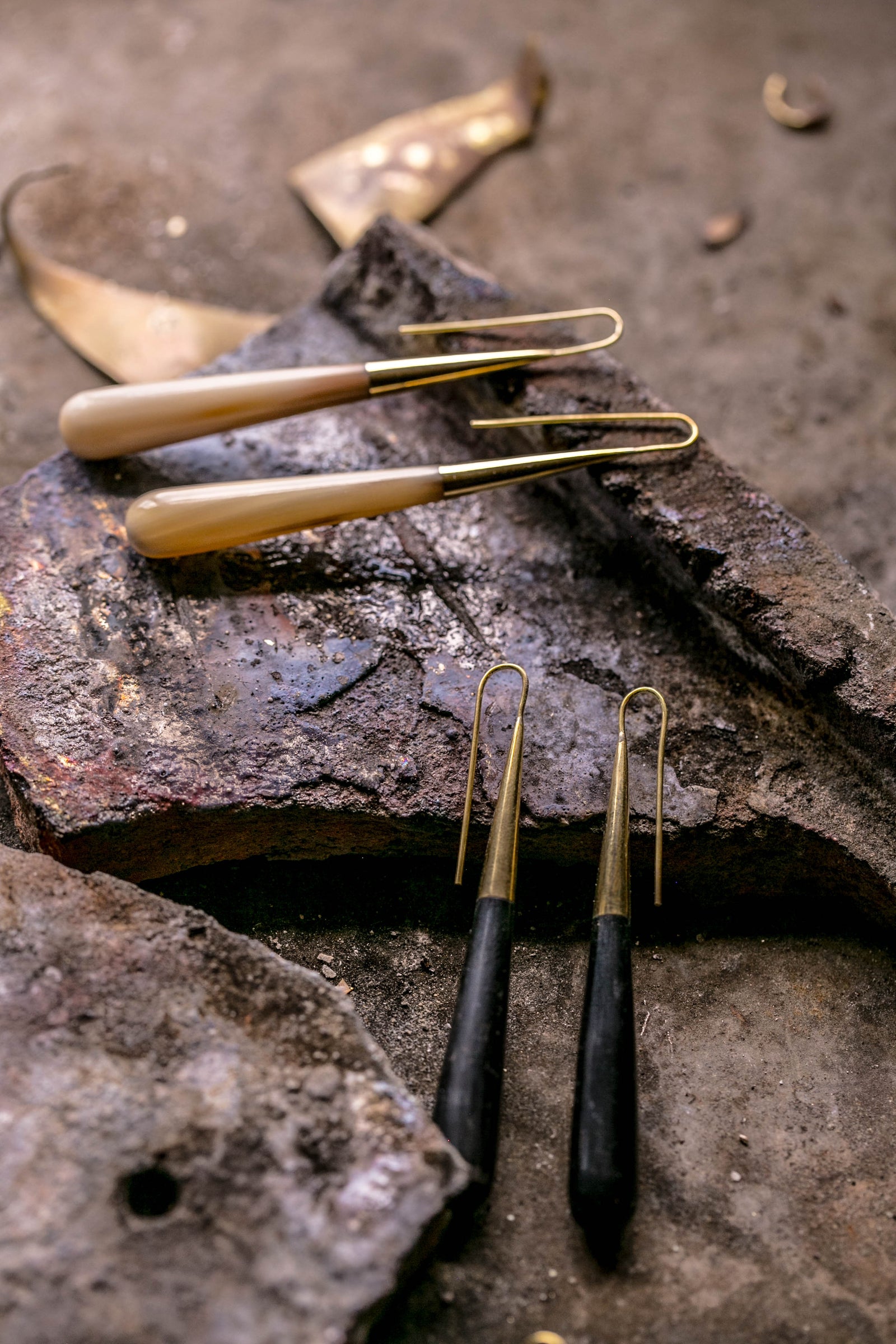
A customer shopping SOKO today sees sculptural cuffs, hoops, stacking rings, pendants and necklaces. The brand says its gold pieces use 24K gold-plated recycled brass; colored pieces use locally sourced recycled glass. It sells through its own store, where the current catalog spans inexpensive sale pieces and items priced near $300. For business buyers, SOKO offers branded wholesale lines, pre-designed private-label pieces and custom manufacturing from design through production.
The jewelry has to make sense without a lecture. Contemporary shapes let it sit beside other fashion jewelry in a store. Its origin then adds something a competing bracelet cannot borrow: a network of named skills and a different production arrangement. The contrast is clearest at Zales. In 2024 the chain put SOKO in its Designer Edit, with best sellers and exclusive Obiti pieces in 24K gold-plated brass. The launch assortment ran from $118 to $258. That was a long trip from selling one-offs through a fledgling marketplace.
04 / THE TRADEWhat a retailer really buys
Retailers buy more than a design. They buy dates, quantities, consistent finish and a plausible answer when something goes wrong. SOKO spent roughly three years, Peinovich told MIT, proving it could create demand for those buyers. Trade shows helped the company develop relationships with Nordstrom, Anthropologie and others. The wholesale channel also let SOKO borrow retailers’ existing audiences, reducing the amount it had to spend persuading every shopper alone.
There is a limit to this arrangement. An artisan network cannot live on admiration if orders are erratic. Peinovich later reflected that higher prices for SOKO pieces did not automatically mean more units for makers, and seasonal demand left production capacity underused. That observation led her to build Powered by People after leaving SOKO, but it also clarifies SOKO’s operating challenge: the better the brand becomes, the more carefully it must ensure that brand success turns into consistent work.
SOKO’s example is most useful where capable producers already exist, mobile communication is common, and buyers want repeatable quality. The copyable move is to start with the order: learn what a buyer can purchase again, define the quality standard, then build the routing, inspection and payment steps around independent makers. A collection without demand is decoration. Software without fulfillment is a demo. SOKO had to make both answer to a real piece of jewelry someone would wear.
The company’s mission is to create dignified economic opportunity, and its B Corp certification gives that claim an external framework. Still, the arresting part of the story is the modest object at the end of the chain. A ring looks simple. Behind it may be a designer, several workshops, a mobile order, a quality check, a retailer and a payment. The factory has no single address. The jewelry does.