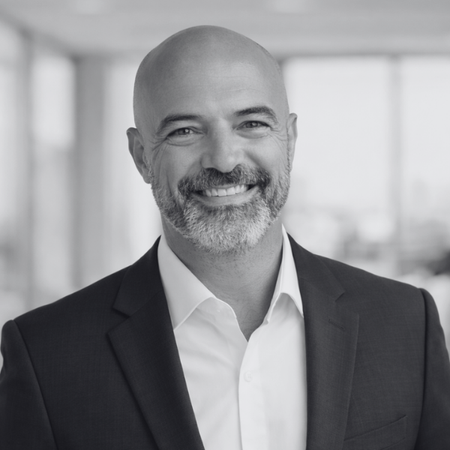
A bag company that measures success in people who never go back.
Ryan Berg runs an athleisure label out of Cincinnati. Totes, belt bags, backpacks, headbands - the kind of clean, well-made gear you would grab without a second thought. Then you turn the tag over. Every Aruna product is sewn by a survivor of sex trafficking, and that is not a marketing line stapled onto a supply chain. It is the supply chain.
The Aruna Project is two things wearing one logo. There is Aruna, the for-profit brand that has to compete on quality and price like anyone else. And there is the nonprofit underneath it - transitional housing, counseling, healthcare, a living wage - the part Berg calls holistic care. The brand creates the jobs. The nonprofit makes sure the jobs hold. Berg's word for the combination is freedom, and he is stubborn about the adjective in front of it: lifelong.
That stubbornness has a number attached. The Aruna Project says it has helped free and employ more than 160 women between India and the Tri-State, and that the corner of India where it works has seen an estimated 86% decrease in trafficking. Berg does not lead with revenue when he talks about growth. He leads with whether a woman who once had no options now has a paycheck that shows up every two weeks.
The name is the thesis. Aruna means "bright morning sun." It is the kind of word you choose when you have decided that the story does not end at rescue - that rescue is the easy part, and the morning after is where the real work lives. A raid frees a body. A job, repeated, two weeks at a time, frees a future.
Berg built the model the way an operator builds anything: by refusing the version that lets everyone off the hook. Donations are a moment. A purchase, by itself, is a transaction. A salary is a relationship. The company started with a single product - a humble drawstring bag - and grew into a full line precisely because a wider catalog means more orders, and more orders mean more women on payroll. The growth chart and the rescue chart are the same chart. That is the trick, and it is not a trick at all.
The essence of our work is not just freeing someone physically; it's about restoring a sense of self, a sense of dignity that trafficking attempts to strip away.— Ryan Berg
He was packing for a business trip when the TV changed the trip.
Here is the detail that explains the rest of the man. Berg was getting ready for a routine business trip to India when a news brief scrolled across the screen: twelve children had just been rescued from a brothel. Most people feel something and then finish packing. Berg rebooked his intentions. He took the trip - but with a new objective. He was going to find that brothel and see it with his own eyes.
He found it, and then some. He walked into a reality he could not un-see: hundreds of women held against their will, and a two-mile stretch of the city estimated to hold around 15,000 enslaved sex workers. That number is not a slogan. It is a census of the problem, and it became the founding wound of everything that followed. He came home and started building.
Aruna means "bright morning sun" in Hindi - the morning after rescue, made into a brand.
The catalog started as one drawstring bag and grew into totes, belt bags and backpacks.
Berg has lived and worked across the United States, China and India.
He co-founded the whole thing with his wife, April. They live in Cincinnati with three kids.
A race where the finish line is a name.
Awareness campaigns love big numbers. Berg goes the other direction. At the Aruna 5K, every runner pins on a bib carrying the name of an enslaved woman. You are not running for a cause. You are running for her, for 3.1 specific miles, with her name on your chest. It is a design choice that does what statistics cannot - it makes the abstract impossible to round off.
The flagship run starts at the National Underground Railroad Freedom Center in Cincinnati, which is about as on-the-nose as a starting line can be. The events have drawn more than 1,500 runners, expanded to roughly 18 runs nationally, and at one point chased a world record for the largest human chain to finish a 5K linked together - with Bengals linebacker Vinny Rey lending a shoulder. A memorial that fights back, basically.
Sex trafficking strips someone of their humanity. They are running for that individual.— Ryan Berg, on the named bibs
The bag is the byproduct. The job is the point.
Rescue frees a body. A wage, repeated, frees a future.