A friendly customer is a lovely thing to have until you need an unfriendly answer. Soham Ganatra discovered the difficulty while trying to make software integrations build themselves. An early customer, Glean, came through people he knew. Six months of work followed. The product failed. Encouragement had proved a poor measuring instrument.
For the next attempt, he sought out strangers. They had no friendship to protect and no reason to make room for an awkward product. That change belongs near the beginning of his story, before the fundraising figures and the expanding catalog of software tools. Ganatra had to improve the way he learned before he could sell a company built around helping AI agents learn.
The trouble with being agreeable
There is an uncomfortable courtesy built into early customer conversations. A person can admire the effort, like the founder, and suggest another feature without wanting the product very much. Each small kindness can look like progress. Put enough of them together and a calendar fills up while the central question remains unanswered.
Ganatra’s account of the pivot includes ten to twenty calls a day and visits to developer communities on Discord. The point was exposure to people whose judgment did not come bundled with affection. The practical test became whether somebody could put the product to work. Praise, however sincere, could only take him part of the way.
That episode gives the rest of Composio’s development a particular cast. Its co-founder and CEO works in a field full of predictions about what computers will soon do. His own route through it includes a reminder that an appealing possibility can consume months before becoming useful. A working result is a more demanding conversationalist.
A friendship before the company
Ganatra studied computer science at IIT Bombay from 2013 to 2017. His LinkedIn profile records a rank of 15 in JEE Advanced, the entrance examination. It also remembers the web and coding club, good friends, and the experience of making things. The credential and the recollection sit comfortably beside each other: an exact number followed by a much less formal account of university life.
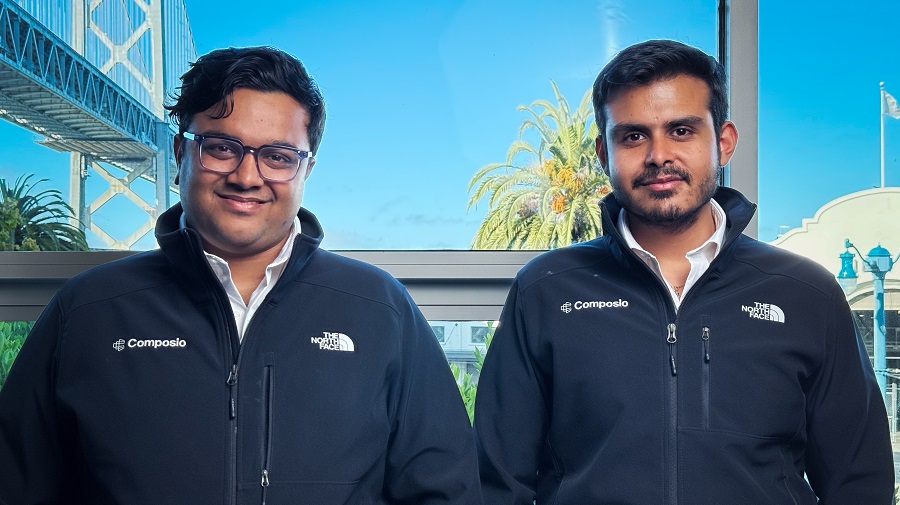
One of those relationships became central to Composio. Ganatra and Karan Vaidya met at a physics olympiad camp in 2012 and later shared a room at IIT Bombay. They founded Composio in 2023, with Vaidya as CTO. Their association predates the present appetite for AI agents by more than a decade. There is something reassuringly ordinary about roommates eventually having a company to argue over.
Ganatra arrived with experience from an earlier AI business and from Bureau. He co-founded Cogno AI, then worked as a founding engineer at Bureau, where his responsibilities included product and engineering management. Those roles placed him close to the work of connecting systems. Integrations are easy to describe in a presentation. Building and maintaining them gives the description a few more footnotes.
The background matters because Composio addresses a difficulty he had encountered at work. A new model can suggest a new product; an old engineering chore can suggest where that product will stumble. Ganatra’s career put both in view. The failed first attempt then narrowed the question: which part could a team make dependable enough that other people would want to build on it?
The unglamorous distance between thinking and doing
Consider a simple, hypothetical request: add a customer update to the right record and tell the team. A language model may understand every word. Finishing still requires access to the customer system, the correct record, a valid permission, and a message sent to the intended destination. Fluency does not supply those arrangements by itself.
- 01Understand
the request - 02Connect
the account - 03Choose
the action - 04Execute
and check
Composio occupies this practical territory, giving agents access to external applications and handling authentication and tool execution. In a March 2024 article, Ganatra described the obstacles in terms of integration scope, variety, and reliability. Developers were spending time with authentication and API specifications before they could make even basic agent applications work.
The framing is revealing. He directs attention toward the interface where an intelligent system meets somebody else’s software. That boundary can be awkward for reasons no amount of eloquence will repair. An account needs authorization. A function expects particular inputs. An action has to return something a program can interpret. The future of work occasionally has the manners of a form that rejects your postcode.
His March 2024 function-calling experiment made the problem concrete. It used ClickUp operations and a small set of fifty prompt-and-solution pairs to examine whether a model chose functions and supplied their arguments correctly. The article tested changes to how parameters were presented. Its question was whether the interface could become easier for the model to use.
That is a useful shift in responsibility. When a system makes a mistake, the surrounding tools deserve examination too. An interface designed for a human programmer reading documentation may be a difficult object for a model to navigate. Ganatra’s published work treats that mismatch as something to experiment with, rather than something to wave away in a demonstration.
The limits of that experiment matter as much as its premise. Fifty examples drawn from selected operations in one application can help compare interface choices. They give a developer a place to begin investigating. They leave plenty of questions about other applications and actual customer accounts. Ganatra put the setup and evaluation code into the article, allowing readers to examine how the test was constructed. The engineering value lies in making a question inspectable, with enough detail for someone else to try it.
A useful explanation has a working example
His writing also offers a way to see the founder at a smaller scale than the company announcement. The subjects include turning code commits into Linear issues, building an investment analyst agent, and using CrewAI for software workflows. These are bounded tasks. The reader can follow an example and decide whether it does something worth repeating.
The public trail is unusually practical. On DEV Community, Ganatra lists Python and Go among his skills and agent tooling among the things he is learning. His author page at Composio gathers tutorials alongside the financing announcement. Reading across them means moving from a corporate ambition to a function parameter without having to change authors.
For a developer product, that kind of teaching has a second purpose. A specific example lets a prospective user recognize their own work. It also makes disagreement easier. Someone can identify the step that failed or the application they need connected. The conversation has something solid to rest on. An account of the future rarely offers such convenient places to point.
There is a modest discipline here that suits the earlier lesson about customers. Show enough of the work that another person can try it. Give them room to decide. A tutorial cannot establish that a company will succeed, but it can establish something useful about one task on one afternoon. For people building software, that is a respectable unit of progress.
The money came with a harder question
On July 22, 2025, Composio announced a $25 million Series A led by Lightspeed Venture Partners, bringing announced funding to $29 million. Existing investors Elevation Capital and Together Fund participated. The round also included founders such as Vercel’s Guillermo Rauch and HubSpot’s Dharmesh Shah. By that summer, Composio reported more than 100,000 developers.
Company funding figures. These describe Composio, not Ganatra’s personal wealth.
Ganatra used his accompanying announcement to describe a shared learning ambition: let useful experience from one agent’s interaction benefit others. The proposition reaches beyond offering a list of connections. It asks whether the practical knowledge of completing tasks can accumulate, so that the next attempt has something more to work with.
“We're nowhere close.”
Soham Ganatra · July 2025
The short sentence appears in his own explanation of that ambition. It is a valuable interruption in a fundraising announcement. He goes on to ask how tacit knowledge can be captured and how experience can improve skills. Those are research and engineering questions, with room for failure between the attractive idea and its implementation.
Recognition followed. His Forbes profile places him in the 2026 Asia 30 Under 30 AI cohort. In August 2026, Step San Francisco listed him as a speaker. An October interview with Vaidya reported more than 500 Composio customers and ten million tool calls a day. Such figures describe a much larger operation than the early experiment. They also mean more occasions for the outside world to disagree with the software.
The TARDIS can wait
Away from the product descriptions, Ganatra’s personal site makes room for anime, coffee, robotics, and space technology. It singles out Lelouch vi Britannia and includes a promise to build a TARDIS by 2040. The time machine has, at least, a delivery date. Software roadmaps have been forgiven considerably less entertaining entries.
Those details give his ambitions a human scale. The same public identity accommodates a science-fiction joke and work on the stubborn mechanics of everyday applications. His current company has plenty to occupy it before time travel: requests that need the right tools, developers who need dependable results, and knowledge that should survive the next attempt.
The question that emerged from his early failure still applies. Will someone who owes you nothing find this useful? Ganatra can now ask it across a far larger business. Every completed task offers an answer. Every failed one gives him something specific to work on.