There is a peculiar ten-minute period after something interesting happens at an awards show. The audience is awake. The clip is fresh. The talent is still in the building. A brand that publishes now joins the conversation; a brand that publishes tomorrow files a report about it. SOCIAL INTELLIGENCE AGENCY® built a business inside those ten minutes.
The Los Angeles firm looks, from a distance, like a familiar bundle of agency services: social management, public relations, campaign strategy, influencer work, video, design and web production. Up close, the distinction is timing. SIA works where a publicist’s caution meets a creator’s reflexes. Its team captures footage, negotiates approvals, edits for the platform, watches the audience and posts while the room is still humming.
That is why its public portfolio leans toward places where delay is costly: the Grammys, the Emmys, the Grammy Museum, film premieres and talent activations. It also explains the spy-agency vocabulary. Staff are “agents.” Jobs are “missions.” The motif is playful, but a control room really does require clear roles, short communication lines and people who know what not to publish.
The assignment that changed the brief
Lisa Jammal arrived through entertainment publicity. She had worked around talent, screenings, red carpets and the choreography of permissions. In 2011, Kiehl’s asked whether she could run on-site Facebook and Twitter coverage for an Earth Day event in Santa Monica. She could. More importantly, she saw that the job was not merely typing updates.
A useful post might require a photograph, a talent check, a publicist’s approval, the right brand language and somebody empowered to press publish. Traditional PR firms understood reputation but often treated social as distribution. Early social specialists understood platforms but did not always understand the machinery around talent. Jammal recognized the seam.
“I knew the landscape was shifting for PR, with the onset of social platforms like MySpace, Twitter, and Facebook.”Lisa Jammal, founder and CEO
She launched The Tweet Squad that November. Her announcement was not coy: a large LinkedIn blast titled “GO TO SOCIAL MEDIA TEAM.” She later recalled that Monster Cable and Condé Nast Ideactive called the next day. In 2014, The Tweet Squad became Social Intelligence Agency. Jammal has cheerfully admitted that she wanted to be in the CIA; her own codename was LJAM 007.
The origin story is funny because the need was serious. Brands were discovering that social did not fit neatly inside old departments. It touched PR, customer care, media, creative, legal, partnerships and events. SIA’s name gave that messy coordination a memorable costume.
A post is the final inch of a long machine
Consider SIA’s own case file for the 66th Grammy Awards. The agency says it coordinated partnership content involving 11 Grammy House partners and 11 Grammys partners. Named sponsors included City National Bank, Dyson, IBM, Mastercard, Lay’s and Smirnoff. Its team supported community and partnership management before, during and after the show, then captured, edited and posted across Recording Academy platforms in real time.
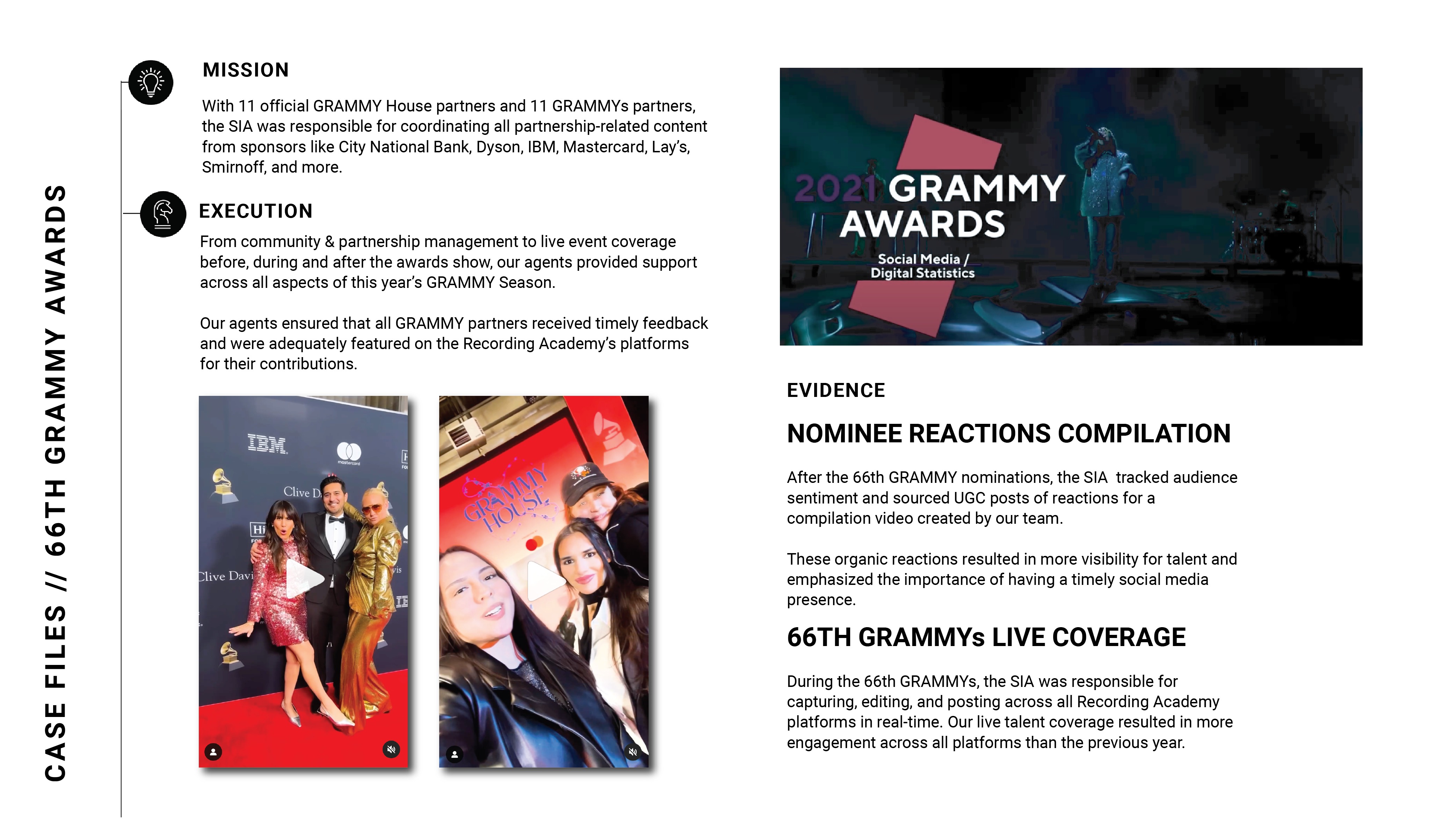
Another detail is more revealing than a vanity metric. After the nominations, SIA tracked audience sentiment and found user posts showing nominees’ reactions. The team turned those discoveries into a compilation. That is the work in miniature: listen, recognize an emerging format, secure usable material, edit it into a story and release it while the emotional charge remains.
The same pattern appears in the Grammy Museum work. SIA says it handles the institution’s social output from idea through execution, covering exhibitions and artist programming across K-pop, hip-hop, country, Latin and other genres. Short interview concepts go to talent teams for review before the visit. Preparation buys speed. The spontaneous-looking Reel has often been rehearsed as a decision tree.
What the customer is actually buying
SIA sells services rather than software. Public pricing is not listed; engagements are likely shaped as retainers or projects, with scope determined by channels, staffing, travel, production volume, response time and approval complexity. The customer is buying fewer handoffs. Instead of hiring a PR firm to guard the message, a production crew to gather assets and a social team to publish them, a client can put the three functions in one room.
The broad menu follows from that premise. Day-to-day social management keeps channels moving between events. Creative production supplies photography, social video, motion graphics, TikToks, Reels, GIFs and editing. Campaign teams handle theatrical and digital releases. Talent and influencer services coordinate activations and cross-brand exposure. Public relations and reputation work provide the judgment beneath it all.
This puts SIA between several familiar alternatives: entertainment PR firms, social-first creative shops, influencer agencies, event-production companies and an in-house brand team. Its strongest reason to exist is not that it can make all the things. Plenty of agencies can. It is that one team can make a reputational decision and a production decision at nearly the same time.
Strong fit
Live events, talent-heavy campaigns, entertainment releases, sponsor-rich programs and brands whose audience expects an immediate response.
Weaker fit
Low-volume organizations with predictable calendars, simple approvals or enough in-house staff to run strategy, capture and publishing themselves.
The first failure was financial, not creative
The tidy version of the agency story would move straight from Kiehl’s to the Grammys. The untidy version includes an early investment that fell through. In a 2019 interview, Jammal said fraudulent conduct associated with the investor left her with more than $50,000 in damage. She said she paid back everyone who was owed and continued without a loan.
The useful business lesson is less cinematic than “never give up.” SIA was selling work that could produce revenue immediately. A client could pay for an event crew, a campaign or ongoing channel management. That does not make a cash shock painless, but it gives the founder something fundable startups often lack: a direct line between today’s labor and this month’s invoice.
The company also changed as the medium changed. Jammal has pointed to Recording Academy work around 2017 as a turn toward more video. Static photos and clever captions were no longer enough. Short-form video, live capture and constant platform shifts expanded the production burden. The agency did not abandon its PR roots; it carried them into a faster format.
The part worth copying
Most companies cannot copy SIA’s access to an awards-show floor. They can copy its sequence. Before an event, list the moments likely to matter. Assign a person to capture each one. Decide who can approve talent, brand, sponsor and legal questions. Create platform-ready templates. Set an escalation path with a response time measured in minutes. Then give one editor the authority to assemble the pieces.
This works when the event produces attention worth catching, the team can reach decision-makers quickly and the brand has enough freedom to sound alive. It works poorly when every post needs a committee meeting, when rights are ambiguous, when there is no genuine audience moment, or when the expense of an on-site crew exceeds the value of being immediate. Speed cannot repair a dull event. It only reveals one faster.
That may be the agency’s most durable insight. Platforms mutate. Twitter becomes X. Vertical video eats the feed. Yesterday’s trick grows embarrassing. But the organizational problem remains: something is happening, people care now, and a brand must decide whether it has anything useful to say. SIA built its office in the gap between the happening and the decision.