The first thing Kr8 Agency shows you is a crowd of people you probably recognize. Beyoncé. Rihanna. The Weeknd. The photographs do the usual work of celebrity photographs: they stop the eye. Then the labels introduce a second cast, the one a fashion business cares about. Alon Livne. PAWAKA. C2H4. The person is famous; the name beside the person is the commercial point.
This is a useful way into Kr8, a Los Angeles creative agency whose public offering stretches from celebrity dressing to email newsletters. The distance between those services is the story. One produces the image a founder might frame. The other deals with what happens when somebody becomes interested enough to click.
Read the portfolio alongside the service descriptions and a proposition emerges: a fashion brand needs people who can help it get noticed, and people who can put that attention to work. Kr8 offers to occupy both roles. The interesting question is how the two connect.

The gift list gets shorter
Kr8’s celebrity services page contains an unusually restrained idea for a business built around exposure. It favors targeted products and occasional, exclusive gifting. It describes dressing for editorial shoots, music videos, award shows, and daily life, but resists treating gift distribution as a numbers contest.
“We ultimately believe less is more.”Kr8, on celebrity gifting
The underlying judgment is about fit. A label has a particular look, a particular customer, and a particular world it wants to inhabit. Sending its products everywhere can confuse that picture. A carefully chosen recipient offers a more coherent introduction. That is the logic of Kr8’s stated approach, rather than a claim that every selective gift pays off.
The agency then describes several uses for a placement: social teams can direct people toward the website, publicists can approach domestic and international media, and sales teams can bring the association into retailer conversations. In this account, the photograph has a working life beyond the first appearance.
Routes described by Kr8. Outcomes depend on the work that follows.
The inbox belongs in the picture
There is another revealing document in Kr8’s public footprint: a recruitment listing for a creative and ecommerce marketing intern. Its tasks include building email and SMS flows in Klaviyo, updating Shopify merchandising, organizing performance data from Meta, Klaviyo, and Shopify, and helping prepare weekly reporting.
That is a different view of the business from the celebrity gallery. It shows the machinery around the image: scheduled messages, product pages, test results, creative files. The listing also connects those tasks to shoot coordination and briefs for designers and video editors. Creative work and store operations appear in the same job description.
Consider a hypothetical customer who sees a piece of clothing, looks up the label, and reaches its shop. The customer now needs clear product information and a usable path to purchase. If they leave, an email relationship may create another occasion to return. The marketing problem changes at each step. An attractive photograph alone cannot answer every question along the way.
Kr8’s web service covers responsive design and development, visual assets, marketing language, and ongoing updates. Its email offer includes design, coding, writing, and funnels. The combination suggests a practical reason to hire across disciplines: the same brand has to make sense in a striking image and a fairly ordinary product description.
Pink fur, a metal mask, and a brand system
On Kr8’s brand development page, Saturdazed imagery sits alongside a description of work that includes logos, typography, and digital and printed materials. One photograph pairs a reflective face covering with a pink coat. It has a specific visual temperature. You would not mistake it for an insurance brochure.
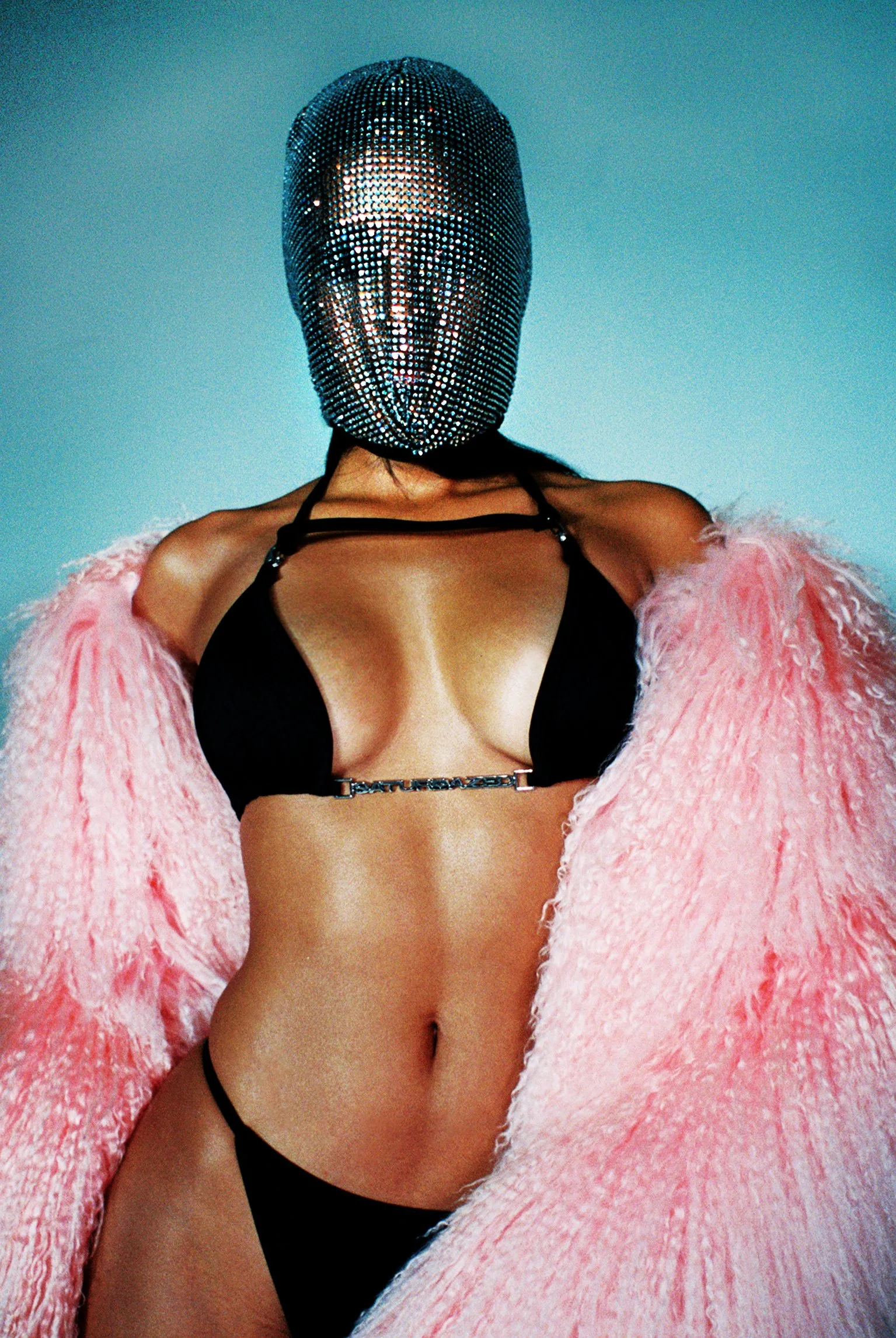
The agency describes brand development as a system extending through design, implementation, voice, and launch activity. The distinction matters for a young label. A logo is one decision. A recognizable set of choices gives the next photographer, designer, or copywriter something to work with.
This part of Kr8’s offer addresses the business before the publicity moment. What should the brand look like? How should it speak? Which details should survive when an image becomes a social post, an advertisement, or a page on the store? Those are useful questions even for a company with no celebrity ambitions.
Its content portfolio also names BARROW’s #BEYOURSELF campaign. The broader production menu spans photography, video, motion graphics, and newsletters. Creative direction extends to fashion advertising, editorial work, runway production, and styling. Taken together, these examples locate Kr8 close to fashion’s visual culture, where a campaign needs a point of view before it needs another format.
A monthly relationship, with several jobs inside
Kr8 describes its commercial offer as access to the benefits of an internal marketing and sales department through a monthly agreement. That is the business model a prospective client can evaluate: recurring agency work, organized around the brand’s needs.
For a buyer, the useful comparison is the set of jobs that need doing. A specialist publicist can focus on coverage. A design studio can concentrate on identity. A performance agency can work on acquisition. An internal team can hold the context. Kr8’s offer brings several of those responsibilities into one relationship, with fashion and entertainment as a visible center of gravity.
The promise is partly about reducing handoffs. A press pitch and a product page can begin with the same understanding of the brand. Whether that arrangement is worthwhile depends on the actual scope: who produces the assets, who operates the channels, and who reviews the results. A monthly fee is meaningful only alongside those commitments.
Before commissioning this kind of work, a brand can put the proposed spend into separate lines: agency time, production, media, and product or shipping costs. That is a buyer’s planning exercise, not Kr8’s published rate card. It makes the conversation concrete enough to compare with other ways of assembling the team.
Give the attention a destination
The copyable part of Kr8’s approach is straightforward. Start with a convincing match between product and person. Decide what a placement would help the brand say. Prepare the next customer encounter before celebrating the exposure. Then judge each channel by the job assigned to it.
This also clarifies where the approach needs care. If a famous person’s audience has little reason to want the product, visibility may be a poor substitute for relevance. If the store cannot answer basic buying questions, a visit may end there. These are planning conditions, not episodes from Kr8’s history.
The gallery establishes the kind of cultural territory Kr8 presents as its work. The service pages explain the activities it offers around that territory. Reading them together is more informative than treating a recognizable face as a sales report. For the right fashion business, the appeal is the prospect of continuity: somebody thinking about the photograph, the pitch, and the next visit to the shop.
A founder can enjoy the famous face. The useful next question is wonderfully mundane: where are we sending the people who notice?