In orbit, two objects can be headed for the same patch of nothing without either operator knowing what the other plans to do. A warning arrives. It may be one of many. The public catalog is imperfect, a satellite's intended trajectory can be private, and the other spacecraft may belong to a company or government whose phone number is not sitting in mission control. The problem sounds like geometry. In practice, it is geometry plus data rights, identity, communications and nerves.
Slingshot Aerospace has spent the past five years trying to put those pieces on one screen. Its software shows operators where objects are, what they have done before, what looks odd and what might happen next. Its optical sensors supply observations. Its Seradata business supplies decades of launch and spacecraft history. Beacon lets operators coordinate around close approaches. A physics-based Digital Space Twin makes the whole mess visible. Agatha hunts for abnormal behavior; TALOS plays an adaptive satellite adversary in military training.
This is not a rocket company. Slingshot does not move objects with engines or collect glamorous pictures of Earth. It sells the less cinematic layer underneath the space economy: the data, simulations and decision tools that help somebody decide whether a dot is debris, a maneuvering spacecraft or a problem.
The first product was focus - and it arrived four years late
The company began in 2017 with three founders: serial entrepreneur David Godwin and former Air Force officers Melanie Stricklan and Thomas Ashman. Their original observation was sound. Satellites, aircraft and drones generated oceans of imagery and sensor data, but useful answers could arrive after the moment to act had passed. Slingshot would apply analytics and machine learning across defense, disaster response and commercial markets.
The trouble was scope. Slingshot was tackling geospatial intelligence on Earth and situational awareness in space at once. Stricklan later offered the refreshingly plain postmortem: “We cast way too wide of a net.” When she became CEO in 2021, the company followed the evidence. Its traction, expertise and enthusiasm were in space. Geospatial work was dropped.
Turn satellite, aircraft and drone data into fast decisions across many industries.
Build the data and operating tools for satellites, debris and behavior in orbit.
What failed first was not the technology. It was the assumption that one young company could win several data markets at once. What changed management's mind was not a futurist memo, either. Customers were pulling the company toward the place where its founders had lived experience and where the operational pain was sharpest. The lesson is less “follow your passion” than “notice which part of the plan keeps earning the right to exist.”
Buy the eyes. Buy the memory. Build the judgment.
The focused company still had a structural problem: a decision platform is only as good as the data arriving underneath it. In August 2022, Slingshot acquired two businesses. Numerica's space division brought a commercial optical network capable of daytime and nighttime tracking from low Earth orbit to geosynchronous orbit. UK-based Seradata brought SpaceTrak, a meticulously curated record of launches, spacecraft, operators and events reaching back to the beginning of spaceflight.
One deal supplied eyes; the other supplied memory. Slingshot has since expanded the network to more than 200 optical sensors at more than 20 sites. The distinction matters. A software vendor dependent entirely on somebody else's feed can polish the interface, but it cannot control collection. Slingshot can task sensors for a particular object, refine observations and mix them with government, operator and third-party data. Seradata then helps an analyst understand what that object is and the history around it.
That integrated stack is Slingshot's real differentiation. LeoLabs is strongly associated with radar tracking in low Earth orbit. ExoAnalytic built a large telescope network. COMSPOC specializes in catalogs and conjunction analysis. Kayhan Space focuses on automated collision workflows. Large defense contractors can deliver classified systems. Slingshot overlaps all of them without being identical to any: optical sensing plus historical context plus a software layer that runs from visualization to coordination and simulation.
A group chat for conjunctions, an adversary for rehearsals
Beacon is the easiest product to understand because its problem is so human. A conjunction alert says two objects may pass dangerously close. Operators then need to compare better trajectories, understand maneuverability and contact one another. Beacon centralizes alerts and gives both sides a coordination channel. In 2022, Slingshot made it free. That was partly a safety decision and partly smart network design: collision coordination is more valuable when the other operator already belongs to the network. By 2023, the company said Beacon included operators responsible for roughly 90 percent of active satellites in low Earth orbit.
The defense products are more unusual. Agatha, developed with DARPA, compares the behavior of thousands of satellites, finds outliers and tries to explain why they are different. In 2024, Slingshot used it to identify an unusual member of a group of Chinese reconnaissance satellites. TALOS goes from detective to sparring partner. It learns representative spacecraft behavior and generates adaptive opponents inside a physics-accurate simulation, letting Space Force Guardians practice against something less predictable than a scripted exercise.
That military training work became material business. A 2022 SpaceWERX-backed contract carried a $25.2 million value. In January 2026, Slingshot announced a $27 million, 18-month award for Space Force training infrastructure. Six months later came MENTAT, a $69.2 million, 4.5-year program named after the human strategists in Dune. Slingshot calls it the largest contract in company history. MENTAT is designed to bring AI-enabled mission rehearsal out of occasional large exercises and into Guardians' regular work environments.
Civil agencies buy a less martial version of the same competence. NOAA chose Slingshot to build the user-facing layer of its Traffic Coordination System for Space, the planned civil successor for services now delivered through the Defense Department's Space-Track.org. The base year was valued at $5.3 million, with four possible option years. The UK Space Agency later selected Slingshot to expand sovereign optical tracking. The customers differ; the job stays recognizable: turn fragmented orbital information into a decision somebody can defend.
The price tag depends on which front door you use
Slingshot does not publish a neat enterprise price list. Its revenue model mixes software subscriptions, licenses, data and API consumption, on-demand sensor tasking, hardware, integration and multi-year government programs. This makes the company more durable than a raw-data shop in theory, but harder to evaluate from outside. Government work can be large and sticky, yet awards arrive in lumps and carry milestones, security requirements and procurement risk.
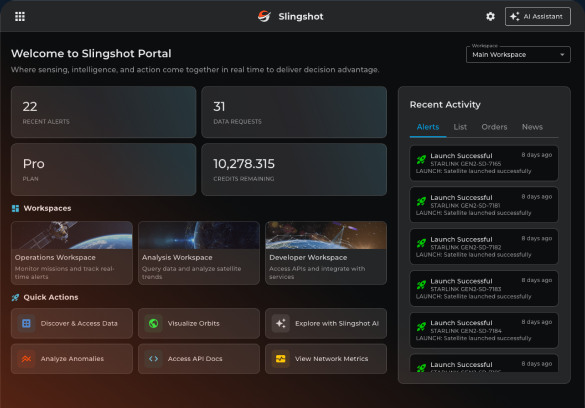
Portal, launched in April 2026, creates a simpler entrance. Its free plan includes one seat, a 14-day Pro trial, basic space data, the Digital Space Twin and an AI assistant. API calls and tracking requests use credits. Four months after launch, Slingshot said Portal served more than 330 commercial, civil and national-security organizations in 19 countries, representing growth of more than 400 percent. That figure measures organizations, not paid accounts or revenue, but it shows how a self-serve product can seed a market traditionally reached through contracts and conference rooms.
Commercial operators
Monitor fleets, triage conjunctions, request tracking and coordinate maneuvers.
Defense
Detect unusual behavior, rehearse threats and deploy in secure or disconnected environments.
Civil agencies
Deliver traffic coordination, public services and shared operating pictures.
Sovereign customers
Own sensors and retain an independent national view of orbital activity.
What other builders can steal
Slingshot's playbook is useful well beyond aerospace. First, narrow the market when the evidence becomes lopsided. The company did not keep geospatial alive as a comforting second option. Second, find the scarce inputs your software cannot manufacture. Numerica and Seradata made the product harder to copy because they added collection and context, not just headcount. Third, use free access where network participation improves the paid product. Beacon needed operators in the room; Portal needs an ecosystem of users, data suppliers and developers.
The five-line copybook
- Kill the broad thesis when one use case repeatedly wins.
- Own a scarce data source instead of renting every input.
- Acquire context that makes raw observations useful.
- Make the coordination layer easy to join.
- Sell outcomes - fewer bad decisions, faster rehearsals - not “AI.”
The limits are just as instructive. This model works when mistakes are expensive, data is fragmented, domain expertise matters and customers can fund a long build. It works less well if public data is already complete, the customer only wants a commodity feed, operators refuse to share essential trajectories, or the buyer has no authority to act. Optical sensors also have physical limits: clouds, geography and illumination matter, which is why the broader market mixes optical, radar, radio-frequency and space-based observations.
Slingshot's largest risk may be the breadth it has rebuilt after escaping breadth once. Portal, sensors, data, collision workflows, training, AI agents and sovereign systems are a formidable bundle - and a demanding product surface for a roughly 220-person company. The defense tilt brings money and validation, but also budget cycles and shifting policy. Meanwhile specialists can attack individual layers with sharper tools.
Still, the logic holds together better than the original everything-data pitch. Slingshot is no longer trying to explain every image from above. It is trying to make one unruly place operational. Space does not need another metaphor about the final frontier. It needs accurate observations, a useful history, a phone book and a rehearsal room. Slingshot has spent nine years assembling exactly that.