The first thing to understand about Silver Lining is that its founder once had the problem she was trying to solve. Carissa Reiniger was helping small businesses grow. Her own company was expanding. Yet the economics were awkward: delivering personal attention cost money, and the people buying that attention were often short of it. A business devoted to making other businesses sustainable needed a more sustainable way to work.
- The offer: a sales plan, software and continuing human support.
- The price: $199 monthly, with reduced pricing for eligible smaller businesses.
- The lesson: put the next customer-finding action on the calendar.
Today, the New York-based company sells silv=r™, a subscription platform for small business owners. It helps them decide how much money they need to make, identify their customers and organize the work of finding those customers. Around the software sits a support system of experts, live sessions and fellow owners. The interesting product is the arrangement of those pieces.
The advice business meets its own invoice
Reiniger started Silver Lining in Canada in 2005, aged 22. She had studied psychology and worked in advertising. Small business networking events offered a way to meet people in Toronto; the conversations became a reason to change careers. She interviewed 400 owners while developing the Silver Lining Action Plan, mercifully shortened to SLAP.
The early company sold consulting. By 2007, it had four offices, including Toronto and Las Vegas. That looks like progress until you examine the delivery costs. In a 2017 interview, Reiniger described overhead and consulting fees that were too high, alongside a model that could not scale. Every additional customer brought another demand for expensive attention.
The next version used corporate-backed training. Large organizations could pay to get owners into a room and teach them the method. Sponsorship helped solve the bill. But the training model left another problem intact: people went home. A workshop could explain sales strategy without providing the months of structure needed to carry it out. Silver Lining had improved access to knowledge while leaving execution unfinished.
Costly to scale.
Support ended too soon.
continuing accountability.
A revenue target needs a Tuesday
SLAPcenter, the first technology-enabled version, arrived in 2012. An improved version followed in 2014. In 2025, the product became silv=r. The new spelling puts an equals sign where the “e” belongs, a small typographic declaration of the company’s preference for action and results.
The working sequence is straightforward. Assess the business as it stands. Identify the ideal client. Define income streams and financial targets. Build a sales, marketing and connecting plan. Then translate the strategy into actions that fit the time and money available. A time budget belongs beside the revenue ambition, which is a useful bit of realism for anyone already doing three jobs.
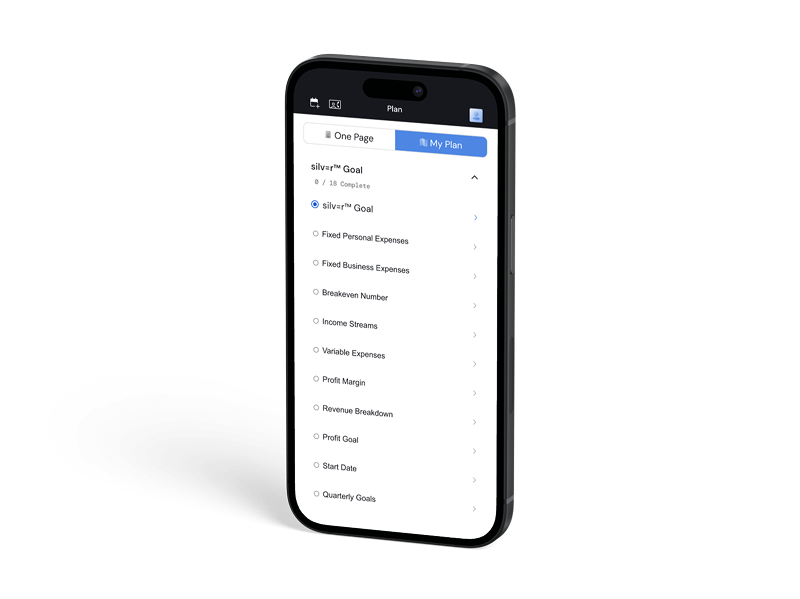
The platform includes sales tracking, campaign suggestions, challenges and opportunities to pause and review progress. Its current offer also includes an AI campaign builder. Human experts remain part of the service, with unlimited one-to-one calls advertised alongside the digital tools. Live “Meets” cover strategy, skills, access to industry leaders and connections with other owners.
The distinction matters. A spreadsheet can hold a target indefinitely. A course can explain the next move. Silver Lining tries to keep the owner in a continuing relationship with the plan. The expertise it sells combines business development with a system designed around behavior: prompts, feedback, repetition and somebody available when momentum disappears.
“We are a behavior change company”Carissa Reiniger, in a 2019 interview
The customer has several job titles
Silver Lining’s published customers include J CHEN PROJECT, a dance company; Talaysay Tours; Plan to Protect; and K&D Consulting. Their products differ. Their need to earn dependable revenue is familiar. This is a market of working owners, including people whose professional identity begins with artist, guide or consultant rather than entrepreneur.
The company’s current media kit reports more than 17,000 businesses served across roughly 80 countries. That is cumulative reach, rather than a count of paying subscribers today. It helps explain the breadth of the model: a shared planning structure can travel across industries, while the owner supplies the particular customer, offer and constraints.
Who pays for the follow-through?
The current advertised subscription is $199 a month, or $2,388 over twelve months at that rate. Businesses earning less than $120,000 annually qualify for Access For All pricing, which the website describes as a small percentage of annual revenue. The standard price therefore tells only part of the access story.
$2,388 over 12 months. Eligible businesses can qualify for reduced pricing.
Institutions are another customer group. Silver Lining offers partners customized branding, content and reporting, giving organizations an ongoing support platform for the businesses they serve. Wells Fargo supports the American Small Business Growth Program, launched in 2021. GoDaddy and JPMorgan Chase supported the Impact5X initiative. These relationships help connect the cost of sustained support with organizations able to fund access.
The comparison with competitors is therefore about delivery as much as software. Owners can hire a coach, attend nonprofit programs, take courses or assemble planning and sales tools themselves. Silver Lining bundles those functions around one continuing process. Its appeal depends on whether that continuity earns a place in the owner’s week.

The part you can borrow
The next moves extend beyond planning. Silver Lining introduced behavior-based financing in 2021. In 2025, it launched small., a media platform, and buy.small, a marketplace where active silv=r customers in good standing can appear without an additional fee. Its announced 2026-2028 strategy includes a proposed sale into a purpose trust.
For an owner reading this, the most portable idea costs nothing: work backward from the money the business needs, name the customer who can provide it, and reserve time for the actions that connect the two. Review what actually happened. Ask another person to help keep the review honest.
That approach requires participation. An owner seeking someone to take over selling may find a planning-and-accountability subscription a poor fit. Nor can regular check-ins create demand for an unwanted offer. Silver Lining’s useful proposition begins with a narrower, credible problem: even a sensible business plan needs repeated attention after the excitement of making it has worn off.