Carissa Reiniger had built the sort of company that looked good from the outside. Offices in four cities. A growing team. Customers, revenue, the agreeable bustle of expansion. Inside, the arithmetic was less flattering. Helping small businesses through an expensive consulting operation required charging prices that small businesses struggled to afford. Growth had enlarged the problem.
She eventually closed three offices and brought the operation back to Toronto. Training replaced consulting. Later, software replaced the training business as the central model. Each version asked the same question: how do you give an owner useful, sustained help without making the help another financial burden?
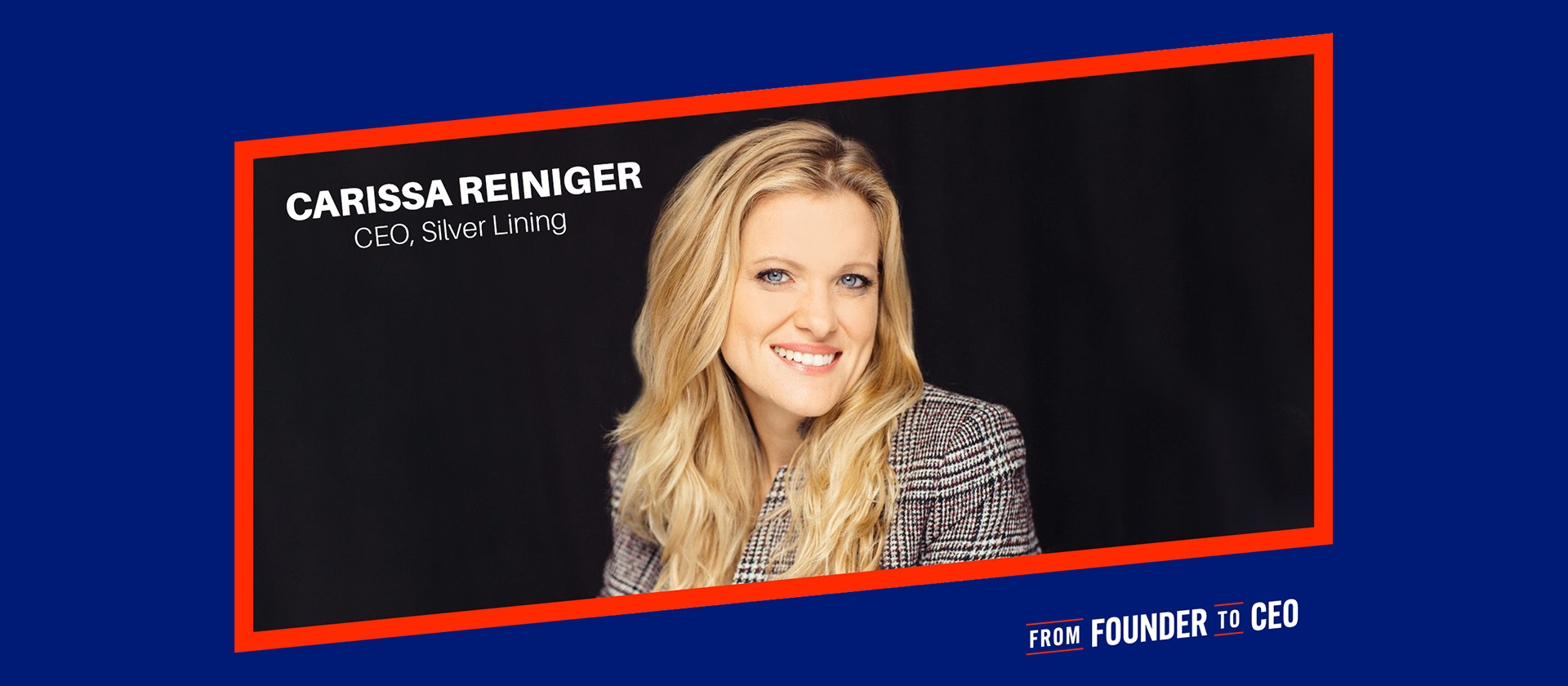
Reiniger founded Silver Lining in 2005, at 22. More than two decades later, her career offers a useful complication to the tidy founder story. The original conviction survived. The machinery built around it had to keep changing. That distinction explains rather more about her than a photograph beside an upward-pointing arrow ever could.
Four hundred conversations before the prescription
Before there was a growth program, there was an Edmonton upbringing and a psychology education at the University of Alberta. Reiniger initially imagined pursuing a doctorate and working with young people. She found herself drawn toward doing things in the world rather than continuing along an academic path. Toronto brought a different set of possibilities.
Her early working life included account management at Inventa and business development at TBWAChiatDay. She knew something about helping large companies make money. At networking events, which she initially attended to make friends, she encountered owners whose enthusiasm for their work was much easier to detect than their profits.
The mismatch bothered her. These people cared about what they made and sold. They worked hard. Yet affection for a business did not settle its bills. Reiniger wanted work she cared about, too, and saw a way to connect her business development experience with their practical needs.
Being 22 also supplied a useful objection: what, exactly, did she know about growing somebody else's small company? She responded by interviewing 400 owners over a year. Again and again, the conversations returned to insufficient time and insufficient money. Cash flow and capacity became the central problem she wanted Silver Lining to address.
Owner interviews helped shape the Silver Lining Action Plan. The listening came before the system.
The awkward economics of being helpful
The first version was a consulting business. It carried a familiar promise: hire people who can help, put them to work for clients, and expand as demand grows. Its weakness was equally familiar. Offices and management needed paying, while the customers came precisely because money was tight.
Around 2009, Reiniger recalled having roughly $400,000 in outstanding receivables. Some clients could not pay. Margins were already narrow. She faced a choice between finding more money to keep the structure standing and acknowledging that the structure itself needed changing.
The closures and layoffs that followed were consequential decisions, rather less photogenic than opening another office. The smaller company shifted into teaching its methodology for corporations and other organizations. Better margins allowed it to repay debt. An operation designed to help owners face their numbers had been forced into the same uncomfortable exercise.
By 2017, she was describing a third model: software subscriptions with different levels of support. Consulting had been difficult to scale affordably; training generated income but could not stay beside an owner for the long haul. The software business was her attempt to solve both problems together.
Same question. Different machinery.
- 01 / ConsultingPersonal attention, expensive overhead.
- 02 / TrainingBetter margins, shorter engagement.
- 03 / Software + supportA continuing plan, with accountability.
A sequence of business models, not a revenue chart.
A calendar has to meet the ambition
The name of her method has a certain lack of corporate delicacy: SLAP. It stands for Silver Lining Action Plan. The program uses behavior change science to help owners set financial goals and carry out the work attached to them. A plan has to survive contact with Tuesday afternoon.
The design brings marketing, sales and business development into a 12-month action plan. Owners can track progress and connect with other business owners and experts. Its underlying wager is understandable: repeated action, supported over time, offers something that a burst of inspiration cannot reliably supply.
Reiniger is particularly interested in how owners allocate scarce resources. In a 2025 conversation with Constant Contact's Dave Charest, she argued that businesses often spend their time and money on activities that fail to move them toward their goals. She presented that as her estimate from experience, rather than a universal measurement of small business.
There is a wonderfully unglamorous implication here. A founder might need fewer activities, a clearer ideal customer and a more disciplined week. Those are less entertaining purchases than a new promise of instant growth. They are also questions an owner can return to when the motivational talk has ended.
“You don't have to pay interest on revenue.”
Carissa Reiniger
Her preference for selling appears in an earlier conversation about cash: owners can seek investors, pursue a bank loan, or generate revenue. Each takes work. The third brings its own financial advantage, as her blunt observation about interest suggests. She keeps bringing the discussion back to customers.
Let the work count toward the money
In 2021, Reiniger founded Silver Lining Capital. The proposition extended her interest in behavior into financing: use activity in the SLAP program to assess access to capital. The everyday work of running a company could become relevant to the money available to it.
That is a consequential extension of her mission. A growth plan can identify a next step, but an owner may still need funds to take it. Linking the program and financing asks whether the relationship built through supporting a business can also inform how that business is funded.
Her wider projects include Thank You Small Business and Impact5X, which focuses on reducing barriers for owners from marginalized communities. She has worked with organizations including Google, Intuit and the White House to bring resources to small companies. The partnerships connect her daily concern with individual owners to institutions that can influence their opportunities.
Silver Lining also operates an Access for All policy, allowing customers to set an affordable price in relation to expected sales goals. The design carries an old problem from her consulting years into a different commercial answer: how much can the person who needs the service actually pay?
Her own apprenticeship included a job at a diaper-cleaning service, washing, drying and packing orders. She has described it with the obvious joke, then the less obvious lesson: no work was beneath her. It is a useful detail in a career spent asking other owners to do necessary, sometimes decidedly unshowy tasks.
She has also said she would ask for help earlier if she were starting again. As a young founder, she tried to appear as though she had everything worked out. The admission gives her interest in accountability a personal edge. Being responsible for a company need not require pretending to know everything about running it.
There are other stages
Reiniger's work has never fitted entirely inside a business dashboard. Her books on entrepreneurship include Inspiring Entrepreneurs, I Will and Thank You Small Business. Through Real Love Stories, she also published two relationship-story collections and created a play produced across Canada in 2007 and 2008.
The arts connection continues in her public role as board president of The Peace Studio. Business, storytelling and community recur across these commitments. An owner explaining a company and a person telling a story both ask someone else to pay attention. Reiniger has spent considerable time arranging the encounter.
In 2026, she hosted Krista Monson on small.talk. Both came from Edmonton. They had first met over lunch in Las Vegas about 20 years earlier; Monson later sought Silver Lining's help while building Sincerely Yours Memoirs. An old conversation had become a working relationship. For a founder who began by listening, it was a fitting reunion.
Small is a choice, too
Her own company works internationally, but she argues that owners should be able to define success without accepting growth at any cost. A small business can have value as a small business. Remaining that size can be a deliberate choice, with consequences for the owner and the community around it.
By February 2026, she was describing Silver Lining as operating in more than 80 countries. The ambition was international; the unit of attention remained a business with an owner, a financial goal and limited hours. Scale, in that arrangement, belongs partly to the support system.
Her leadership work has carried the same questions into other rooms. She co-chaired YPO's 2026 Global Impact Summit in the Amazon, where the setting delivered more logistical complications than an organizer could reasonably want. For Reiniger, the experience reinforced an argument that social consequences belong inside everyday leadership decisions.
She now lives in New York and remains openly proud of being Canadian and Albertan. Those affiliations sit comfortably with a career spent crossing between local businesses and international networks. The distance from Edmonton is considerable. The recurring interest in what people can build together feels much closer to home.
There is no particularly tidy stopping point to her story. The useful question keeps returning: what would help this owner make the business work? Reiniger has changed offices, delivery methods and financial arrangements in pursuit of an answer. The persistence is in the question. The next version still has to earn its place.
Keep the conversation going
Watch: Carissa Reiniger with John Corcoran on YouTube ↗
Listen: From Founder To CEO, September 2026 ↗ · Be a Marketer, March 2025 ↗
Read: Leadership in the Amazon ↗ · The early founder interview ↗