A business can have customers, orders and a plausible future, then stumble over a request for its financial statements. The demand is there. The evidence is scattered. Bags, the New York fintech founded in 2020, made that awkward interval its business: the distance between an owner knowing something is working and a lender being able to see it.
- Bags began with loan discovery, then moved into the financial work behind an application.
- It combines software and human accountants; paid bookkeeping starts at $565 a month.
- Its useful lesson: prepare the evidence before the cash becomes urgent.
The application broke before the business did
Daniel Taylor described the problem in a July 2024 Startup CPG interview. Bags was introducing businesses to suitable lenders, yet applications were getting rejected because the documents were missing. Finding the money had solved only part of the problem. An introduction could not reconcile an account or produce a usable balance sheet.
That discovery changed the product. Taylor also described a problem with the original business model: origination fees rewarded transactions. In his account, the marketplace’s incentives and the customer’s longer financial journey had drifted apart. Bags moved toward subscriptions paid by the businesses themselves, with ongoing financial management alongside debt planning. The relationship could continue between borrowing decisions.
“our incentives were misaligned”
Daniel Taylor, on the earlier marketplace
Startup CPG interview, July 2024
The founding team brought different experience to the question. Taylor had sold social-data startup Asktipster to Flowcode. Ignacio Semerene came from Monzo; William Hayden had worked at IPG. Their original emphasis was women and diverse entrepreneurs seeking fairer access to working capital. Today, Bags serves owners across demographics while retaining that founding concern about who gets a fair hearing.



A finance department, by the month
Consumer brands make the cash problem especially easy to understand. Inventory must be paid for before a retailer pays the brand. A promising order can therefore create a financing headache. A useful finance service has to understand both the sale and the wait. Bags’ work connects bookkeeping to that practical question: what can the business afford to do next?
The current offer is concrete. Bags Plus includes weekly transaction categorization, monthly reconciliation and financial statements, recording of receivables and payables, CFO Insights and debt-strategy tools. Bags Pro adds weekly bill payment and invoicing, fuller receivables and payables management, payroll management and controller-level support. An owner buys recurring work as well as access to a platform.
Published entry prices, October 2026. Plans scale with revenue.
Those prices require context. Tax preparation is a separate offering, with packages starting at $840, $1,800 and $2,760 depending on business structure. The bookkeeping plans are advertised as month-to-month. Buyers should establish the scope of cleanup and extra services before comparing the subscription with their current costs. A starting price is a starting point for that conversation.
The easiest entry is a free Books Review. An owner connects QuickBooks or uploads financials. The review checks classification, balance-sheet integrity, debt structure and data quality, then explains findings and prioritizes actions. This is also a straightforward sales mechanism: diagnose a problem, then offer the team that can repair it. Owners can take the findings without buying the service.
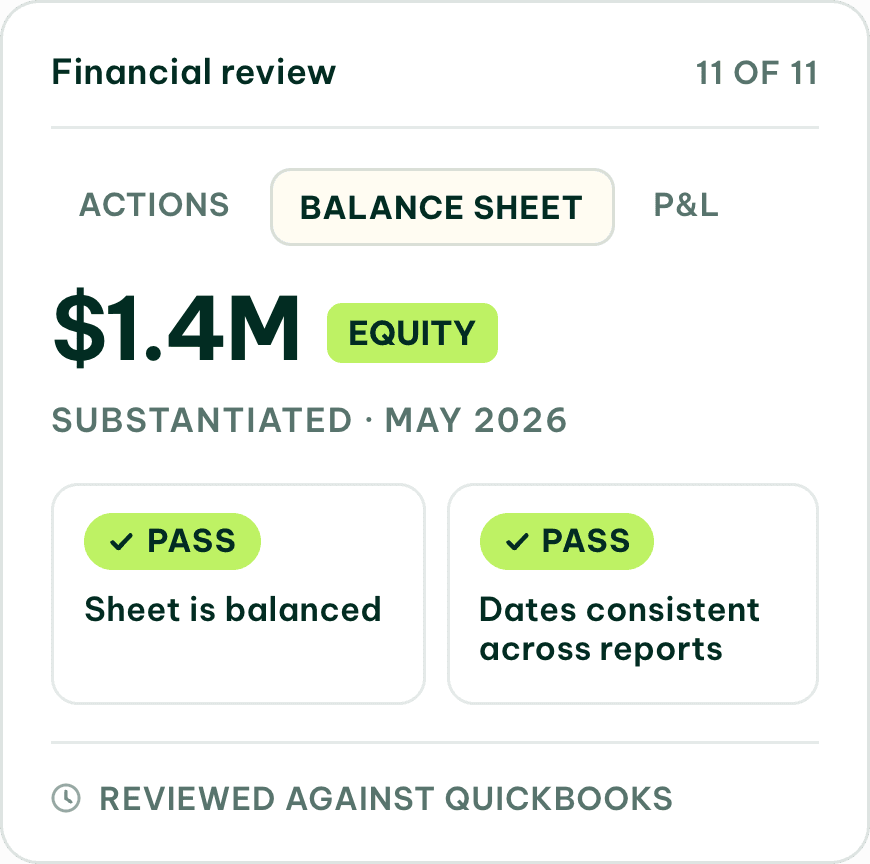
Bags sits between familiar alternatives. An owner could hire a bookkeeper, keep QuickBooks, seek separate financial advice and shop for a loan independently. Outsourced accounting providers such as Pilot address overlapping needs. Bags’ argument is that these jobs belong together, because the records used to run the business are also the records used to finance it.
Follow the paperwork into the lender
That logic becomes more interesting when the customer relationship reaches a lender. In November 2025, Bags and community lender TruFund announced a partnership initially covering Texas, Louisiana, Georgia, Alabama and New York. The program combines document analysis, financial insights, debt tools and coaching before and after funding. Preparation becomes part of the lending process.
- 01Review
the records - 02Repair
the books - 03Prepare
the application - 04Monitor
after funding
There are real gates. TruFund’s announced small-business loan ranges from $50,000 to $350,000 and requires at least two years of operating history. Better records cannot erase that requirement. Bags’ own terms say a subscription does not guarantee financing. A well-prepared application still has to qualify for the particular lender and product.
A separate Bags program for Goldman Sachs Black in Business alumni offers specified financial tools and one funding-coach session free. Bookkeeping and tax work sit outside that benefit. Together, these arrangements show another route into the market: serve businesses through organizations that already work with them, rather than waiting for each owner to discover a finance provider alone.
Investors have financed the expansion. Bags announced a $3 million seed round in 2022 and a further $2.75 million investment led by Ford Foundation in December 2025. The latter announcement said Bags had worked with more than 10,000 businesses. That broad engagement figure should not be confused with a count of paying subscribers.
Borrow the habit before the money
The part another owner can copy is satisfyingly unglamorous. Keep the accounts reconciled. Produce current statements. Match the proposed borrowing to a specific use and a plausible repayment schedule. Start the conversation before an order, a payroll run or a seasonal dip makes every decision urgent. None of those habits requires buying Bags.
The limits are equally practical. Clearer records cannot manufacture demand, turn weak margins into strong ones or make an unsuitable debt affordable. For a very small business, even the entry subscription is a meaningful expense. Bags makes the most sense when recurring financial work, better decisions and preparation for capital justify that cost. Its story begins with a loan search; its useful insight is how much work must happen before the search can pay off.