The awkward thing about most recipes is that they begin in the middle. They tell you to mince the garlic, blanch the asparagus or fold in the eggs, as if a person who needed a recipe already knew the verb. Kevin Yu discovered this while trying to cook dinner for his girlfriend. He knew how to follow directions. He did not know how to cook. A conventional recipe gave him the former while quietly demanding the latter.
- SideChef began as a step-by-step cooking app and grew into a business selling recipe technology.
- Its consumer product connects guided cooking, meal plans and grocery ordering.
- Retailers and brands use its white-label sites, shopping links and in-recipe campaigns.
- Its public 2023 Series B was $6 million; reported institutional funding topped $16 million.
Yu had spent years in video games, where progress is broken into visible actions and immediate feedback. His idea was to give dinner the same kind of guidance. SideChef, founded in 2013 and launched as an app in 2014, turned a recipe into a sequence: a photograph or video for the step, a timer when timing mattered, and later voice prompts for hands occupied by dough or dishwater. It is a small design change with a large psychological effect. “Make dinner” is a daunting instruction. “Do this next” is less so.

The recipe that wanted a shopping cart
The first product solved the moment after a cook had decided what to make. The next problem arrived earlier: getting the ingredients. Yu told TechCrunch that he realized people were not likely to spend much buying individual recipes. Grocery commerce offered a better fit. SideChef already had the useful raw material - structured lists of ingredients, quantities and servings. Match those to a retailer's catalog and a lasagna recipe can become a cart with pasta, sauce and cheese, adjusted for the number of diners.
The company linked recipes to Instacart around 2016, and later connected shopping through partners including Walmart and Amazon Fresh. The grocery partners fulfill orders; SideChef handles the path from appetite to a set of products. On the consumer app, a cook can filter by diet or ingredients on hand, add meals to a plan, assemble a list, order groceries where the integrations work, then return for the guided steps. SideChef also offers an optional Premium subscription for cooking classes, listed at $4.99 a month on Google Play. The basic app remains free.
“What started as teaching myself how to cook became kind of a ‘Rosetta Stone’ to connect the entire industry.”Kevin Yu, speaking to TechCrunch in 2023
That “Rosetta Stone” line is a little grand, but the mechanism is concrete. A recipe describes an intention in a form that a phone, grocer, brand or connected oven can use. The same ingredient mapping that saves a beginner from forgetting the onions can put a packaged-food company's product in front of someone deciding what to make tonight. It can also tell a retailer which products people tried to add to a cart. This is why SideChef's pitch now stretches far beyond an app store listing.
The useful unit is the entire journey, not a page view of the recipe.
A grocer can borrow the kitchen
Consider Sunset Foods, a five-store Illinois supermarket chain. In June 2025 it launched Recipe Rack, a recipe site built with SideChef's platform. The site opened with more than 8,000 guided recipes, searchable by cuisine, time, ingredients and dietary need. In-store QR codes pointed shoppers toward meal ideas. Behind the pages sat SideChef's recipe management system, with tagging and an ingredient database. Sunset Foods said the full platform launched in under four weeks.
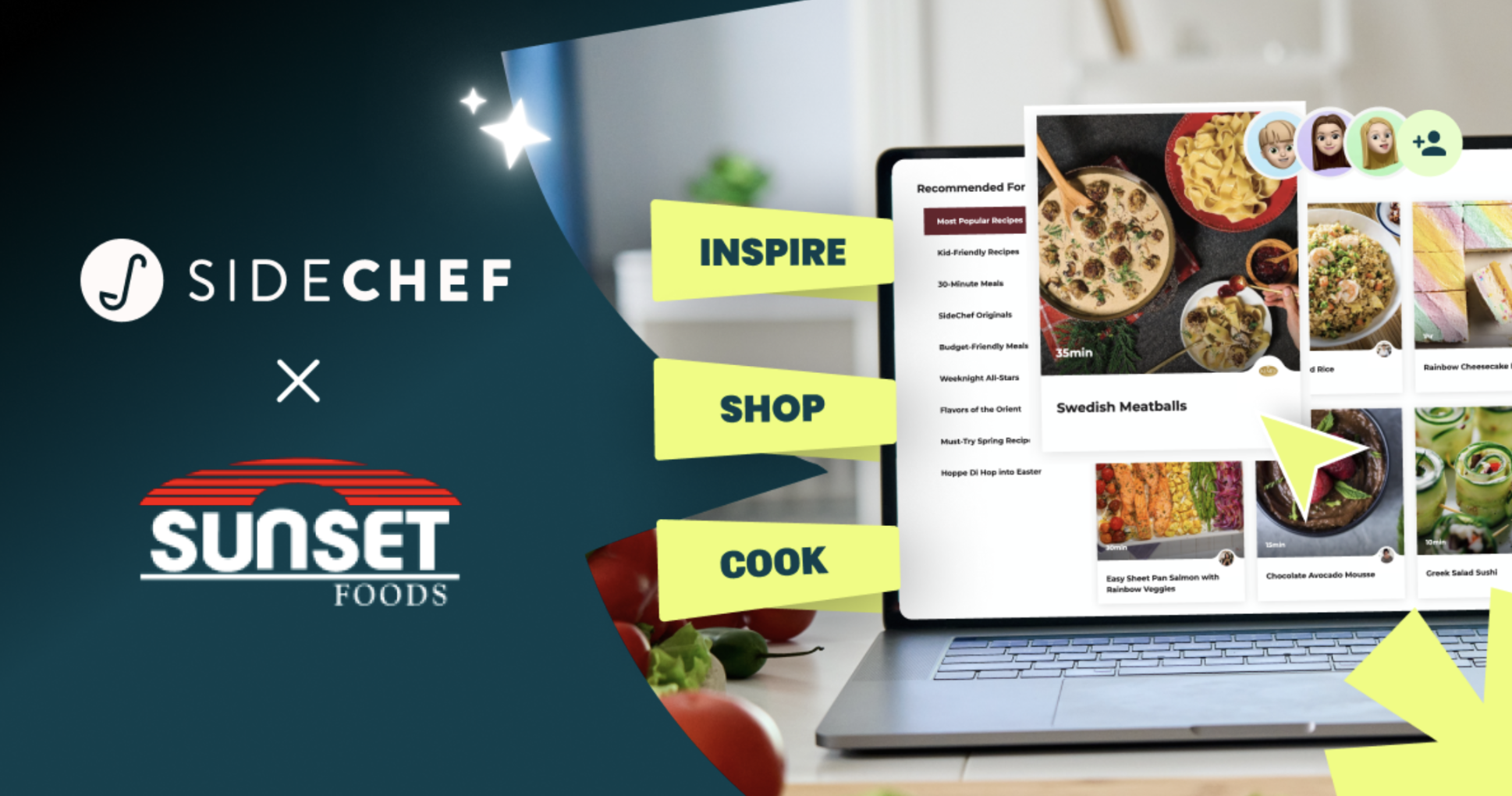
That launch shows SideChef's second customer clearly. A home cook wants dinner to be simpler. A grocer wants that dinner decision to happen within its orbit and lead to a basket. Food publishers want readers to stay and act. Appliance makers want a connected oven to do something more persuasive than connect. Brands want their products considered while ingredients are being chosen. SideChef sells technology and services into these needs: white-label recipe sites and apps, recipe widgets, shoppable links, content, and contextual campaigns. Its public materials describe cost-per-order advertising, a model that ties brand spending to grocery orders sent to retailers.
A retailer could build a recipe library, content system and cart mapping itself. The appeal of SideChef is that those pieces have already been made to work together. Its own app serves as both product and demonstration. The trade-off is dependence on a partner's catalog, availability and checkout: a beautiful recipe cannot guarantee the right garlic is in stock. Its consumer shopping integration is also geographically narrower than its worldwide recipe audience.
The part that did not sell itself
SideChef's commercial turn came from a candid observation: cooks were willing to use recipes, but that did not mean they would buy many of them. Rather than make instructions expensive, the company followed the transaction that recipes already influenced. It also sought appliance partnerships with companies such as GE and LG. LG Electronics invested $6 million in SideChef's 2023 Series B; the company and contemporaneous reporting put total institutional funding through that round above $16 million. The stated plan was to make recipes shoppable across more of the web and deepen smart-kitchen technology.
There is another audience in the room now: marketers. In 2025 SideChef partnered with Pathformance to measure the effect of in-recipe campaigns on online and in-store sales. It also partnered with nutrition-data company Edamam, joining meal recommendations to shoppable cooking. RecipeGen AI, introduced in beta in 2024, proposes a guided recipe from a dish photo. These features all extend the same wager: the useful moment is when inspiration can still change what a person buys and cooks.
The company's position is distinct from a plain recipe publisher and from a grocery delivery service. Publishers can supply inspiration without owning checkout. Grocers can own checkout without teaching anyone how to cook. SideChef works in the seam. That position is valuable only if it keeps both halves honest. An inaccurate generated recipe, a poor product match or a broken retailer handoff turns convenience back into work for the cook. The claim worth watching is not how many recipes a platform stores, but how reliably a dinner idea survives the trip to the plate.
The copyable idea is smaller than the platform
There is a lesson here for anyone building a product around content. Start with the verb your audience cannot yet perform. Make that step explicit. Then ask what comes immediately before and after it. SideChef began with “mince,” moved backward to “buy garlic,” and forward to “turn on the oven.” The company's most ambitious products did not emerge from adding unrelated features. They followed the same dinner across different people and businesses.
That approach will not travel automatically. It needs reliable ingredient data, retail access, useful instructions and a reason for partners to trust the handoff. But it explains why a company founded to teach one person to cook can end up building software for a supermarket. The recipe was never merely a set of words. It was a set of decisions, waiting for someone to connect them.