An agency can design a polished app and still spend its afternoon chasing a missing brief. Shiftr has made that unglamorous problem part of its own development agenda. The California company sells software engineering, product design and AI services. Behind those assignments, it has also been changing the machinery that turns an inquiry into a project somebody can actually deliver.
Founder Volodia Yeghiazaryan, who appears on the company website as Val Y., calls the resulting approach “The Smart Agency”. In his account of 2025, revenue rose 217% from the previous year, signed contracts reached 116, and roughly 40% of processes were automated. Those are founder-reported figures. They describe a company trying to expand its capacity while making its working relationships more durable.
The interesting question is what happens between winning the work and doing it. Shiftr’s public material offers a view of both sides: the services clients buy and the operating changes intended to keep those services moving.
versus 2024
during 2025
founder’s estimate
Figures reported by founder Volodia Yeghiazaryan in his 2025 results post.
The inbox became an engineering problem
An automation case study published by REPCONN describes the earlier bottleneck: requirements scattered across conversations, manual scheduling, estimates dependent on senior attention and repetitive project setup. Coordination was consuming capacity before the design work could properly begin.
REPCONN says it connected intake, scheduling, approval, estimation and delivery. The system gathers missing information, prepares estimates and moves approved assignments into project tools. Human review remains part of the sequence. The vendor reports 4.2 times the concurrent project capacity and 87% less administrative overhead; it describes its figures as aggregated and rounded.
That account makes the first useful move refreshingly ordinary: collect a complete brief. For another agency, the copyable idea is to map the information needed at each decision before choosing automation tools. An estimate still needs judgment, and a client still needs someone accountable for it.
- 01IntakeComplete the brief
- 02ReviewMake the decision
- 03EstimateDefine the work
- 04AssignBegin delivery
Simplified from the workflow described by REPCONN.
Growth with a longer memory
Yeghiazaryan’s annual-results post places long-term contracts alongside revenue growth. He reports a 3.5-fold increase in long-term contracts and 243% growth in contract value. The picture he presents is of a business seeking continuity as well as more assignments. The post does not establish that automation caused the growth.
Longer engagements fit the services Shiftr now promotes. A team that stays with a product can work on its next release, monitor its behavior and carry forward decisions made during the first build. For a buyer, the useful question becomes whether the people who understand the product will still be available when the roadmap changes.
The company’s own language has broadened, too. Earlier recruitment described a creative design agency. Its current homepage leads with software engineering. Design remains prominent, but it sits beside mobile development, AI and ongoing technical delivery. This is a shift in public positioning, visible in the work Shiftr chooses to put at the front of its shop window.
One brief, three ways to buy
Shiftr offers three main ways to engage an engineering team. Staff augmentation adds specialists to a client’s existing organization. Dedicated teams provide an assigned group for a product or workstream. Software outsourcing puts a cross-functional team in charge of delivery from scope through deployment. These choices divide management responsibility as much as they divide labor.
For a company with technical leadership already in place, embedded engineers can fill a capacity or skills gap. A dedicated team suits a sustained piece of work that needs its own daily coordination. Managed outsourcing is aimed at buyers who want to set priorities, review milestones and leave execution to an external team. Those distinctions should shape the contract before anyone debates a framework.
The company’s project calculator makes the commercial logic visible. Buyers choose a product type, roles and duration. The available roles extend beyond developers to design, quality assurance, project management, infrastructure and AI. It is a services business whose estimates depend on the people and time required for the brief.
A useful budget discussion therefore starts with a deliverable: which users, which functions and what counts as acceptance. The calculator is a scoping aid. A buyer should connect its staffing choices to a release plan and agree how changes affect the estimate. A free consultation provides the entry point for that discussion.
The portfolio has a workplace problem
BizForce, an Australian project in Shiftr’s portfolio, brings the offer down to earth. Shiftr describes designing and building a shared collaboration platform for individuals, teams and organizations. The assignment was to accommodate different working styles without overwhelming people on their first visit.
That is a demanding brief for any workplace application. Shiftr’s case study explicitly names Slack, Microsoft Teams and Notion as the competitive environment for the product. It describes surveys, interviews, competitor analysis and analytics feeding the design, followed by testing and refinement. The aim was to give conversations and coordination a common home.
The important distinction is that BizForce is presented as client work. Hiring Shiftr means commissioning product development expertise, with the resulting interface and workflow shaped around a particular business. The portfolio image makes that work tangible: discussions, opportunities, events and an activity center arranged within a shared workspace.

A runner needs a different screen
Another case study, RaceTrak, describes a race-tracking product for athletes, organizers and spectators. Shiftr says it handled design and development across mobile and web. Its page describes the product as approaching launch, so the account is best read as a build story rather than evidence of widespread adoption.
The requirements are wonderfully specific. An athlete wants split times. An organizer needs a view of the field. A supporter wants to follow one runner. Shiftr describes live GPS tracking, lap detection, results and leaderboards, with WebSockets carrying updates. The interface uses readable numbers, strong contrast and short navigation paths for people looking at a screen while an event unfolds.
For a prospective client, that example offers a practical test of a development partner: can it explain how the users differ before showing the screens? A shared dataset does not mean a shared priority. Designing around those differences is where the research brief starts to earn its keep.
From a wallet to the campaign that sells it
Sovran demonstrates a different kind of complexity. Shiftr describes a fintech assignment combining wallet functions, QR payments and digital financial infrastructure for Indigenous communities. Its account starts with discovery and stakeholder workshops, moves through user journeys and prototypes, and then brings design and engineering together across web and Android experiences.
The value of that sequence is easy to understand. A payment flow has to communicate what a user is doing, even when the infrastructure underneath is complicated. In this project, Shiftr presents the interface as part of the technical problem. Prototyping is a way to examine the transaction journey before committing to the final build.
That research emphasis also appears in its product-design offering. Shiftr lists problem validation, user interviews, surveys, usability tests and a continuing record of findings. Its MVP service is framed around narrowing an idea and testing it before full development. The common thread is deciding what deserves to be built before multiplying the screens.
The marketing operation extends the relationship beyond delivery. A separate Shiftr site offers paid search, paid social, creative production, app campaigns and website optimization. Its testimonial roster includes HappyHomeInitiative, Romanian-English Linguistic School and ZamiPet. For clients buying across those services, the appeal is keeping the product and its acquisition work within one commercial relationship.
The AI work includes the maintenance
Shiftr’s AI offering includes predictive models, business-intelligence dashboards, language-based applications and workflow automation. Its service descriptions go beyond adding a chat window. They include examining data infrastructure, ranking use cases, tracking experiments and dealing with models whose performance declines after deployment.
The ordering matters. Shiftr describes evaluating candidate uses against data readiness, expected return and operational complexity. That is a sensible buying lens: an attractive demo still needs a usable dataset and a job worth doing. A dashboard, forecast or assistant should be judged against the decision it helps someone make.
This also defines the conditions for a useful engagement. Work that depends on undocumented rules will need those rules clarified. A product with unresolved user needs will need research. Adding engineers or automation cannot decide the business priorities on a client’s behalf. Shiftr’s discovery and assessment services make room for that work before implementation.
“We act like partners, not vendors.”
SHIFTR / STATED COMPANY VALUE
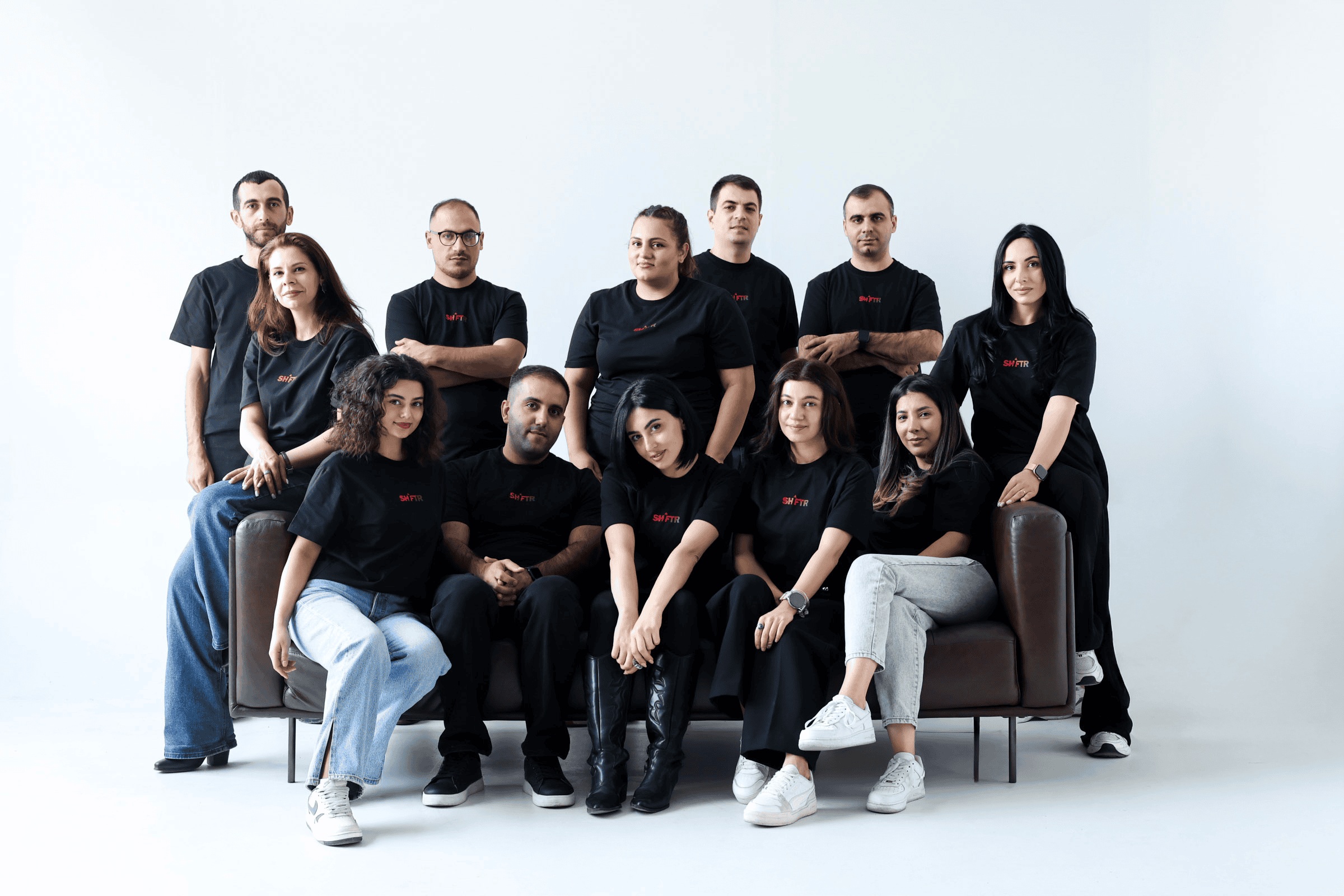
The team behind the handoffs
Shiftr’s footprint connects California with an executive office in Yerevan, Armenia. Its current address places the headquarters in Glendale, within the Los Angeles area. LinkedIn lists the company in the 11-50 employee band. Public hiring has included remote, project-based engineering collaboration as well as design and sales roles in Yerevan.
The team page spans product management, design, quality assurance, client success and operations. Its stated values include ownership and clear communication. “We act like partners, not vendors,” the company says. The phrase becomes meaningful when translated into daily behavior: who explains a tradeoff, who reviews a milestone and who responds when the brief changes.
In the market, Shiftr sits among firms selling an external product team. The alternatives include hiring internally, assembling independent specialists or splitting design and engineering across suppliers. Its distinctive pitch is the combination of those disciplines with several engagement models and a marketing operation that can continue the work after release.
The case for hiring it is strongest when a buyer needs those connections and can name the outcome. For readers running their own service business, the smaller lesson is available immediately: inspect the journey from inquiry to assignment. There may be a surprisingly expensive wait hiding between two perfectly competent people.