Consider a parking garage. A driver reserves a space on a phone, arrives at a gate, leaves a car, and later pays. Four ordinary actions. Behind them sit several different systems, each with its own idea of who the customer is and what just happened. The interesting software problem begins where those systems meet. OutworX, a San Jose software engineering and outsourcing company, has made that sort of meeting part of its business.
- Custom apps, software testing, online stores, and outsourced engineering teams.
- A parking specialty that connects reservations, payments, permits, and valet operations.
- A services business: customers buy engineering work and delivery capacity.
Its catalogue stretches from mobile development to recruitment and AI. That breadth can make the company difficult to picture. A garage helps. Here is a business where an attractive screen has limited value unless an invoice, a payment record, and a physical barrier agree. OutworX’s most revealing proposition is the work of getting them to agree.
A garage is a software problem
On its parking services page, OutworX lists connections to revenue control, reservations, access control, license plate recognition, accounting, and mobile payments. It also offers custom websites and apps. The customer is the parking operator, while the person who benefits from fewer interruptions is the driver. Those are two different audiences with different definitions of success.
Monthly parking makes the distinction especially clear. An operator needs permits sold, invoices posted, and recurring charges processed. A customer needs an account that works. OutworX offers development around all of those tasks. Its ticketless and valet offerings add electronic tickets, phone payments and tips, parking histories, and integration with gates. The scope extends beyond replacing paper with a screen.
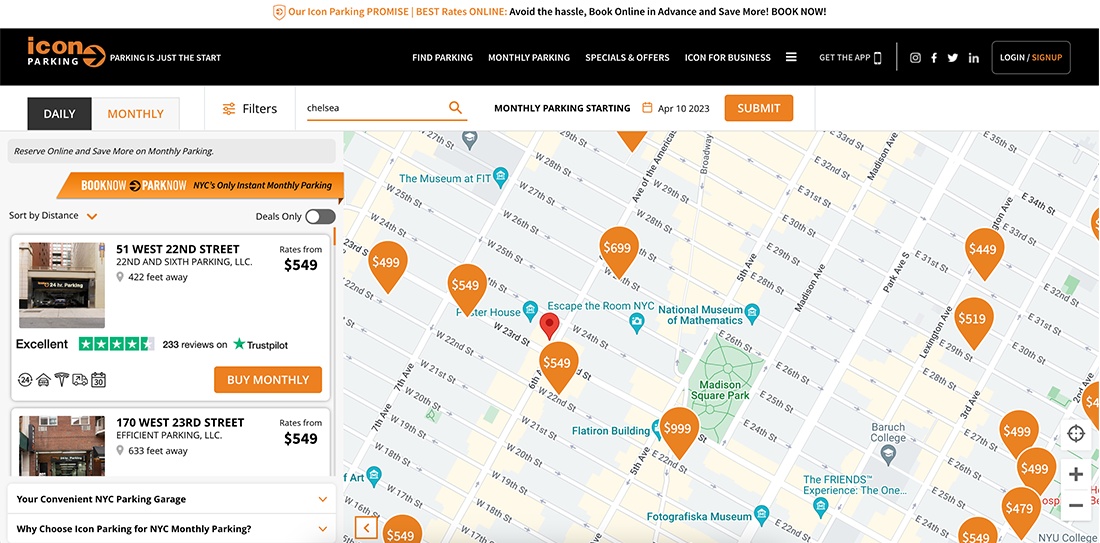
The portfolio names Icon Parking under both web development and mobile apps. That pairing matters: the website and the phone are entrances to the same operation. The practical question for an operator is whether the underlying workflow can follow a customer through both. It is a more demanding brief than asking someone to make an app.
The product is also the team
OutworX’s LinkedIn profile dates the company to 2003 and describes a US headquarters with an offshore development center in Noida, India. The arrangement serves software vendors, corporate IT departments, and other businesses buying engineering capacity. Customers can commission development, add people to an existing team, or use a dedicated team. Maintenance and support extend the relationship after a release.
Its resource management offering names three engagement models: TeamX, ProjectX, and ResourceX. Dedicated teams come with infrastructure, reporting, and customer control over team composition and project flow. Managed outsourcing takes on more of the operating burden. The business model is paid services and staffing, with scope and responsibility shaped around the engagement.
This puts OutworX in the market for outsourced product engineering and IT services. A buyer can assemble an internal team, hire individual contractors, or choose another development and testing firm. For parking, an additional alternative is packaged software. OutworX argues for customization when an operator wants its own customer experience and connections to existing systems. That is a purchasing choice about control, as well as price.
The cheap hour has homework
On cost, the company advertises outsourcing savings of up to 75% against typical US costs. That is its marketing claim, rather than an independently measured result. It also promotes dedicated resources at as little as one-third of direct employee cost. Both claims concern delivery economics. Neither should be mistaken for the total cost of changing how a business operates.
“Up to” does real work here.
OutworX’s advertised outsourcing savings versus typical US costs. A company claim, not a project budget or guaranteed outcome.
The sensible buying exercise is to specify a bounded piece of work: one permit renewal journey, one payment integration, one release’s regression suite. Agree on acceptance criteria and ownership. Include the customer’s management time and the work needed to connect existing systems when comparing proposals. Those are practical implications of buying custom engineering, rather than reported steps from a particular OutworX project.
Communication belongs in that calculation. In a testimonial published by OutworX, Chris Moher, identified as director of software products at TCS, an ARI company, describes the assigned team as an extension of his company. It is a useful description of the intended relationship. A customer still needs someone who can decide what the software must do.
“My OutworX team has truly become a seamless extension of our company.”Chris Moher · customer testimonial published by OutworX
Testing the seams
The quality assurance practice makes this relationship more concrete. OutworX offers manual, automated, performance, mobile, and security testing. Its automation work includes Selenium and Appium; performance testing includes JMeter. The range covers different questions: does the feature work, does it keep working after changes, and what happens under load?
Its security testing description explicitly includes weaknesses arising from an application’s relationship with the rest of the IT infrastructure. That is a telling detail. Return to the garage: a working payment screen is only one checkpoint. The larger job is making sure the surrounding operation behaves coherently. Testing those connections gives the development offering a useful companion.
From checkout to truck loading
The same practical bias appears in ecommerce development. OutworX works with WordPress, WooCommerce, Magento, and OpenCart, offering themes, plugins, payment integration, and maintenance. Businesses with an existing platform can commission changes around it. A merchant whose requirements fit a standard store may have less reason to fund custom development.
Its current AI framework catalogue adds some unexpectedly tangible examples: document text extraction, a UI editor, and Best Fit Finder, a truck loading tool that uses box dimensions and visualizes a packing layout. These are advertised capabilities, rather than evidence of customer results. They make the AI pitch easier to interrogate: which task, which input, which usable output?
That question is also a good way to understand OutworX. Start with the recurring task that causes trouble, then follow it across the systems and people involved. Decide what should happen at each handoff. For a garage, the most persuasive demonstration might be quite unglamorous: a reservation recognized, a payment recorded, a gate opening when it should.