The useful thing about a mathematics education is not that life eventually hands you a tidy equation. It is that you become suspicious of missing variables. Sheila Hooda has carried that suspicion through more than three decades of consulting, banking, corporate strategy and governance. Her career has moved from Pune to Ahmedabad to Chicago, then through institutions where decisions acquire extra zeros and consequences arrive several quarters later. The titles changed. The recurring job did not: find the forces other people have not connected yet.
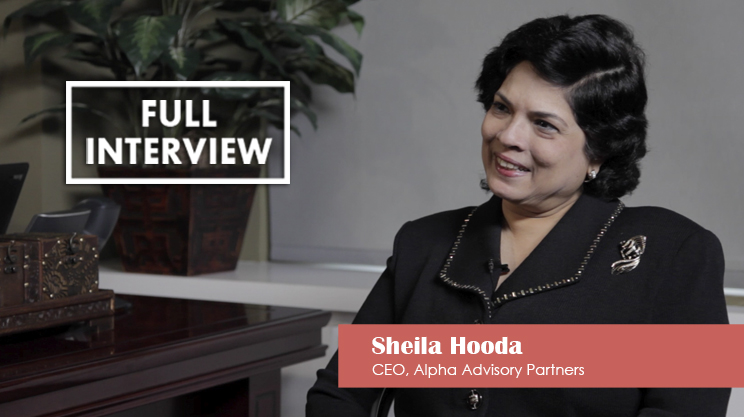
Today Hooda is CEO, president and founder of Alpha Advisory Partners, the firm she started in 2013 to advise financial and business-services companies facing digital, market or regulatory disruption. She is also an independent director at Enact Holdings and Alera Group, and a trustee of AGL Private Credit Income Fund. That supplied record corrects an easy database mix-up: she sits on Alera's board; her founder and CEO title belongs to Alpha Advisory Partners.
Her résumé could be read as a tour of late twentieth- and early twenty-first-century finance: McKinsey, Bankers Trust, Credit Suisse, TIAA, Thomson Reuters. More revealing is the sequence of vantage points. A consultant sees patterns across companies. An investment banker sees what capital rewards and what transactions expose. A corporate strategist discovers whether the elegant idea can survive an operating calendar. A director must ask the question that makes management's answer more useful without reaching across the table to run the company.
A career assembled in lenses
Hooda earned a bachelor's degree in mathematics from Savitribai Phule Pune University, followed by a postgraduate management diploma from the Indian Institute of Management Ahmedabad and an MBA from the University of Chicago Booth School of Business in 1988. The progression feels almost architectural: quantitative structure, management practice, then a global business vocabulary.
She began her U.S. career at McKinsey and also held an early leadership role at Andersen Consulting. Banking followed at Bankers Trust and Credit Suisse, where she became a managing director in global investment banking. At TIAA she held senior managing director roles in strategy, mergers and acquisitions, and corporate development. At Thomson Reuters she became global head of strategy and business development in the Investors segment of the Financial & Risk division.
Those jobs sit close together on a profile page. In practice, each carries a different clock. A deal runs toward a close. A transformation runs through years of resistance, redesign and repetition. Customer centricity, another theme of Hooda's work, runs on the customer's clock, which is inconveniently indifferent to the annual planning cycle. The advantage of crossing all three is learning that strategy cannot merely be correct. It has to remain legible when handed from the people who designed it to the people who must live with it.
The company built for the awkward middle
Hooda founded Alpha Advisory Partners at the point where her operating experience could become a method of its own. The firm advises on strategy, turnaround and transformation, customer centricity and digital business models. These are awkward-middle assignments. The old model still earns money. The new model is not yet dependable. Everyone agrees change is necessary, while disagreeing about which discomforts count as progress.
Her public writing refuses to isolate technology inside the technology department. Digital capability touches the customer proposition, capital allocation, cybersecurity, talent and culture. A board that discusses each topic as a separate presentation can miss the plot connecting them. Hooda's preferred tool is scenario planning: describe plausible futures, examine their effects on strategy, finance, operations and people, then decide what can be strengthened before any particular future wins.
The Hooda working loop
This sounds methodical because it is. It is also a form of corporate imagination. A forecast asks for the likely destination. A scenario asks what the luggage should contain if the train is diverted. Hooda has applied the idea to elections, regulation, economic cycles, supply chains and geopolitics. The value is less clairvoyance than optionality. Prepared organizations have more moves available when the board packet meets the world.
“Long-term company resilience and performance could depend directly on supply chain reliability.”Sheila Hooda, on board oversight
Governance is a verb
Board service entered Hooda's career as more than a ceremonial last chapter. She has worked across public companies, private companies, insurance, investment management and acquisition vehicles. From 2016 to 2023 she served on the Mutual of Omaha board and chaired its risk committee. She served at Virtus Investment Partners, ProSight Global, ScION Tech Growth I and ScION Tech Growth II, chairing audit or nominating and governance committees in several of those rooms.
At Enact Holdings, which she joined in 2021, she chairs the nominating and corporate governance committee and sits on audit. She joined Alera Group's board in February 2024. In November that year she joined the AGL Private Credit Income Fund board of trustees and became chair of nominating and corporate governance. The pattern is unusually broad: audit asks whether the record is reliable, risk asks what could bend the enterprise, and governance asks whether the right people and processes are in place to respond.
Hooda's view of the board-management relationship is pointedly human. She has written that the two sides increasingly need to work in partnership based on trust, with more space for open discussion and debate. That matters because bad news dislikes ceremony. The thicker the performance around a board meeting, the longer reality may wait in the hallway. Trust is not softness here. It is a delivery system for inconvenient information.
Connect risks before ranking them. The same assumption may be hiding in the strategy deck, the capital plan and the talent forecast.
Her 2024 remarks on activist investors sharpen the point. Boards, she argued, should be capable of “thinking like activists”: revisiting strategy, finding vulnerabilities, examining operational efficiency and reassessing board skills before outside pressure dictates the timetable. This is not an invitation to permanent panic. It is housekeeping with sharper questions. If a stranger can discover the loose floorboard, the people who live in the house should have noticed it first.
Learning before authority hardens
A personal clue in Hooda's public record is her recurring interest in learning. In a Sarder TV interview series, she describes learning as absorbing, lifelong and tied to innovation. She discusses whether leadership can be taught, recounts a crisis from her own career and offers advice to young women about confidence and ambition. Another segment turns to her work with Pratham USA, linking executive life with educational opportunity.
Her nonprofit commitments have continued across education, vocational skills, women's empowerment and rural entrepreneurship. Public profiles list work with Medha and the Buddha Institute, organizations focused on helping young people build employable skills and supporting entrepreneurship in rural communities. She is also a lifetime member of the Council on Foreign Relations and has served in university and governance communities.
The through-line is not résumé polish. It is the refusal to let expertise become sealed. Hooda has pursued formal board credentials through the National Association of Corporate Directors and studied emerging issues including artificial intelligence, cybersecurity, climate oversight and cryptocurrency. A director's experience is valuable, but its shelf life is not infinite. Yesterday's scar tissue can prevent tomorrow's wound, or it can make a leader expect the old accident again. Learning tells the difference.
Recognition, with work still on the desk
In January 2026, Alera Group announced that Hooda had been named to BoardProspects' Exceptional Private Company Directors list and Women’s Inc. Magazine's Most Influential Directors list. Earlier recognition included the NACD Directorship 100, Directors & Boards' Directors to Watch, BoardProspects' list of 100 Asian Pacific directors making a difference and the inaugural Financial Times/Agenda D-100.
Awards compress a career into a flattering noun. Hooda's actual work is made of verbs: assess, challenge, prepare, transform, learn. Her latest public appearances keep returning to unsettled terrain. Elections move policy. Geopolitics moves supply chains. Technology moves customers and attackers at once. Capital grows more or less patient. A useful director cannot remove those forces. She can make them discussable soon enough for the company to act.
That may be the clearest lesson in her path from mathematics to M&A to governance. Seeing around corners is not a mystical gift. It is a discipline of looking at the whole street: who is moving, what is connected, which assumptions are doing too much work and where a choice will disappear if nobody makes it now. The future still arrives without rehearsal. Hooda's career suggests that the questions do not have to.