An airport café is an unlikely place to measure a career in private equity. The usual instruments are spreadsheets, fund returns and an eventual sale. Carolyn Campbell has another measure: recognising a business that used to be small and now meets customers under a familiar name. She has described arriving at African airports and taking pleasure in seeing cafés and banks that her firm helped grow. For a traveller, they are places to buy coffee or change money. For an investor who remembers an earlier version of the company, they are evidence of years of work.
Campbell co-founded Emerging Capital Partners, the investment firm known as ECP, and serves as its managing partner and chief operating officer. Based in Washington, she has built a career across the distance between raising capital and making businesses function. That distance can be considerable. A successful investment proposal fits neatly into a presentation. A growing company has to cope with employees, customers, reporting systems, regulations and the occasional inconvenient fact that arrives after the presentation has been printed.
Her board work ranges from energy and water to banking and restaurants. Eranove, Oragroup and Burger King South Africa belong to very different parts of daily life. Put together, they offer a useful way into her story. Campbell’s working world contains businesses that must deliver something tangible, repeatedly. Electricity has to arrive. Money has to move. Lunch has to turn up.
A lawyer in markets being remade
Before there were African investment funds to run, there was corporate law. Campbell worked at White & Case in Warsaw, London and Washington, advising on transactions that crossed borders. Her earlier practice included work on Eastern Europe’s market transformation, alongside mergers and acquisitions, capital markets and corporate finance. The geography matters: she was working where the relationship between capital, ownership and institutions was changing.
She brought an unusually broad education to those assignments. At the University of Connecticut, she studied economics and French, graduating summa cum laude, and earned a master’s in economics. She obtained a law degree from the University of Virginia School of Law and a doctorate in politics from Oxford. Economics, language, law and politics form a rather practical combination when a business agreement has to survive contact with another country.
The qualifications are only the beginning of the explanation. A transaction can make financial sense and still stumble over a misunderstanding, a weak institutional arrangement or competing expectations. Campbell’s legal work put those questions inside the job. Her later move into investing widened her responsibilities from helping structure a deal to helping oversee what followed it.
She also lectured on international negotiations at George Washington University’s National Law Center. Negotiation belongs naturally in this history. An investment joins people who want different things at different times: a founder seeking room to grow, a management team seeking workable targets, investors seeking a return. The agreement is an opening chapter. Someone still has to help keep the plot coherent.
The long route from capital to companies
ECP dates its investment history to 2000. Campbell’s path through that period included a director role at Emerging Markets Partnership, or EMP, from July 2000 to March 2005. There she managed investment portfolios and led deal teams working across Eastern Europe, Asia and Africa. Her later ECP leadership responsibilities combined investment decisions with the running of the firm itself.
Private equity makes an appealingly short story when told from a distance: raise money, buy a business, improve it, sell. Every verb conceals a separate negotiation. Raising money requires persuading institutions to entrust capital to a team. Buying requires agreeing on price and control. Improvement takes place in an operating business. Selling requires a buyer, suitable timing and a company someone else is prepared to own.
Campbell has spent her career moving among those tasks. Her responsibilities have included investment and valuation committees, fundraising, and supervision of finance, legal and compliance functions. The result is a role with two sets of obligations. She helps oversee portfolio companies while also overseeing the organisation entrusted with the investors’ money.
The scale helps explain why an operations title carries weight here. In May 2024, ECP’s record was described as more than $3.5 billion raised for growth investment, with 73 investments across 45 countries. Those figures represent the firm’s collective work. For its COO, they also represent the breadth of the systems and decisions that need to hold together.
A café has a supply chain
Campbell’s interest in restaurants makes the investment process easier to picture. ECP invested in East African chain Java House and, toward the end of 2018, in Kenya’s Artcaffé group. She has identified the opportunity in helping a popular café or casual dining outlet become a chain. The first location establishes an idea. Subsequent locations ask whether the business can repeat it.
Repetition sounds modest until one considers what it requires. A customer expects a recognisable experience; the company needs purchasing, staffing and financial controls that can support more premises. A restaurant can be loved and still be difficult to expand. Affection is a valuable ingredient. It is an unreliable substitute for an operating plan.
Her current board responsibilities include chairing Burger King South Africa. That position brings her investment and governance experience into a business whose output is immediately understandable. Customers judge a meal in minutes. Directors must think about a company across years. Both perspectives belong in a business built around serving people repeatedly.
The restaurant examples also prevent the story from floating away into financial abstraction. Growth capital eventually becomes something: another outlet, a larger organisation, a new capability. Campbell’s work reaches into the decisions that make that conversion possible. A company has to become capable of carrying its own expansion, with managers and systems that can handle the extra weight.
A café, a bank, a connection.
Management, reporting and governance.
Growth that survives a change of hands.
What a board meeting is for
In a 2014 public discussion in Washington, Campbell was asked what implementing governance actually meant. Her answer moved quickly into specific practices: establishing boards, bringing anti-bribery and anti-money-laundering procedures into companies, revisiting them at meetings, and checking that the procedures were being followed. She also described anonymous reporting channels and the training needed to make employees comfortable using them.
The detail is revealing. A policy can be written once. A reporting culture has to be maintained. Giving a junior employee a route to raise concerns about a superior changes the direction in which information can travel. The board receives more than whatever the people at the top choose to tell it.
That is a practical interpretation of governance: decisions, information and responsibility arranged so that people can act. It makes sense alongside Campbell’s legal background. Rules have consequences when someone knows how to apply them, and when the organisation has a reason to keep applying them after the initial attention has passed.
Her work on financial reporting, business plans and IT systems belongs in the same picture. Each provides a way to understand what an organisation is doing. For an investor seeking growth, accurate information is part of the machinery. A company that expands faster than its ability to account for itself can create a very expensive mystery.
Across languages, across obligations
Campbell’s fluent French sits alongside her work in both English-speaking and French-speaking markets. Her board portfolio includes France-based energy and water group Eranove and West African financial services group Oragroup. She is also a director of Reviera Enterprises, a US infrastructure business. Her responsibilities span companies and jurisdictions, with the work extending across the United States, Europe and Africa.
Different businesses require different kinds of attention. A utility operates within one set of commercial and regulatory constraints; a financial services group within another. The shared discipline is knowing which questions a director needs to ask, and which answers deserve a second look. Experience across sectors can be useful precisely because the details refuse to be identical.
Her public roles also include membership of the Mastercard Foundation Asset Management board. She is a lifetime member of the Council on Foreign Relations and served as a board member and treasurer of Washington International School from 2012 to 2018. These affiliations place her financial and international experience in settings beyond ECP’s portfolio.
In August 2014, she joined a discussion of Africa’s economic future alongside Mo Ibrahim, Donald Kaberuka and Jason Njoku. Such a panel combines the investor’s view with those of an entrepreneur and a development institution. Campbell’s contribution belonged to that intersection: the practical work of financing businesses, building their organisations and preparing for eventual changes in ownership.
A name etched in glass
In October 2019, Campbell received Private Equity Africa’s Women Impact Award in London. A photograph she shared shows the glass award on a desk, with her name beneath an outline of the continent. It is a pleasingly literal object in a profession otherwise inclined to measure itself with numbers.
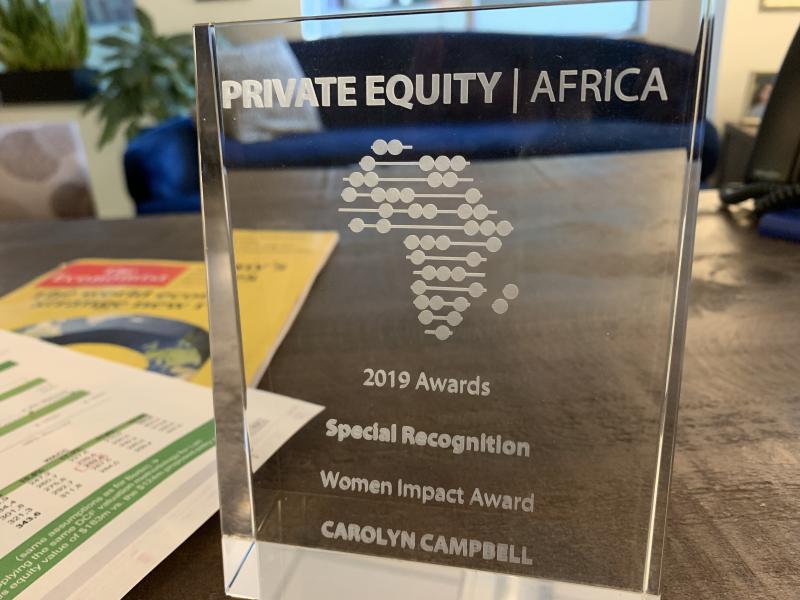
Her response to the recognition credited the support of ECP’s limited partners, the investors behind its funds. That acknowledgement gives the photograph a useful companion. Her name is etched into the glass; the work involves a much larger collection of people. An investment firm depends on the capital entrusted to it and on the management teams making decisions inside its businesses.
Recognition also gives a career a date to pause at. The operations continue afterward. Valuations must be considered, companies governed, and the terms of future growth debated. An award can occupy a desk. It cannot take the next board meeting.
The next business still has to work
Campbell’s more recent public work includes a May 2024 panel on climate reporting and building sustainability. The subject connects with her experience in energy, infrastructure and company oversight. As reporting expectations change, directors have to understand how those expectations enter a business’s decisions and operations.
Her stated professional interest is helping companies grow through their own operations and international expansion. That ambition has a familiar shape across her career: a functioning business becoming capable of doing more. The question keeps changing with the company, the sector and the country. The work keeps returning to management, information, institutions and capital.
“Investors have long memories.”
Carolyn Campbell, 2018
It is a compact observation with a considerable workload attached. A relationship with an investor survives through repeated decisions and results. The same is true of the relationship between a company and its customers. For Campbell, those two worlds meet in the businesses she helps oversee. Somewhere, a customer walks into a café or a bank without needing to know the investment history. The company’s job is to be ready.