Hurley Doddy had an opportunity to tell a very good Warren Buffett story. Asked in 2007 whether he had worked with Buffett at Salomon Brothers, he answered with a wonderfully limited claim: “I think I rode up in the elevator with Warren once.” He had been a comparatively junior figure, he explained. The encounter was brief. There would be no borrowed halo.
An elevator ride is a pleasingly small beginning for a career spent moving between countries. Doddy went on to help build Emerging Capital Partners, an investment firm focused on African businesses. His work would involve finding companies, backing their expansion and helping put them in a position where someone else might eventually want to own them. A famous fellow passenger was incidental to all that.
Today, Doddy is ECP’s founding partner, managing director and chief executive. He is based in Washington, but the geography of his working life spreads considerably further. The interesting thread is the distance between an investor and a company: how to cross it, who can help, and what becomes possible once the two know each other well enough to get to work.
An education in several time zones
He studied economics at Princeton. In 1984 he joined Salomon Brothers, beginning a run of more than fourteen years that included New York, Tokyo and São Paulo. The work covered bonds, derivatives and emerging markets. The cities are more than decorative additions to a biography. They locate his early career in financial markets with different currencies, customers and operating conditions.
In Tokyo, he worked on derivatives. In Brazil, he ran a joint-venture operation as managing director. His subsequent London role at Sumitomo Finance International involved a $200 million equity risk arbitrage book. Before becoming associated with African private equity, he had already worked across financial products and national boundaries. The eventual investment focus narrowed; the earlier experience had been geographically broad.
ECP’s founding belongs to the turn of the millennium. Doddy’s current corporate biography dates it to 1999. The firm brought together an Africa-focused investment practice with a team whose names recur throughout its history, including Carolyn Campbell and Vincent Le Guennou. This was a partnership with several working parts. Assembling it required people who could manage funds and people who could find, evaluate and support businesses.
- 1984Salomon BrothersNew York · Tokyo · São Paulo
- Before ECPSumitomo Finance InternationalLondon
- 1999Emerging Capital PartnersWashington · African markets
- 2019 / 2022Sixth Street board rolesSpecialty Lending / Lending Partners
A company big enough to grow
By July 2010, ECP had closed a $613 million fund, bringing its reported capital raised for African investments to $1.8 billion. Those figures belong to that moment. They show the scale at which the firm was working a decade into its African investment history, when persuading institutions to commit money was part of the job alongside choosing where it would go.
A useful glimpse of Doddy’s thinking appears in his observation about deal size: “There are not many $100m deals for sale, but plenty of $100m opportunities to bolt together.” The remark gives an active meaning to growth capital. A finished regional business might be hard to buy. Smaller businesses, acquisitions and expansion could supply the ingredients from which to build one. The investment opportunity included work still to be done.
A coffee chain offers a less abstract illustration. In 2012, ECP acquired a majority stake in Nairobi Java House. That transaction won an Africa Investor deal award. Doddy delivered a video address expressing the firm’s confidence in the growing African middle class. A cup of coffee is rather more legible than a demographic projection. It has a customer, a location and a price.
Java House placed a consumer business beside the financial services and communications companies in ECP’s portfolio. The connection was demand: what people would buy as their spending power changed, and what businesses would need in order to serve them. The company gave the investment argument a shopfront. It also made clear how varied an Africa-focused portfolio could be.
The map acquires more pins
Continental Reinsurance makes the regional expansion idea particularly visible. Doddy was its chairman when ECP and its investment partners sold C-Re Holding to Saham Finances in 2015. The holding company owned a 53.6 percent stake in the reinsurer. Under their ownership, Continental Re’s presence had expanded from two countries to six. Growth, in this instance, had quite a literal geography.
The sale announcement described support for recapitalization, senior management and expansion. Nigeria, Cameroon, Botswana, Côte d’Ivoire, Kenya and Tunisia formed the country list. Each added market made the business less confined to its original base. The eventual buyer was another insurance group with its own regional relationships. The next owner belonged in the story of what the business had become.
Côte d’Ivoire · Kenya · Tunisia
Buying, growing and selling are related tasks, though the dates between them can stretch. In 2014, Doddy discussed ECP’s exit from the Tunisian consumer-products company Société d’Articles Hygiéniques. The reported return was 2.4 times the investment in local currency and 1.6 times in dollars. The difference is a compact lesson in cross-border finance. A business result and an investor’s currency result can tell different stories.
He also made a plain observation about exits: a good, profitable African company could find a buyer. Earlier in ECP’s history, he said, that outcome had been less clear. This is an important part of the career: establishing that ownership could change hands, whether through a corporate buyer or a public listing. The cheque coming back mattered as much as the cheque going out.
The useful people are already there
Doddy has repeatedly argued for investment teams close to their companies. In a 2015 discussion, he argued that the people doing the investing needed to be locally based. Finding opportunities, investigating them and working with a business after investing all depended on that proximity. The same discussion connected environmental, social and governance standards to managing risk and improving a company’s value.
“we believe it is critical to be locally based.”
Hurley Doddy · 2015
ECP’s personnel decisions give the argument names and locations. In 2016, Brice Lodugnon and Paul Maasdorp were promoted to managing directors. Lodugnon led the Abidjan office and focused on Francophone West Africa; Maasdorp worked from Nairobi, with an East African emphasis. Their portfolio responsibilities covered businesses including Eranove, Oragroup, IHS and Java House. Those were distinct assignments within a shared investment approach.
Nonnie Wanjihia Burbidge joined the firm that year to work on fundraising in Sub-Saharan Africa, particularly East and South Africa. Doddy described the appointments in terms of complementary skills and networks. The description is practical. A fund needs relationships with the institutions supplying money as well as with the companies receiving it. The map has investors at both ends.
In a 2017 frontier-market discussion, Doddy described a regional platform as a way for companies to expand into smaller markets. International experience and local knowledge had to coexist. So did opportunity and the difficulty of executing a deal. His argument was for a business capable of crossing borders with people who understood the places it was entering. The smaller market could be part of a larger company’s reach.
Towers, turbines and the next owner
The firm’s later history includes infrastructure on a different scale. IHS Towers listed on the New York Stock Exchange in 2021. ECP was among its top three pre-IPO shareholders, alongside MTN and Wendel. The communications business joined private capital to public markets. Its listing supplied another example of how an investment associated with African growth could reach a different pool of owners.
That same year, ECP joined A.P. Moller Capital, DEG and IFU in creating ECP Power & Water Holding to invest in Eranove. ECP had been the industrial group’s largest shareholder since 2008. At the time of the partnership announcement, Eranove’s 2020 figures included 2.9 million electricity customers and 1.4 million water customers. Here the underlying demand arrived through a socket and a tap.
These are firm investments, involving colleagues and partners. They belong in Doddy’s story without requiring him to be the sole author of every outcome. Regional expansion, infrastructure and eventual changes of ownership recur across the record. So does the need for a team. A founder’s title can fit on a business card; the work behind a portfolio plainly cannot.
Washington remains on the itinerary
His responsibilities also extend to Sixth Street Specialty Lending, whose board he joined in January 2019, and Sixth Street Lending Partners. In April 2026, Specialty Lending nominated him for another director term. His career now includes the oversight of investment businesses as well as leadership at ECP. Board work adds another place where financial experience has to become a decision.
There is a local entry in the record, too. Doddy served as trustee and treasurer of Compass Pro Bono. The organization connects business professionals with nonprofits for strategic consulting. It puts professional skills to use in a setting far removed from a telecom company’s listing. Washington is his base and also the setting for this part of his volunteer service.
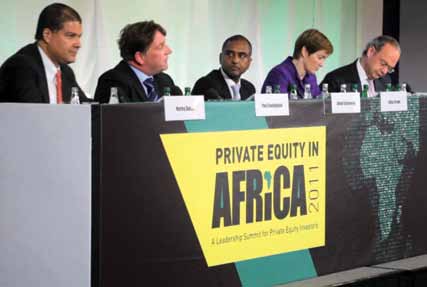
Back in Lagos in 2011, he made another elevator observation: “Every guy in the elevator’s not pitching a deal here yet.” The joke was about competition for investments. Placed beside the Buffett recollection, it gives the career an agreeable pair of bookends. One elevator contained a famous investor. The other, in his telling, contained room to look for a business. Doddy’s working life has unfolded between the two: travelling, choosing partners and getting close enough to a company to help it grow.